"Marketing effects take place over an extended period of time. The long-term effects are often the exact opposite of the short-term effects."
- Al Ries and Jack Trout, The 22 Immutable Laws of Marketing
Your market has two groups of buyers.
Most of them aren't looking to buy yet. Over several months, they form a view of who understands their problem, and when they're finally ready to buy, the brands they remember make their shortlist. That's demand creation.
A small part of the market is ready to buy right now, with a budget and a deadline. They put in the time to evaluate the options, compare the vendors on their shortlist, and sign. That's demand capture.
Most of the time, you create content for the first group. Your reporting, on the other hand, only measures the second. You connect the two by giving your future buyers something worth remembering, following up fast when they raise a hand, and agreeing with your CEO on how you'll measure both.
I've seen solid content lose its budget in the gap between these two worlds of demand generation, and closing that gap is what I care about most.
Before you read on, open the last five deals you closed in a new tab. By the end of this article, you'll know what to analyse in them and what to improve.
Tell me if any of these sound like your last two quarters.
1. Your content gets praise, and your pipeline doesn't notice.
Peers comment on your posts, and a prospect brings one up on a call. Your CRM still shows nothing that started with content, so at the next budget review your CFO cuts the content line first.
2. Your campaigns hit the lead target, and sales stops opening the alerts.
Your dashboard is green, and the people downloading your content have the right titles. Sales calls a few of them, hears that they were only reading, and goes back to its own list. By the next planning cycle you're the one explaining why the leads were bad.
3. You cut one budget to fund the other, and both get worse.
You pause content to put more into ads, or pause ads to give content a chance. For a while nothing moves. Then your cost per meeting creeps up, or your inbound slows down. Every swing costs you learning time you can't afford, and you start the next one from zero.
Let me tell you a story. I experienced the first situation with a founder we worked with this summer on his LinkedIn organic content. He paused our engagement, saying he hadn't caught a single opportunity in three months of working together.
A few days earlier, his newest article had drawn attention and comments from people at companies he wanted to sell to. Our weekly report didn't cover those metrics.
Jay Yang's essay on his marketing philosophy pushed me to write down our philosophy for B2B. I start by unpacking his split between creating future demand and capturing current demand. Then I add what it takes for a B2B tech company: a buying committee that makes the decision together, and a way to measure and report the results. I wrote this for founders and marketing leaders who do a lot of demand generation work and can't yet connect it to revenue.
You may still measure leads. SiriusDecisions launched its Demand Waterfall in 2006 and taught a generation of marketers to report volume at every stage. It moved the model to buying groups in 2017, and after Forrester acquired it, the model became a Revenue Waterfall in 2021. The people who taught us to count leads moved their own model to buying groups years ago.
A lead is a person who filled in a form. Demand is a group of people who have started to believe something about their problem and about you. You can report on leads every week. You see demand later, and demand is what signs your contracts.
Here's how I define the job.
Demand generation helps the right buyers recognise a problem worth solving, prefer your way of solving it, and take a sensible next step when their time to act arrives.
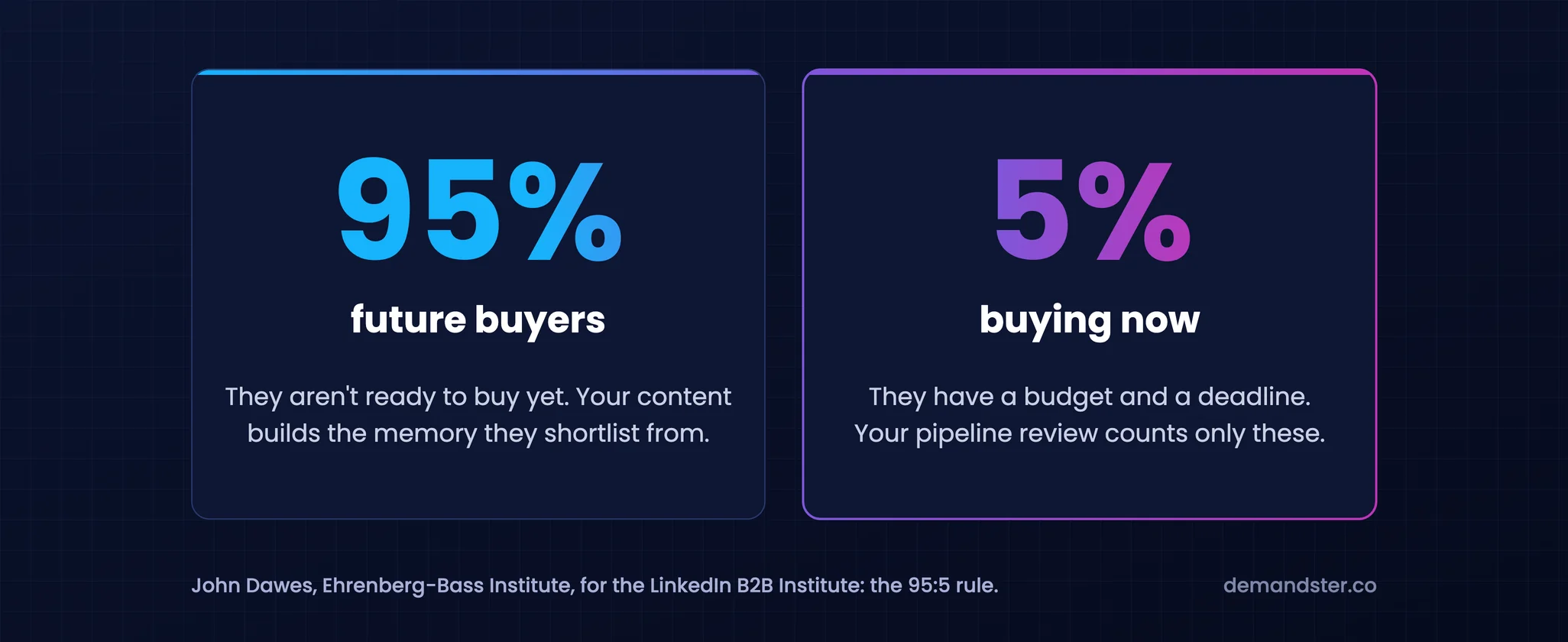
You're probably familiar with the 95:5 rule. John Dawes of the Ehrenberg-Bass Institute, writing for LinkedIn's B2B Institute, estimated that around 5% of business buyers are in market in a given quarter. He calls it a heuristic rather than a precise rule. The other 95% aren't buying right now.
The 95% are your future buyers. Long before they have a budget or a project, they read, listen and form an opinion about which companies understand their problem. When the time comes to buy, those are the companies they call first. I've written about how buyers form and lose that memory. This is your demand creation game.
The 5% are looking to buy now. They have a budget and a deadline, and they need a reason to talk to you this month. This is your demand capture work.
Les Binet and Peter Field's work for the B2B Institute suggests roughly 46% of budget on brand building and 54% on activation. Your pipeline report probably shows you only the second.
I see teams choose between two sensible behaviours, and both break when your quarterly results underdeliver.
The first behaviour is patience. You publish, trust the long game, and point at the 95% when someone asks for the return. Every three months they ask again, and after two or three quarters without an answer, the budget moves.
Your CEO will tell you they can't wait a year for content to pay off. I agree with them, and you don't have to wait that long. You'll see the first signs within weeks. Someone replies to a post. A buyer you've never met asks for a call. A prospect mentions your article on a sales call. Write down these signs as they happen, and by month two you'll have evidence to show your CEO that the content is working. Ignore them, and your content looks dead until the week your CFO cuts the budget.
The second behaviour is proof. You only invest in what your attribution report can connect to pipeline. You cut everything else, and you focus on the 5% of buyers who are ready now. The risk is that your paid ads depend on your content more than your dashboard shows, so you end up removing the thing that made the ads work.
Alex Hormozi has a story that describes this risk, in $100M Leads. In January 2020 his paid ads stopped working like they used to. His team argued about the creative, the copy, the offer and the price. His business partner, Leila Hormozi, asked a different question. What had they stopped doing in the months before the decline?
Alex had stopped making content for gym owners and started talking about general business. He surveyed his clients and found that 78% had consumed at least two long-form pieces of his content before they booked a call.
"I had fallen into my old ways and given paid ads all the credit. But, our free content was nurturing the demand."
- Alex Hormozi, $100M Leads
I prefer a third option. Connect the two groups on purpose, so the work you do for future buyers appears in this quarter's numbers early enough to justify its budget. I call that connection the demand system, and the rest of this piece shows you how to build it.
You may already have positioning, and it's probably on your website. Good, so test it against your main competitor, which is the way your buyer works today.
Every B2B product replaces something. Usually that's an existing way of doing the job that's often painful, a partial solution, an agency, a tool that barely works, or a person who holds it all together. Your buyer knows and feels how the current way fails them, and they've learned to live with it.
For years I assumed buyers stayed with the current way because they preferred it. Then I read the research on stalled deals, and changed my mind.
Matthew Dixon and Ted McKenna analysed more than 2.5 million recorded sales conversations. They found that 40 to 60% of deals end with a buyer who said they intended to buy and then did nothing. When the authors split those losses, 56% came from indecision driven by the fear of getting it wrong, and 44% from a preference for the status quo.
You need to focus your content on a different job. Showing what the current way costs proves there's a problem. It doesn't calm the fear of changing. To ease that fear, show your buyer how the change went for a company like theirs: what it took, who did it, what went wrong and how you fixed it.
Then test your positioning with four questions.
If your website answers all four in your buyer's words, you have a position. If it answers them in your words, you have a description.
I often say most sales pipeline problems are foundational GTM strategy problems.
Jay builds a brand through three associations, which he calls power, trust and likeness. Two of them carry straight into B2B, and I'd swap the third.
Power means showing you have what others want, like the car, the building or the portfolio number. B2B operators tend to read that as a flex, so I'd use proof of work in its place. That's the teardown, the benchmark, the ranked list, the success stories and the number you produced that didn't exist before you did the work.
"Trust is the belief that following your direction will produce a good result."
- Jay Yang
That tells you what kind of content to create. Give your buyer directions they can follow, and make sure they're helpful, or even better, that they make your buyer the hero in their job. Every time the ideas you shared work, you earn mind share and heart share.
Likeness means your buyer sees themselves in you, and in B2B the fastest route there is their own language. This quarter Google started showing our site on the first page for a search from someone who felt their thought leadership function and their demand generation function were working completely separately, and didn't know how to connect them.
A person may have typed it, or an AI assistant may have searched it for them. Either way, your buyer describes the problem in those words, and this article is part of my answer. I also wrote about it in why your thought leadership is not producing pipeline.
Write your ad copy in the words your customers used on their sales calls. Most teams already know that much.
Does your ad investment turn into revenue? That depends on what you do after a buyer raises their hand.
A buyer downloads a guide, replies to an email, or visits your pricing page twice. Each of those tells you something about timing, and each one cools down fast. In my experience the window closes within days. I've written separately about what a buying signal costs when you build the follow-up and when you leave it to memory.
I've seen more pipeline lost at this step than anywhere else. Your content did its work, because a buyer remembered you and came to you. Then no one on your team owned the follow-up, or you handed it to a sequence that treated a CTO who read your guide like a stranger on a list.
Your contact buys together with several colleagues, and they often disagree. Gartner surveyed 632 B2B buyers and found unhealthy conflict in 74% of buying teams. When sellers tailored messages to the whole group, stakeholders found it easier to agree. When they tailored messages to each person's priorities, each stakeholder became more convinced of their own view, and the group drifted further apart.
So before you create your next big piece of content, map the buying awareness level and the customer journey. Who is in the group, and how far has each of them moved?
One of the best frameworks for this comes from Eugene Schwartz, who described five stages of buyer awareness in Breakthrough Advertising, back in 1966: unaware, problem aware, solution aware, product aware and most aware.
We sometimes plan content for clients with a shorter version of three stages.
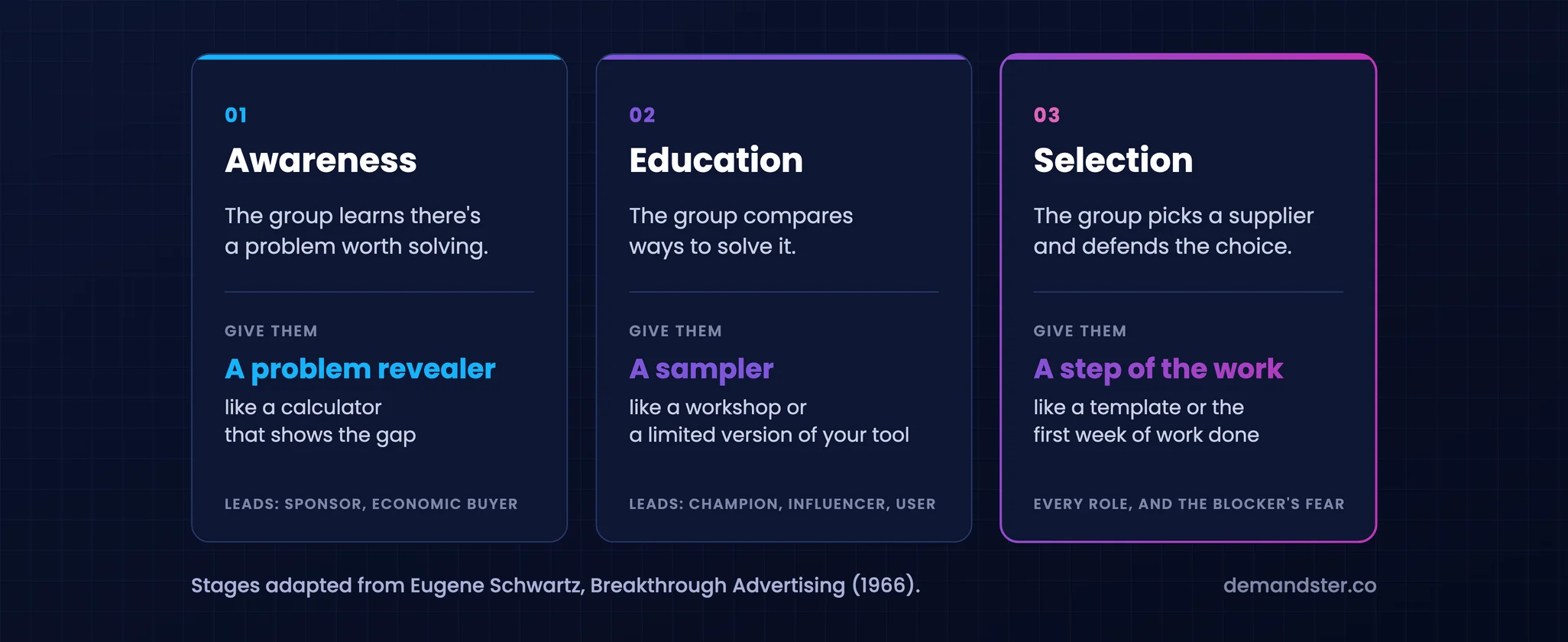
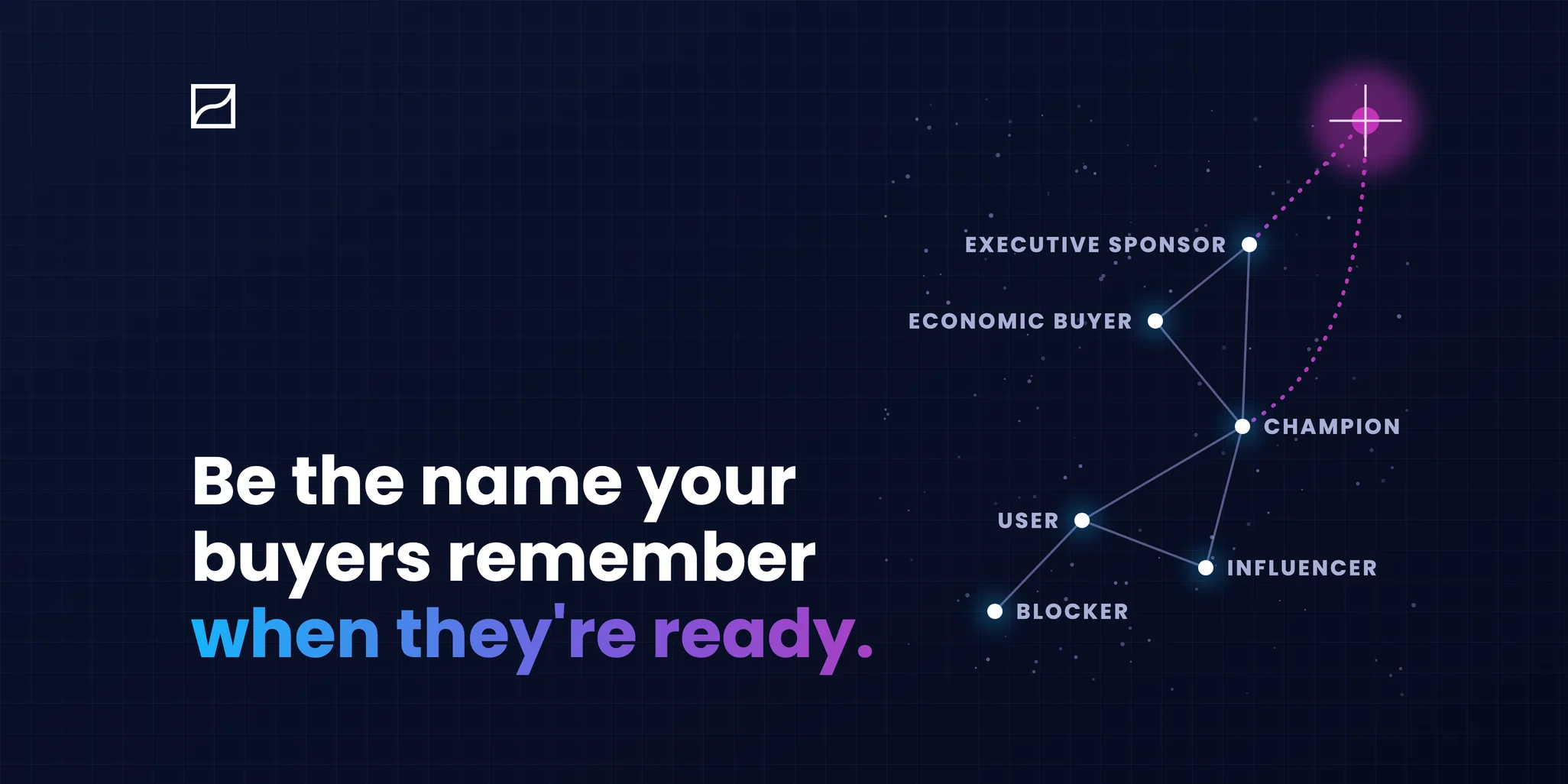
Now cross those stages with the people. I map six roles in a typical deal.
The blocker is the role I see left without content most often. Dixon and McKenna's 56% points the same way, because fear stalls more deals than preference does. Write down what your blocker fears, and answer it in your content. For how this works with a small team, see our lean ABM playbook.
You'll hear that AI makes content free for everyone. It does, so your output alone stops setting you apart. Dan Koe describes the pattern well. AI automates the mechanical work in a skill, and the human role moves up a layer.
AI takes over your demand system step by step, and I rank the steps like this.
Hand the first three to AI, and spend your team's best hours on the fourth.
Your buyers are doing a version of the same thing. In TrustRadius's 2026 research with 1,862 technology buyers, 94% of those who used AI said they fact-check its answers at least some of the time. They check what the machine says against sources they trust. You want your content to be one of those sources.
In the spirit of the argument, an AI model drafted pieces of this article. I brought the client story, the search query and my reading of Jay and Hormozi, and the moves below come from our own work.
"A delay in a balancing feedback loop makes a system likely to oscillate."
- Donella Meadows, Thinking in Systems
Your content pays back with a delay of months. Judge it on the quarter alone, and you'll cut it right before it would have paid. The money moves to ads. A few months later your cost per meeting goes up, because fewer buyers know your name, so you move the money back to content and start again.
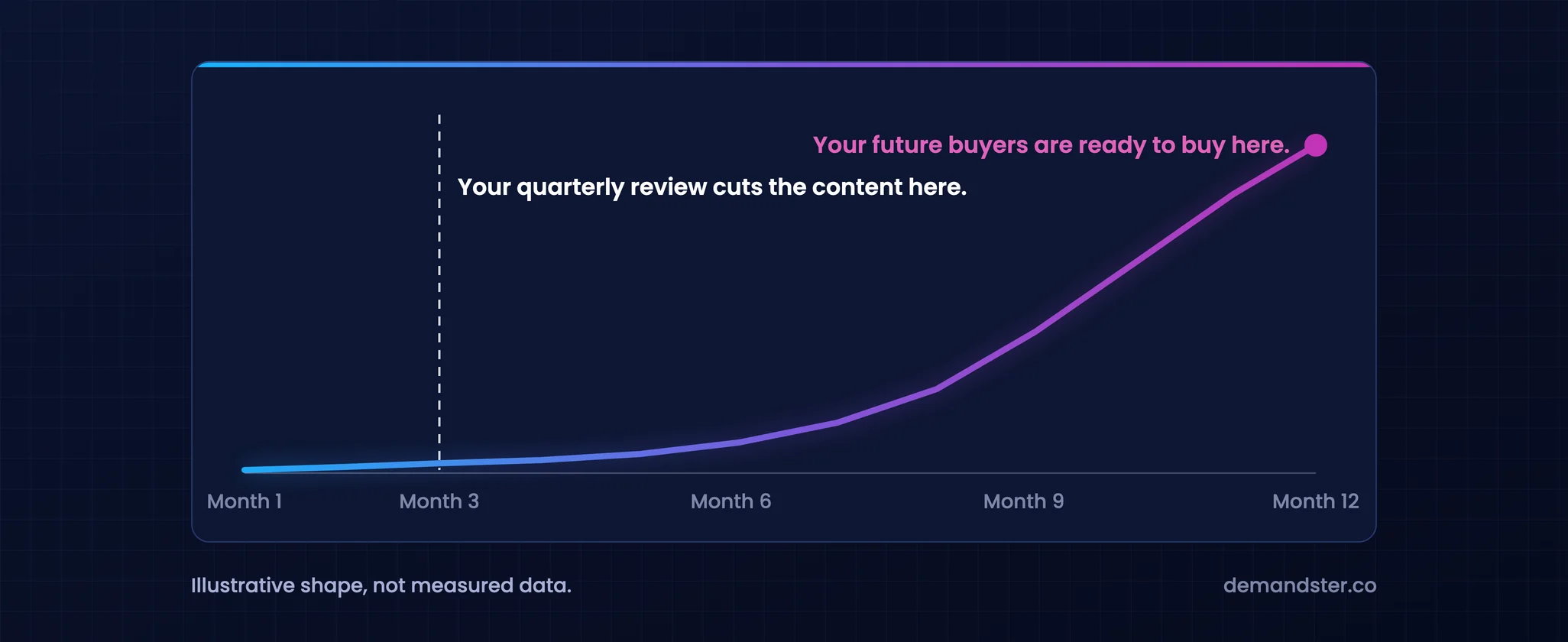
I'll be careful here, because you can't measure how well demand creation and content perform as precisely as the tools promise.
Every attribution model tells a different story about the same deals. First touch credits whatever a buyer met first. Last touch credits whatever they met right before converting, and it erases the content that shaped your future buyers almost completely. Linear, time-decay and position-based models spread the credit in between. HubSpot offers most of these natively, and every one of them misses the buyer who read your posts for six months and never clicked.
A few years ago, Refine Labs showed how big that blind spot can get in their own funnel. Over twelve months and 620 conversions, their software credited web search with 78% of conversions. Asked directly, customers picked web search 12% of the time, and they credited social media, podcasts, word of mouth and community for 85%. An agency measured its own funnel there, so hold the exact numbers loosely. We saw the same pattern with the founder I told you about.
So choose your model on purpose, be mindful of its limits, and track three KPIs.
HubSpot's Kipp Bodnar and Kieran Flanagan make a related case in their book, Loop. They argue the teams that win now are the ones that learn fastest. You can only learn fast from a signal you trust, and attribution alone won't give you one.
Write those KPIs on a scorecard, a dashboard or a page with a review date, and have your CEO or leader sign it before the next piece of content or ad goes out.
1. Understand your buyer's current way intimately. Have AI analyse your closed-won calls. Pull out what each buyer did before they found you, who kept it working, and what they feared about changing it. Ask yourself if you can explain why a sensible buyer keeps the current way. If you can't, research comes before publishing. For a structured check of the layer underneath, our free GTM Diagnostic takes a few minutes.
Done looks like: a single page your sales team says is accurate.
2. Create a realistic content calendar. Pick a cadence you can keep through your worst quarter, and feed it from your calls, your own data, and the decisions and mistakes you learned from. Ask yourself if it would still ship in a month when you and the team have no time. If it wouldn't, slow the cadence until it would. That problem is why we built the Reputation Engine, which drafts a founder's LinkedIn presence from their own posts, transcripts and weekly answers, so their input takes about ten minutes a week.
Done looks like: eight weeks of dates, each with the source it comes from.
3. Give the signals that matter an owner and a deadline. Decide which signals count, like a download, a reply or a second visit to your pricing page. Then decide who follows up on each, within how many days, and with what. Ask yourself who would know by tomorrow if a target account downloaded something today. If you can't answer with a person's name, you don't have a rule yet.
Done looks like: a written rule, and a first week of follow-ups logged against it.
4. Map your content to the buying committee and the stage. Draw the grid of six roles and three stages, and place every asset you already have in it. Fill the empty cells, starting with the blocker and with the champion at selection. Ask yourself if your champion could move the group forward without you in the room. If they couldn't, write about the problem the whole group shares.
Done looks like: an asset for every role at every stage, and a champion who has forwarded one.
5. Choose your attribution model and sign the page before you place your next bets. Pick the model, be clear on what it can't track, add the account check and the question about how buyers heard of you, and set a review date. Ask yourself if the plan would survive a quiet first month. If it wouldn't, write the page before you spend.
Done looks like: a signed page with a date and your KPIs.
Go back to the tab you opened at the start of this article. For each deal, find out what first put you in that buyer's mind, who else in their group you reached, and who followed up when they raised their hand.
If you can trace all three for most of your deals, your content and your pipeline already work together. Write it on the signed page, so it survives your next budget review.
If you can't, you're where that founder and I were in July. The work was good, the early signs were there, and our weekly report couldn't show them. Start with move 3 this week, because it's the easiest gap to close and the quickest to show results.
Somewhere in your market, a buyer who won't be ready until next year is reading your post this week. Keep educating them, follow up when they raise a hand, and when they're ready to buy, you'll be the name on their shortlist.
The 95:5 rule says that only around 5% of B2B buyers are in market for a product in a given quarter, and the other 95% will buy later. John Dawes of the Ehrenberg-Bass Institute set it out for the LinkedIn B2B Institute and calls it a heuristic. It means most of your marketing should build memory, familiarity and goodwill with future buyers, because those buyers shortlist the vendors they already know when they're ready.
A typical B2B buying committee has at least six roles: the executive sponsor who authorises the initiative, the economic buyer who controls the budget, the champion who owns the problem, the influencer whose expert view the others follow, the user who works with the product every day, and the blocker who can stall the deal. Each needs different content at the awareness, education and selection stages, and the blocker is the role most often left without any.
Use a linear or time-decay attribution model for content. A last-touch model gives almost all the credit to the final click, even though your content did its work months earlier. No attribution model can see every prospect who reads and consumes your content without clicking. Track how many of your target accounts engage with your content each month, and ask every new prospect how they heard about you on the website form and calls (self-reported attribution).
Demand creation builds preference with the buyers who aren't ready to buy yet, through content, thought leadership and proof they recall. Demand capture converts the buyers who are ready now, through campaigns, search and fast follow-up. A demand generation framework connects the two, so the work you do for future buyers appears in your pipeline early enough to justify its budget. For a longer explanation, see lead generation and demand generation explained.
---