"A reliable way to make people believe in falsehoods is frequent repetition, because familiarity is not easily distinguished from truth."
- Daniel Kahneman, Thinking, Fast and Slow
If your thought leadership is not producing pipeline, most likely that's because most of it is thoughts. Leadership is missing.
Your thought leadership converts into commercial outcomes when few things are true. The thinking is original enough that the market can't get it elsewhere. It arrives consistently, because a buyer's memory of you decays, and publishing is the only thing that refreshes it. It is tied to something (a problem, a pain, challenge, workflow) the buyer meets every week, so it comes back to mind when they need it. And other people say it and repeat it in their own words. Such as experts, customers, peers. Remove any one of those and you are publishing opinions into a feed.
Tell me if this is you.
You publish two or three times a week. The posts get reactions from people you know. The pipeline review has nothing in it that started with a post, and you are starting to wonder if the content is a hobby the company tolerates.
You produced a guide last quarter. It was good. You know it was good because people you respect told you so. Downloads came in, the sales team got a spreadsheet, and it has not been opened since.
Your CEO asked what thought leadership is for. You gave the right answer, trust and awareness and shortening the cycle, and you watched it fail to persuade someone who signs off budgets. Give it two more quarters of that and the budget goes to whoever can show a number.
I recognise all three. I have also watched thought leadership carry a company from pre-product market fit through a successful exit, with 40 to 50 percent of deals arriving inbound or marketing sourced. The difference was never effort. In one case the content took the market somewhere it had not been. In the other it described things the market already knew, in slightly better words.
The phrase has two words, and they compound.
Thought is original thinking. A position the market had no way to reach without you, or a piece of evidence it did not have. Leadership is often the more difficult part. It means you are out in front, showing the market a path, showing people something they will use in their job. People follow a leader because following pays off for them, in a decision made faster or a mistake they get to skip.
Edelman and LinkedIn have surveyed thousands of executives about this for years. In the 2024 B2B Thought Leadership Impact Report, 73 percent said an organization's thought leadership is a more trustworthy basis for judging its capabilities than its marketing materials. Seventy-five percent said a single piece led them to research a product they had not been considering. Nine in ten said they are more receptive to outreach from a company that publishes consistently good work.
Then the number that explains your pipeline review meeting. In the same survey, only 15 percent of the thought leadership those executives read was rated very good.
So the market wants it, trusts it, and acts on it, and roughly 85 percent of what gets published fails the bar. A lot of what I read is thoughts, rarely leadership. Well-formed, well-edited, defensible, and interchangeable with the post above it and the post below it. It leads nowhere, so no one follows it anywhere, and your pipeline stays empty.
If that description is uncomfortable, it is because the work behind the content was sincere. I know. The first time I watched content produce pipeline, I misread why it had.
My first job in marketing was at a digital agency working with consumer brands, in the years HubSpot was turning inbound marketing into a movement. I tried a small experiment: a couple of blog posts and a short gated guide. Inbound enquiries arrived. I remember thinking this is the playbook, and that the playbook was publish useful things and people come.
Years later I was head of marketing at a visual commerce company, in a category so new we had to explain it before we could sell it. We were a vertical player with less funding than the companies we were up against. The only way to become known was to become the best source of useful thinking in that market. We put everything into that, and for a while the results were fine and forgettable.
The turn came when we started building psychology into the content on purpose. The flagship became an index: we ranked the top 100 players in the segment, wrote a chapter on why each ranked feature mattered, interviewed the people retailers already respected and quoted them by name, and released it on a schedule the market learned to expect. It captured buyers who were already exploring, because a ranked list is the most useful thing you can hand someone mid-decision. Slower, and more valuable, it also did something else: it made the company the reference point for the category. Two years in, 40 to 50 percent of our deals were arriving inbound or marketing sourced.
What I got wrong at the agency was believing the mechanism was usefulness. Usefulness gets you read once, and that is where its work ends. The pipeline came from a handful of principles that decide how a buyer's mind treats what it reads, and I learned them by accident before I learned them by name.
"Cognitive ease is both a cause and a consequence of a pleasant feeling."
- Daniel Kahneman, Thinking, Fast and Slow
The buyer thinks they are evaluating rationally. They are mostly confirming a preference that formed earlier and out of sight.
Kahneman's account of how the mind works in Thinking, Fast and Slow has two modes. System 1 is fast, automatic, and works on familiarity. Its counterpart, System 2, is slow, deliberate, and expensive, so the mind avoids using it. Shortlists form in System 1. The vendor evaluation the buyer believes they are conducting, with the scorecard and the reference calls, is System 2 justifying what System 1 already chose.
The 2025 6sense Buyer Experience Report puts numbers on this from nearly 4,000 buyers. The typical buyer is 61 percent of the way through the journey before first contact with a seller, and the vendor that wins is on the day-one shortlist 95 percent of the time. In 85 percent of successful purchases the buyer had direct prior experience with the vendor they chose. I wrote about what that does to cold outreach in why outbound stopped working. It's a chain. The shortlist forms early, it forms from familiarity, and it decides who wins the deal.
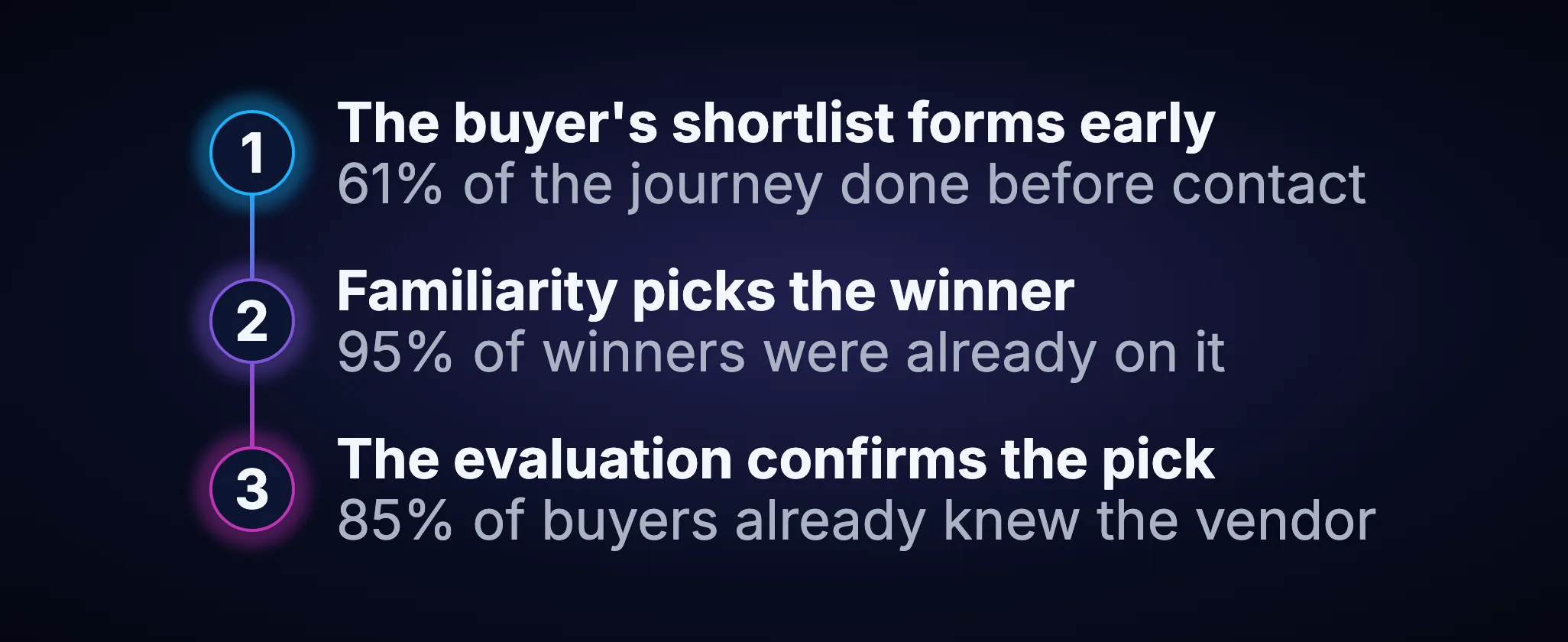
Familiarity is what repeated exposure produces. Kahneman's line at the top of this piece is about falsehoods, and the mechanism works the same way on things that are true. Repetition creates ease, ease feels like truth, and a company that has been useful to a buyer six times before the buying window opens is on the shortlist before the buyer knows there is a shortlist. This is why consistency beats brilliance in thought leadership. A brilliant piece read once produces admiration, and a useful piece read every two weeks for a year produces a preference the buyer will later call their own judgment.
In Blindsight, Matt Johnson and Prince Ghuman make a point marketers nod at and then ignore: a brand is a memory. The logo, the site and the deck are cues that retrieve it, and memory decays on its own schedule, with no regard for your content calendar.
This is the mechanism behind the gap between a good guide and an empty pipeline. Your guide was useful in March. By June the buyer's memory of who wrote it has faded to a shape, and by September, when the budget line opens, another vendor's name is fresher, and the competitor name wins because familiarity feels like a reason.
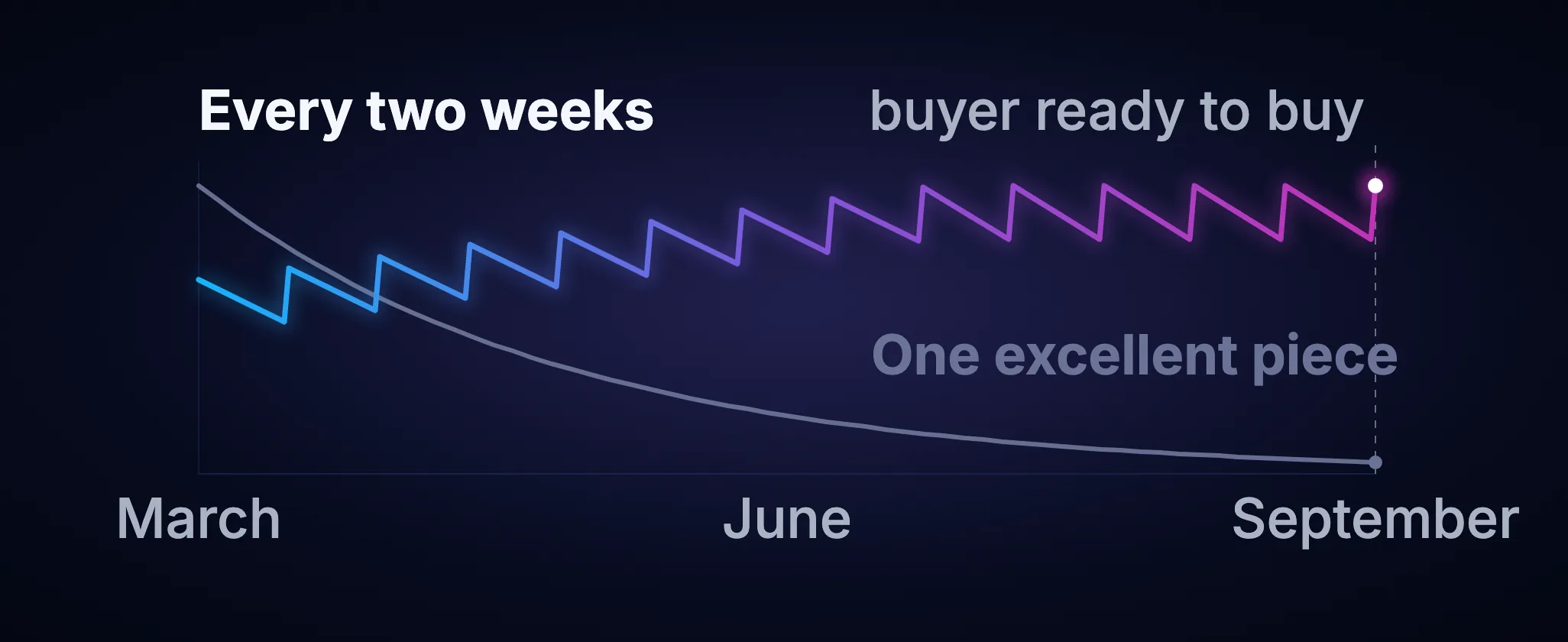
The implication is uncomfortable for anyone hoping to produce a masterpiece and coast. Your job as a marketer is omnipresence in the buyer's world, on a cadence that keeps the memory refreshed. That is why our index was released on a schedule, why our best clients publish on a rhythm the market learns, and why an excellent piece each quarter loses to a decent piece every two weeks.
"Top of mind means tip of tongue."
- Jonah Berger, Contagious
Jonah Berger's research on why ideas spread, in Contagious, found that the strongest predictor of how much people talk about something is a trigger: a cue in their environment that brings it to mind. Products tied to frequent cues are discussed more, regardless of how interesting they are.
Thought leadership that produces pipeline is tied to a trigger in the buyer's week. An idea tied to nothing the buyer regularly encounters gets consumed and forgotten, however good it was. Tie it to a recurring moment and the moment retrieves you.
Let me tell you one story. A veteran technology leader at a managed services company, someone who had built a marketing function around being seen as the expert in his space, downloaded our guide. Its title is Random Acts of Marketing. When our SDR called a few days later, he took the meeting, and he opened it by telling us the marketing had clearly resonated.
The title had done the work. It put a label on a problem he already recognised, and every time he watched his own team launch something disconnected, the phrase came back. The download was the trigger firing, and the call caught it while it was still firing. He also told us he had looked us up and been surprised that a company our size produced work of that quality, which is its own lesson about what the buyer does between the download and the call.
Two of Robert Cialdini's principles in Influence carried that index, and they explain why an original research piece outperforms an equally intelligent opinion piece every time. People defer to experts, and people follow the lead of others like them, and both effects get stronger when the decision is uncertain, which describes every B2B purchase I have been near.
Start with authority. When the industry experts we interviewed said inside our report that 3D visualization was the trend that mattered, retailers believed it in a way they would never have believed it from a vendor selling 3D visualization. The authority belonged to the people we quoted. We had built the room they spoke in, and the room gets remembered alongside them.
Then social proof. Ranking the top 100 players did two things. The companies on the list shared it, because being ranked is status. Everyone left off the list read it more carefully than anyone on it, because being left out is a signal about where they stand. Berger writes about this too. Social currency is a reason to share that has nothing to do with you.
There is a third voice, and it is the one most marketing teams never recruit. Your customers. The strongest thought leadership I have been part of had clients making the same argument we made, in their own words, about their own situation. In that role it came from a close relationship with the customer success team and its leader, Jasna, because the people who own the client relationship are the people who can ask a happy client to say out loud what they already believe. In more mature companies, that is a customer marketing function. Either way, when the market hears your claim from your customers, in their words, it stops sounding like a pitch and starts sounding like a consensus.
"In a crowded marketplace, fitting in is failing. In a busy marketplace, not standing out is the same as being invisible."
- Seth Godin, Purple Cow
Godin's Purple Cow was about products. The same rule holds for words. I am not sure many people in B2B agree with this, and I think it belongs in the equation either way: your thought leadership needs a quirk. A recognizable way of saying things that is yours, so that a reader two paragraphs into an unsigned post knows who wrote it.
The reason is the memory mechanism above. A flawless voice is easy to read and impossible to remember, because it sounds like every other smooth voice in the feed. One with a recognizable shape gets remembered, and every piece you publish refreshes the same memory instead of creating a new one that fades on its own.
This is where a lot of well-resourced thought leadership fails. It has been through enough reviewers that every edge is gone. What is left is correct and forgettable.
You have been reading a piece that opened by telling you your thought leadership is thoughts. That line is the quirk at work. I hope it irritated you a little, because you will remember who said it.
I propose several moves, each with a way to know if you did it and a way to know when you are done. I would rather you do two of them properly than all of them as a checklist.
1. Pick your best bet and make it original. A flagship piece the market can't get elsewhere. An index, a benchmark, a ranked list, a measured claim. Ask yourself if a competitor can produce this by reading what already exists. If yes, it is a thought, and you should raise the bet. Done looks like: the piece contains a number/ranking or insight that did not exist before you produced it.
2. Build the psychology in from the brief. Whose authority does the piece borrow, and are they quoted by name? Who has a social reason to share it that has nothing to do with you? Done looks like: at least three people outside your company have their names in the piece and a reason to send it to their peers.
3. Commit to a cadence before you commit to a topic. Memory decays on a schedule. Decide the rhythm first and let it constrain the ambition. Ask yourself if you can hold this cadence through your worst quarter. If the answer is no, slow it down until it is yes. Done looks like: a calendar with dates, and a market that has started to expect the next one.
4. Tie the idea to a moment in the buyer's week. Name the recurring situation where your idea should come back to mind. The pipeline review, the budget meeting, the campaign post-mortem. Ask yourself if a buyer in that moment would think of your phrase. Done looks like: the title of the piece is a sentence a buyer would say out loud in that meeting.
5. Catch the raised hand, then recruit the ones who convert. When a buyer downloads, replies, or shows up twice, that is the trigger firing, and the window to catch it is measured in days. I have written separately about what that follow-up costs when it is built and when it is left to memory, so I will leave the mechanics there. The part that belongs here: when a client converts, go back through customer success and ask them to say what they believe in their own words. Done looks like: your next flagship piece carries a customer voice making your argument for you.
If the gap you recognise in this piece is the one between publishing good work and a pipeline that reflects it, that gap is the system we install. It starts with the positioning and the flagship bet, then the cadence and the distribution, then the capture and the follow-up, in that order.
Thought leadership fails to produce pipeline when it is thoughts without leadership. Correct, sanded down, interchangeable, published when inspiration strikes, and tied to nothing in the buyer's week. It produces pipeline when the thinking is original, the cadence is fixed, the idea has a trigger, and other people carry it in their own voices. All of it is psychology applied with discipline, and it is a long game you can start winning in the second round, because the first round hands you the data.
So, look at the last piece your team published. If a buyer read it without your logo attached, would they know who wrote it, and would they think of it again?
It shapes the shortlist before the buying window opens. Buyers are 61 percent of the way through a purchase before speaking to a seller, and the winning vendor is on the day-one shortlist 95 percent of the time (6sense, 2025). Thought leadership is how a company earns a place on that list, through repeated useful exposure that builds familiarity and trust. Pipeline follows a quarter or two later as inbound conversations and warmer outbound, which is why it comes as a lagging indicator.
Yes, and it usually means the content is being measured by the wrong clock. Thought leadership builds a memory and a preference over months. Demand generation counts meetings this quarter. The two connect when a company holds a publishing cadence long enough for familiarity to form, ties its ideas to moments buyers already encounter, and works the signals that publishing creates within days rather than weeks. Without those three, the two functions are doing different jobs and the disconnect is structural.
With a well-orchestrated follow-up behind it, the first attributable meetings can arrive within a month or maximum two of publishing. The compounding effect, where inbound becomes a steady share of pipeline, takes closer to a year. In a prior marketing leadership role, the inbound share of deals reached 40 to 50 percent over roughly two years of a schedule the market learned to expect. A single strong piece can produce conversations sooner, especially a ranked index or original research that buyers use mid-decision, but the preference that decides deals is built through repetition.
Track three things monthly. Share of qualified accounts engaging with your content, which shows if the right people are being exposed. Meetings where the buyer references your content unprompted, which shows if the memory is forming. And the inbound and marketing-sourced share of new pipeline over a rolling six months, which is the number a CEO will accept. MQLs count form fills, and a form fill from someone who cannot buy is worth less than a meeting where the buyer quotes your work back to you. Count conversations and sourced pipeline, and let the MQL column go.