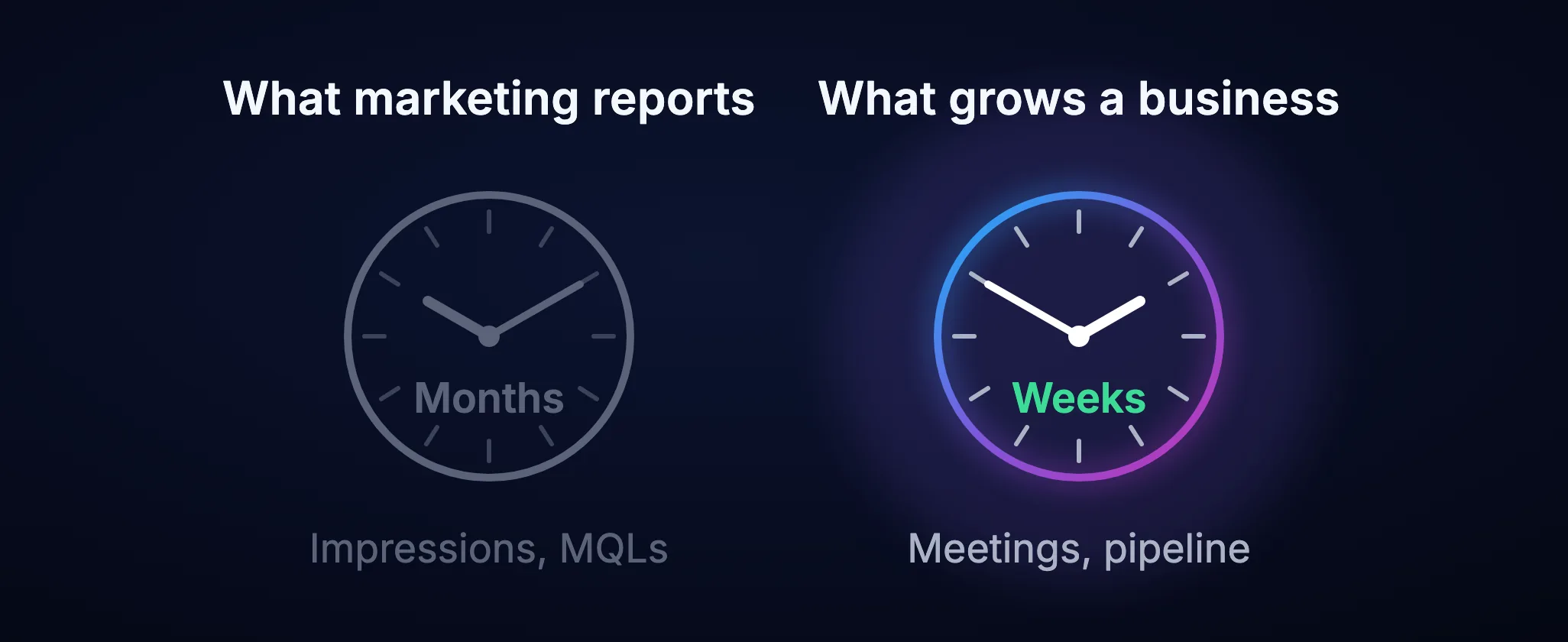
A B2B demand generation strategy you can trust works like a well measured experiment. You sign the definition of a qualified lead before any media investment. Marketing reports on KPIs that move the needle: meetings, pipeline, cost per acquired customer, lifetime value.
You paid for marketing once. You can't point at what it built.
Maybe it was ten grand on an agency. Maybe a freelancer, a campaign, a few months of content that filled a dashboard with numbers your sales team never asked for. A CRO told me on a first call that his company had given marketing a go once, spent about ten grand, and nothing came of it. Three years later he still remembered the invoice. He could not recall one thing it bought.
So he went back to founder-led selling, attending events and building relationships, partner motions. You probably did too, because selling is the one motion where you watch cause and effect with your own eyes.
The thing is, the next attempt can go differently if the test itself is designed differently. That is what this article covers. See what a trustworthy marketing experiment looks like, and the demand generation framework that turns the next attempt into something you can measure and build upon.
Because the data supports you.
Gartner surveyed 412 senior sales and marketing leaders and found the two functions collaborate on three of fifteen commercial activities. Ninety percent said their priorities conflict more than they align. Ebsta and Pavilion tracked 655,000 opportunities and $48 billion of pipeline and found paid-marketing-sourced deals converting at 0.68x efficiency, against 1.2x for organic inbound and 1.3x for partner referrals. The marketing channel with highest investment converts the worst of the three. HockeyStack's analysis of 270,811 MQLs across 87 B2B SaaS companies found lead-generation MQLs converting to sales-qualified at 4.93%.
You felt all of that before reading a single study.
There is a deeper mechanism, and it explains why you trust your sales team's gut while the marketing reports slide past you. Daniel Kahneman and Gary Klein, after years of public disagreement, agreed in 2009 on when gut judgment deserves trust: the environment has to hold a pattern, and you need fast, clear feedback on every call you make. Your sales instinct passes both tests. You call, the meeting happens or it doesn't, the deal closes or dies, and the CRM keeps score within weeks. Marketing never gave you that loop. Feedback loops arrive as metrics further in the funnel, on a lag of months, with no line connecting any of it to a specific account name in your pipeline. Your gut never received the instrument it needed to form a judgment, in either direction.
So the distrust is justified in a way. The question is what it's costing you, and that question has a number on it. We'll get there.
Ask the people who do marketing for a living, and plenty will hand you the same list you're holding.
Emily Kramer, who led marketing at Amplitude and Asana before co-founding MKT1, has named her biggest frustration: marketing teams whose single goal is a quarterly MQL count. Three years later she was telling marketers to tie their work to pipeline and revenue, and to show sales how campaigns move quota attainment rather than lead counts. Dave Gerhardt, who built the Exit Five community for B2B marketers, pushes from the other side: a team measuring only what ties directly to pipeline will miss the larger shift in how buyers decide.
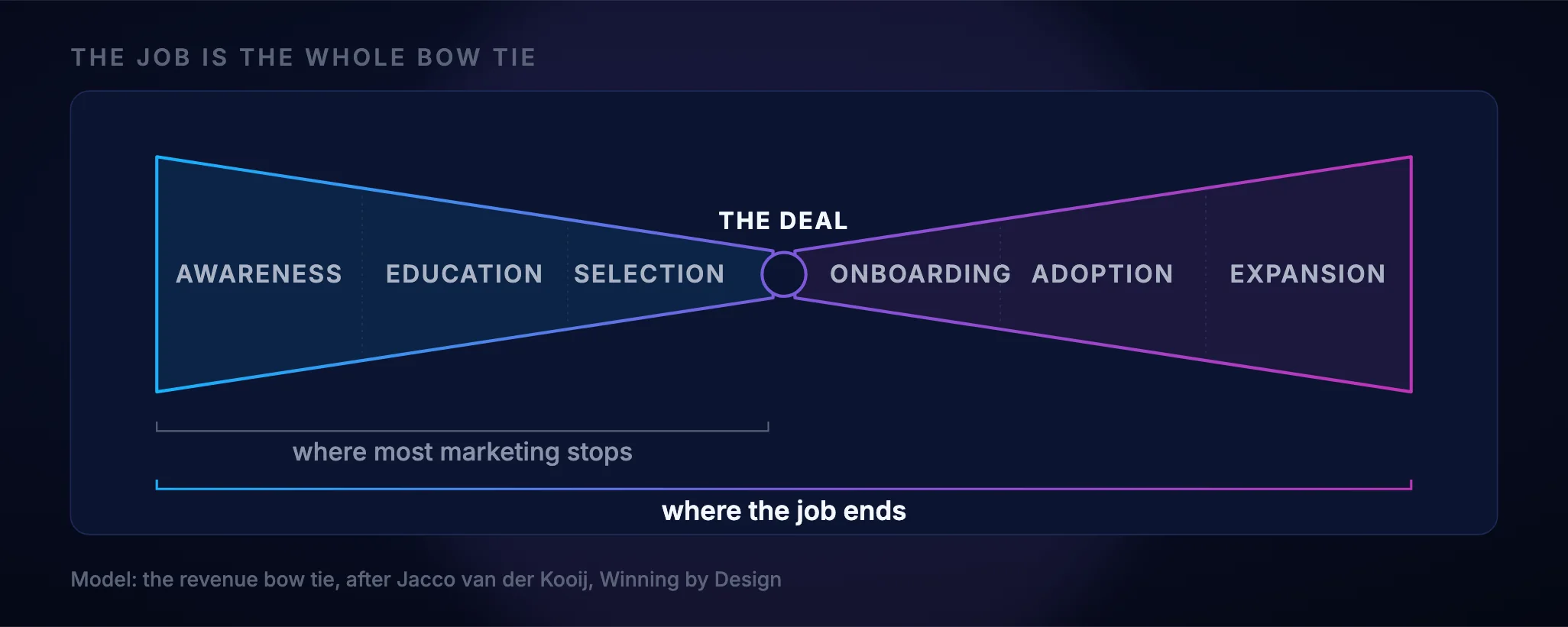
Between these positions is the assignment you should hold marketing to. In B2B, the standard expectations is for marketing to create about half of net-new revenue and influence almost all of it, across the whole customer journey, from first awareness through retention and expansion. Picture a bow tie rather than a funnel. The deal is the knot in the middle. The right half, onboarding through expansion, decides how much every deal ends up being worth, and typical reporting stops before it.
Demand generation builds awareness and preference with buyers who understand they have a problem but are not in a buying mode yet. Demand capture converts buyers who have already decided to purchase and need a final reason to choose you. Fund one while measuring it like the other, and your test fails before it starts.
I learned the difference early in my career from two founders.
The first, the CEO who became one of my mentors, brought me in as the second marketing hire without expecting immediate results. He cared about qualified pipeline and attribution from day one, and he knew the direct numbers take time to show up. We entered a category before anyone had educated the market on it, invested in content and thought leadership before the category had a name, and became one of its two most recognized companies. Within a year, marketing contributed roughly forty to fifty percent of net-new pipeline, and later reached customer marketing and expansion too. Binet and Field's IPA research documents the same pattern at scale: short-term work shows up in weeks, brand work takes months to register, and teams that only invest in the fast half never build the slow half.
The second founder wanted to see SEO results in a month. SEO wont produce measurable results in a month. And once trust eroded inside that team, rebuilding it cost more than earning it would have.
The first founder supported a marketing strategy that understood how striking a balance in marketing is key. You capture existing demand while creating new demand for your product or service. The second funded one and measured it like the other. For the full breakdown of the two motions, read lead generation and demand generation explained.
Like any experiment you'd trust with your own money: you need hypothesis, a model, KPIs, and feedback loop for a next round.
Think about how you'd trust a strength program at the gym. You wouldn't take someone else's workout log as proof of what your body will do. You'd follow the program yourself, track your own numbers, and adjust. Testing marketing needs the same setup: a program built for your company, tested inside your company, on numbers you can watch from week one.
A case study is someone else's workout log.
Let me give you a simple analogy for a test that has four parts:
Repeat those four in a circle and you have an experiment. Do the first three once and stop, and you have a story.
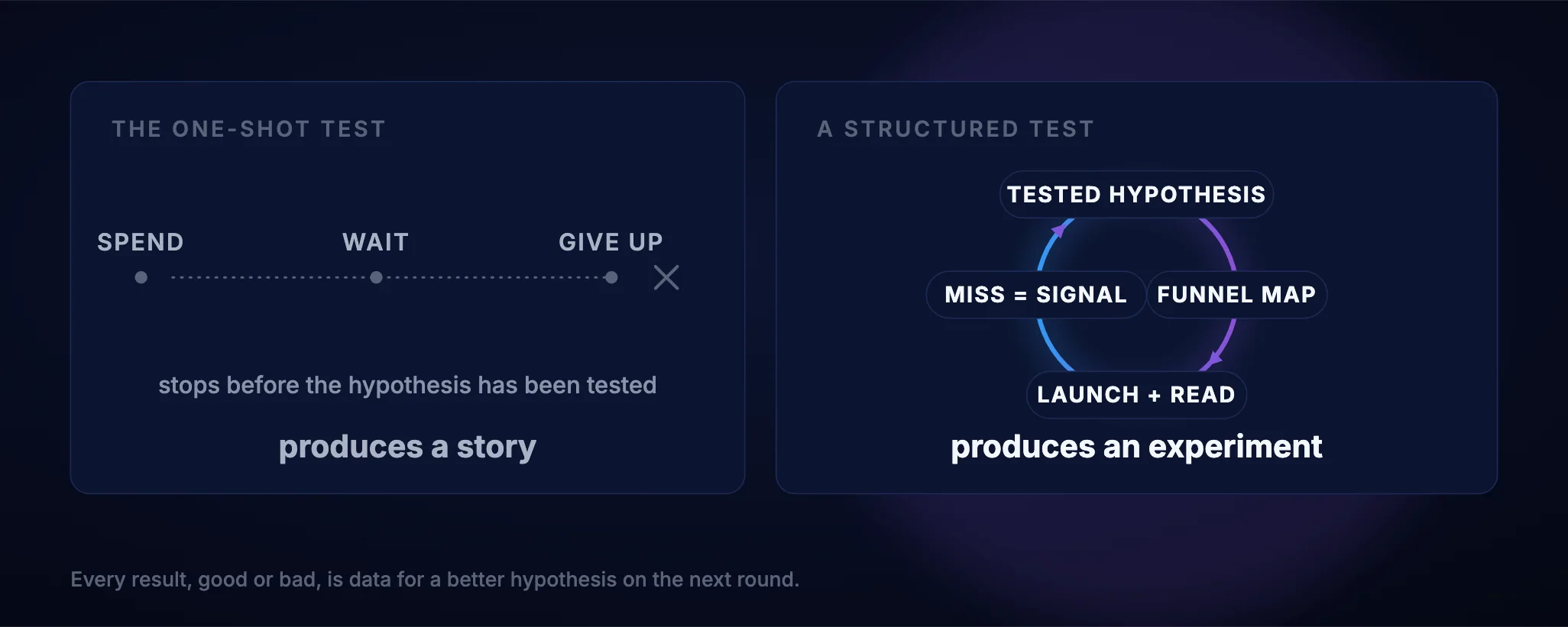
| The one-shot test | A structured experiment | |
|---|---|---|
| Definition of success | Undefined, decided after the fact | Signed on one page before any spend |
| Reporting | Impressions and MQLs, monthly | Meetings, pipeline, cost per meeting, weekly |
| Timeline | Until patience ends | Minimum a quarter, checkpoint at day 60 |
| A miss means | Marketing doesn't work here | One or few assumptions wrong; the next round inherits the lessons |
| What it produces | A story | A decision |
More than any other variable you could think off.
Two programs from our own portfolio, same methodology, same care. A visual commerce SaaS client's 13-month program produced 726 qualified downloads and 350 additional signals, and the team turned them into 110 booked meetings, at roughly €26 per qualified download and €170 per meeting. A B2B consulting client's ABM program aimed at CTOs produced 42 qualified downloads at €34.71 each, a 41% qualification rate most paid teams would frame and hang on the wall. It produced only a few conversations.
We did identical audience profiling exercise, put serious work in the narrative. Same tight creative and relentless distribution. Both converted top of the funnel with beautiful results. ICP contacts downloading thought leadership content. The difference was what happened after the download. The first team mapped accounts, personalised the outreach, and engaged prospects fast. The other worked signals ad hoc, without any plan for touches and multithreading. Workato's mystery shop of 114 B2B companies found more than 99% missed the five-minute response mark on demo requests, and nearly one in five never replied at all.
One variable made the whole difference for the entire result.
We look at four major phases: Foundation, Build, Activation, Scale. It's the roadmap from our guide on random acts of marketing.
Foundation maps your market and documents your ICP, aligns messaging across your team, and audits your tech stack so a signal has somewhere to go. Everything starts with one buyer segment whose problem hurts enough to justify a budget. Skip that step and every downstream choice inherits the guess. April Dunford's work on positioning makes the point at the company level: excellent execution on top of the wrong positioning still fails.
Build creates the pillar content, the distribution strategy, and the signal tracking, before anything spends.
Activation is the multi-channel launch, the sales enablement behind it, and performance monitoring against the funnel map from your experiment.
Scale doubles down on the motions that won, retires the underperformers fast, and documents the playbooks so the win repeats without heroics. This is where the demand generation engine built on thought leadership takes over from the test.
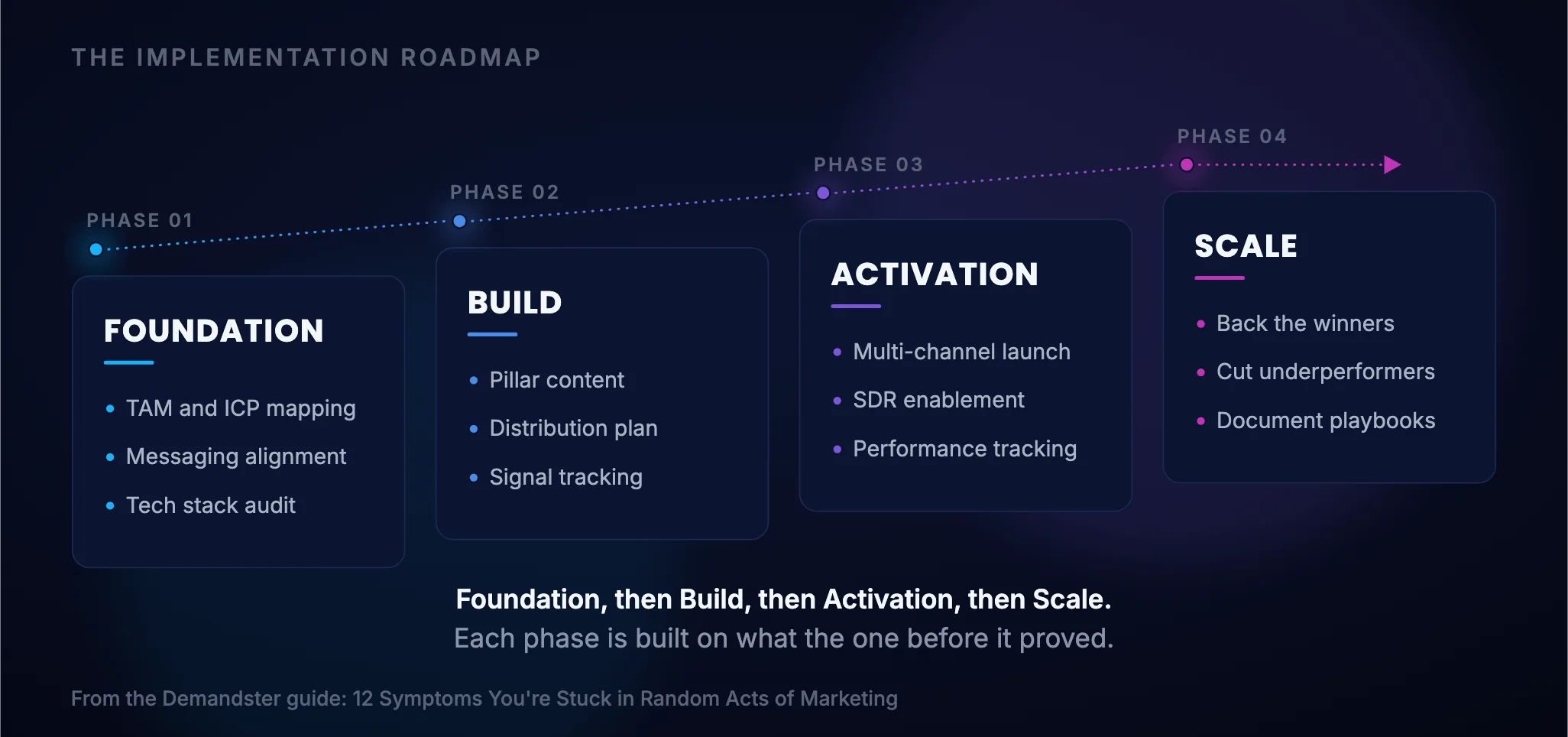
None of it is a sixty-day miracle. It's a sequence, each stage built on what the one before it proved. Your next spend either follows that sequence or it doesn't, and you'll be able to tell which within a quarter.
Measure it, put the target on paper, and give it one quarter with a checkpoint at day sixty.
Start with the funnel metrics. I call it the price of knowing for a quarter of demand generation, weighed against the value of one closed deal. At most complex B2B deal sizes the deal is worth more, which means you're paying a fraction of one contract to learn something about your own market that stays true either way. Ten grand spent on a test you read to the end is tuition. Ten grand spent on a test abandoned in month two is a loss.
You already make this exact deal with every sales hire: a target on paper, a ramp, both of you looking at the same numbers at every check-in, judgment at the end of the ramp. Marketing must earns trust the same way:
A quarter of finding out has a price you can calculate today, down to the euro. Three more years of not knowing has a price too, and it compounds: every deal stays founder-led, while a competitor wins market and mind share by educating your buyers with thought leadership content.
Which of those two numbers is bigger for you?
Lead generation collects contact details, usually by gating content, and counts leads. Demand generation creates the conditions for buyers to want a conversation: it builds awareness and preference with the buying committee before a form is ever filled, then captures that interest with fast follow-up. A lead is a name; demand is a reason to meet. The full comparison is in lead generation and demand generation explained.
Typically a quarter, agreed before any spend, with a checkpoint at day sixty. By day sixty a properly built program should show traceable signals: meetings, replies, or qualified conversations with accounts that match the signed definition. If they're missing, your review will show you which part broke, the assumptions, the content, or the follow-up, so the next round starts from evidence instead of a guess.
Speed and tested hypotheses. A senior in-house hire takes months to recruit and ramp, and their first campaigns are still first attempts. An agency that has tested in adjacent markets starts from a hypothesis that already worked somewhere similar, and a structured engagement can show traction inside one quarter. The trade only makes sense with the trust structure in place: a signed definition of qualified, reporting in sales units, and a date for judgment.
Thought leadership is the demand creation half of the strategy: it educates the market, builds the memory that puts you on shortlists, and warms every later touch, including outbound. It works on a longer clock than paid capture, which is why it needs a founder who funds it past the first quarter. The mechanics are in our guide to building a demand generation engine through thought leadership.