Six in ten B2B companies never answer a demo request.
That figure comes from RevenueHero, who tested 1,000 B2B SaaS companies and found 63.5% let the loudest hand-raise in the funnel pass without a reply. Workato mystery-shopped another 114 this spring: over 99% missed the five-minute window, the average personalised reply took nearly twelve hours, and one in five sent no email at all. Every one of those ignored hands was bought and paid for, with ads, content, landing pages and salaries behind it. You pay the same for a lead you don't call as for one that books a meeting. Ignoring it raises your cost per meeting.
Let's define the terms, because the industry uses them loosely, and there's a huge difference. A signal is any first-party action a company can track and monitor: a content download, a tool submission, a webinar registration, repeat pricing-page visits, a reply, a comment from someone on the buying committee. A qualified signal is one of those from a person who fits your ICP. On the other hand, a buying signal is rare, because at any moment only about 5% of your market is actively looking to buy. A single content download shows interest. Intent is a different signal, and one click rarely proves it.
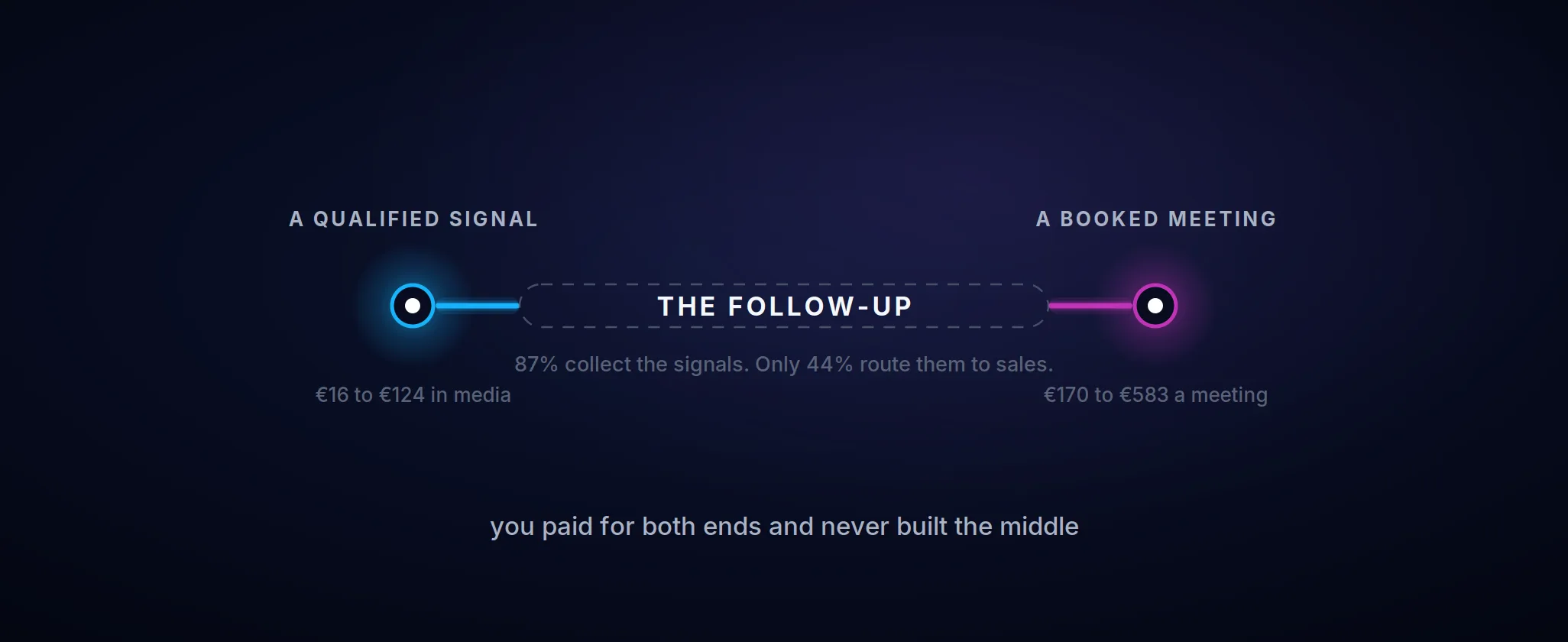
Pipeline comes from meetings that happened, so cost per meeting becomes the main number to manage. Across a sample from our campaigns in B2B complex sales from 2026, we found that a qualified signal cost €16 to €124 in paid media, and a booked meeting from those signals cost €170 to €6,423, counting media spend only, before anyone's salary.
Buyers are raising more hands, and the research points the same direction.
Demand for gated content grew 57.6% since 2021, per NetLine's 2026 report, built on 7.2 million registrations in 2025. Buyers still trade a work email for something worth having. HockeyStack measured 270,811 MQLs across 87 B2B SaaS companies and found a gated lead becomes a sales conversation 4.93% of the time, and a customer about once in 180 attempts.
Ebsta and Pavilion's 2025 benchmarks, built on 655,000 opportunities and 48 billion dollars of pipeline, rank paid-marketing pipeline the least efficient source they measure, at 0.68x against 1.3x for partner referrals.
Each of these studies stops at the form fill or the response time. And on the other side, appointment-setting agencies give us the numbers for the price of buying a meeting. Between these two sits the number founders and commercial leaders care about, which is what the meeting costs through your own campaign, from media spend to booked call. We looked for it in the published research and did not find anything useful, and decided to share bits of first-party data.
Below we're sharing a sample from our own campaigns, but with a disclaimer or two. Costs like these can vary with market, vertical, deal size and sales cycle, so treat our figures as reference points from B2B complex sales, mostly in Europe. Yours will land somewhere else. Per meeting is media spend divided by meetings booked. Salaries and tools are not in it, so read every row as a floor, not a price. Where a figure comes from matters too: ad spend and lead counts are verified from the ad accounts, qualified and meeting counts come from CRMs, and the €124 is the top of a €92 to €124 range that depends on the spend base used.
| Campaign | Media spend | Qualified signals | Per qualified | Meetings | Per meeting |
|---|---|---|---|---|---|
| Lead-magnet campaign, visual-tech SaaS, 13 months | €18,743 | 726* | €26 | 110* | €170 |
| Our own pipeline engine, two-month campaign | €2,917 | 184 | €16 | 5 | €583 |
| ABM pilot, UK retail | €6,423 | 52 | €124 | 1 | €6,423 |
| ABM campaign, B2B consulting, CTO audience | €1,486 | 42 | €34.71 | 0 | none |
Once you understand how the follow-up was orchestrated it explains the order and ranking, top to bottom.
For the client example on the top row our team was part of the follow-up execution and orchestration. Every signal matching the ICP triggered a next step across email, LinkedIn and phone, on a documented SOP with a 24 to 72 hour window. Barely any signal was not followed up with, and that's the main reason why this is the best cost per meeting from the sample at €170.
The second row is our own engine, where we were less religious about the follow up. Contacts fell through occasionally and the cost per meeting went up. It was the same mechanism but with looser execution.
The retail pilot targets enterprise buyers in a complex sale, so a higher cost per meeting is not surprising there. A few hundred euro would have been a fair outcome. €6,423 sits well outside that, and that was an expensive lesson for both teams: enterprise buyers respond to account intelligence and a personalised approach, and a templated motion is the exact opposite.
The CTO campaign is that lesson at full price. Someone on their side did own the follow-up there, which is worth saying plainly, and what they had was a short, templated sequence. Reaching a CTO at a private-equity-backed Series B company takes more than that: account research, a plan built around seniority, a script worth the investment, and coaching on the conversation you intend to lead. You can automate parts of it, for instance the LinkedIn invite and the first email after a download. But the engine behind most parts still has to be built and regularly deployed.
Which sets up the figure no study reports directly. That programme worked more than 1,100 signals over 13 months with the follow-up in place, and 110 of them became booked meetings.
About one in ten.
The nearest published reference is First Page Sage's 13% MQL-to-SQL rate for B2B SaaS, from six years of their client data, where an SQL includes a scheduled meeting. Their denominator is different, so read it as a neighbouring figure that points the same way. For a planning assumption on a gated campaign: 5 to 10 percent of worked signals become meetings. Without the follow-up, our sample says to expect a fraction of that.
The meeting costs have a market price to compare against too. Appointment-setting agencies quote $50 to $500 per meeting, with C-suite meetings at $600 to $1,500. That is vendor pricing, the rate a service sells at, but it frames the table. A well-built inbound motion beats the market rate for senior meetings, while leaving goodwill and heart share with thought leadership and content assets behind. It earns sales conversations by delivering work worth a senior buyer's time, and that work keeps compounding after the meeting is booked. In the AI era where anyone can generate output at volume, trust is the moat. The best content-led programmes produce brand and demand from the same spend.
We build every campaign around speed as the promise, and the effectiveness of this response data is the reason. When 99% of companies miss the window and six in ten never answer a demo request, a reliably fast response is the cheapest advantage left in B2B.
Fast means different things for different signals. NetLine measures a 47.7-hour gap between a buyer downloading an asset and opening it. A pitch call ten minutes after the form fill reaches someone who has read nothing. A message two weeks later reaches someone who has forgotten you. So for content signals, the window that works is 24 to 72 hours, late enough that the asset got opened, early enough that the interest is warm. For a direct hand-raise, a demo request or a reply, the time window is minutes. And the response has to fire from a system on its own, because the week everyone is busy delivering is the week the zero in our table came from.
Ehrenberg-Bass research puts about 5% of your market in-market in any given quarter, the 95:5 rule from John Dawes. This is why a single download shows interest. Most of the people engaging with your content sit among the 95, learning and exploring. Signals are how you find the accounts inside the 5, and most teams already collect them. In Sopro's 2026 study of 442 B2B decision-makers, 87% gather intent signals in some form. Only 44% route them to sales. The signals exist, but you need a rule for which ones earn a person's time.
A team that treats every signal as urgent has, in practice, decided that none of them are.
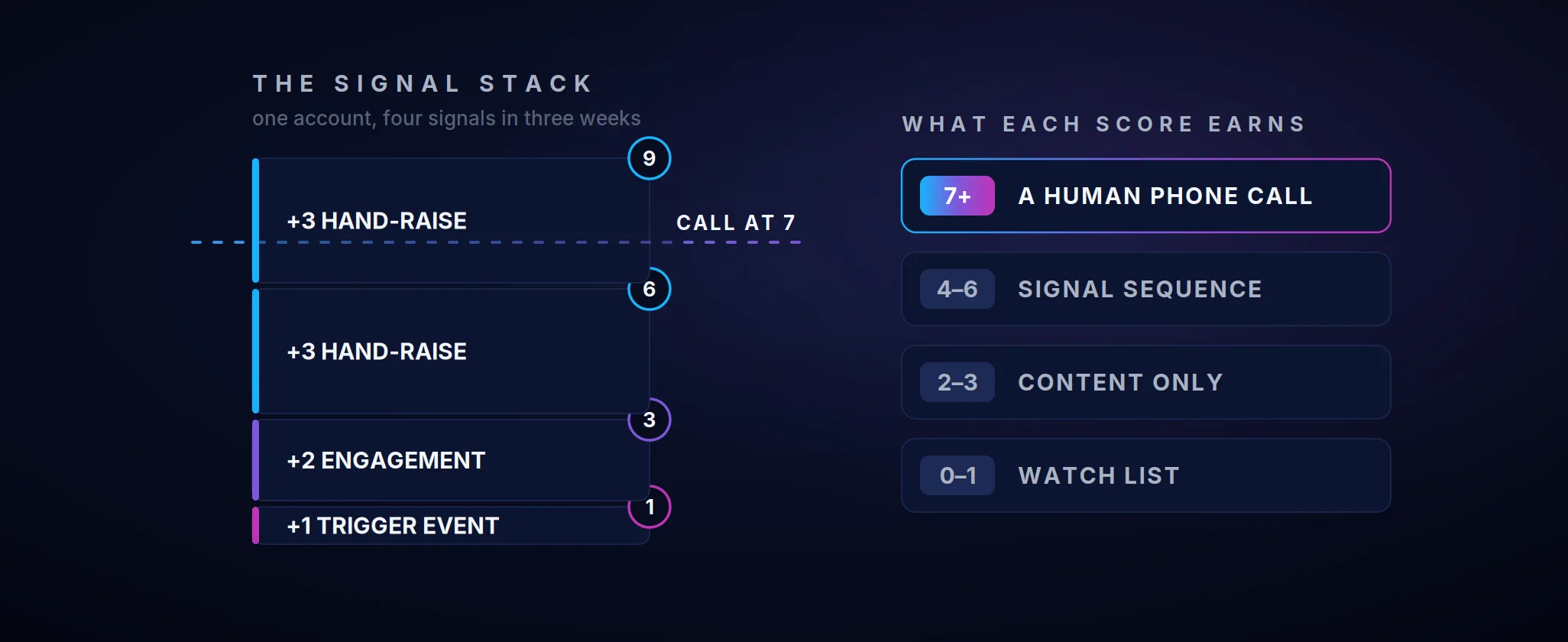
One signal is a data point. A stack of signals from one account inside a short window is a buying moment.
Here's a simple signal stack scoring model to consider:
| Signal class | Weight | What counts |
|---|---|---|
| Hand-raise | +3 | Lead magnet download from an ICP account, repeat pricing or demo page visits, a reply or DM, a conversation at an event |
| Engagement | +2 | Reactions and comments from ICP roles, webinar or rewatch views, email opens stacking past five, attending your talk or booth |
| Trigger event | +1 | Funding round, a new leader in seat, job posts for the role your service replaces, a tech-stack change |
What happens next depends on the account's total. An account at zero or one goes on a watch list, re-scored monthly. At two or three it gets content only. At four to six it enters a signal sequence, multi-touch across email and LinkedIn. At seven or higher, someone picks up the phone within one to three days.
The weights are our field judgment from client campaigns and our own pipeline, and we encourage you to adjust them as your conversion data arrives. A trigger alone never earns a call, because the context around it changes what it means: a signal for the same job post is a gap at 50 employees and routine at 500. Read Emily Kramer's account-driven GTM work at MKT1 for a deeper model on this, scoring signals against tiered accounts with rules of engagement per tier.
If you want to see where your own setup stands first, the engine scorecard covers the same ground.
The next time a vendor quotes you a cost per lead, ask what their forecasted meeting cost is in your scenario. An agency that can give you the answer has measured the thing you are buying. A vendor who cannot is pricing form fills.
Most sales pipeline problems are foundational GTM strategy problems, and this table is a reflection of that.
Both assets in our table (the one behind 110 meetings and the other behind zero) captured downloads. The difference was the demand capture engine waiting behind the form.
A signal becomes pipeline only when someone works it. Until then, it's just a list object in your CRM.
What does a B2B buying signal cost in 2026?
Across our campaigns in B2B complex sales, a qualified signal, meaning an ICP-fit action such as a download or a reply, cost between €16 and €124 in paid media, and a booked meeting produced from those signals cost €170 to €6,423 in media spend, before labour. These figures move with vertical, deal size and sales cycle, so treat them as reference points; your own numbers will differ. The campaign with follow-up inside a 24 to 72 hour window produced meetings at €170. The campaign with a light, templated follow-up produced none.
What is a B2B buying signal?
A signal is any first-party action a company can observe: a content download, a tool submission, a webinar registration, repeat pricing or demo page visits, a reply or DM, or a comment from someone on the buying committee. A qualified signal is one from a person who fits the ICP. A true buying signal is a stack of signals from one account inside a short window, because about 5% of a market is in buying mode at any time (Ehrenberg-Bass), so a single download usually marks interest, and intent takes a stack. Third-party trigger events such as funding rounds and job posts add context but rarely justify contact on their own.
How many B2B signals become sales meetings?
On a 13-month lead-magnet programme with follow-up triggered inside a 24 to 72 hour window, more than 1,100 worked signals produced 110 booked meetings, about one in ten. Downloads were the largest single source, and we attribute the meetings at programme level, across every signal type, so read one in ten as the rate for a fully worked signal base. First Page Sage reports a 13% MQL-to-SQL rate for B2B SaaS on a different denominator. 5 to 10 percent is the defensible planning band. Without owned follow-up the figure collapses: campaigns in the same sample converted 2%, 3% and 0%.
Why is cost per lead a misleading metric?
Because it prices the form fill, a download, a tool submission and a webinar registration all count the same, so the metric rewards volume over outcome. On one of our accounts, cost per lead was €12 while cost per qualified lead on the same spend was €124, since cost per lead counts every submission and cost per qualified lead counts only contacts worth a salesperson's time. HockeyStack's analysis of 270,811 MQLs found gated leads become sales conversations 4.93% of the time and customers about once in 180.
Do lead magnets still work in 2026?
Yes. NetLine's 2026 report, covering 7.2 million registrations in 2025, shows demand for gated content up 57.6% since 2021. The format works. What breaks is the response: over 99% of B2B companies miss a five-minute window, one in five never sends an email, and buyers take an average of 47.7 hours to open what they requested.
How do I calculate cost per qualified lead?
Three steps. Define qualified as a written rule covering role, seniority and company profile, then apply it contact by contact for one month, because the form field lies. Count how many qualified contacts became a conversation with a human. Divide by the whole cost including the hours your team spent, since media spend alone understates the true figure.
How do you decide which buying signals to act on?
Score them per account, on a running total, so a lone signal never earns a call by itself. Hand-raises such as an ICP download, repeat pricing-page visits or a reply score plus three. Engagement such as comments from ICP roles, rewatch views or stacking opens scores plus two. Trigger events such as funding, a new leader or a relevant job post score plus one. An account at zero or one goes on a watch list and is re-scored monthly, at two or three it gets content only, at four to six it enters a multi-touch signal sequence, and at seven or higher someone picks up the phone within 24 to 72 hours.