Your thought leadership builds sales pipeline when three main layers connect: content that educates and moves people, distribution that reaches the buying committee, and a demand capture system that turns attention and intent into conversations.
A little bit while back we wrote that thought leadership is the best SDR you will never hire, and still stand behind the line. In a typical B2B deal, around 7 of 10 people involved in the decision never speak to a salesperson (Edelman, 2025). They read, form an opinion, and put you on the shortlist or leave you off it, months before you know the deal exists. Your content is doing sales work with people you will never meet.
More than any other marketing input, according to the largest study on the subject. The 2024 Edelman-LinkedIn B2B Thought Leadership Impact Report, a survey of 3,484 executives, found that 73% of decision-makers treat an organization's thought leadership as a more trustworthy basis for assessing its capabilities than its marketing materials. Sixty percent said good thought leadership makes them willing to pay a premium, and 86% said it makes them likely to invite that company into an RFP.
Read those three numbers as a chain. Trust, price, and access. Thought leadership has an impact on all three before a salesperson exists in the deal.
The 2025 edition also describes the part sellers feel every day. Seventy-one percent of hidden buying-committee members, the people who shape the decision without ever talking to vendors, have little or no contact with sales reps. Ninety-five percent of them say strong thought leadership makes them receptive to outreach. Your content is the only member of your team allowed in the room where the deal is decided.
There are two reasons, one on the buyer side and one on yours.
The buyer-side reason is quality saturation. In the same Edelman data, buyers rated only 15% of the thought leadership they consume as excellent.
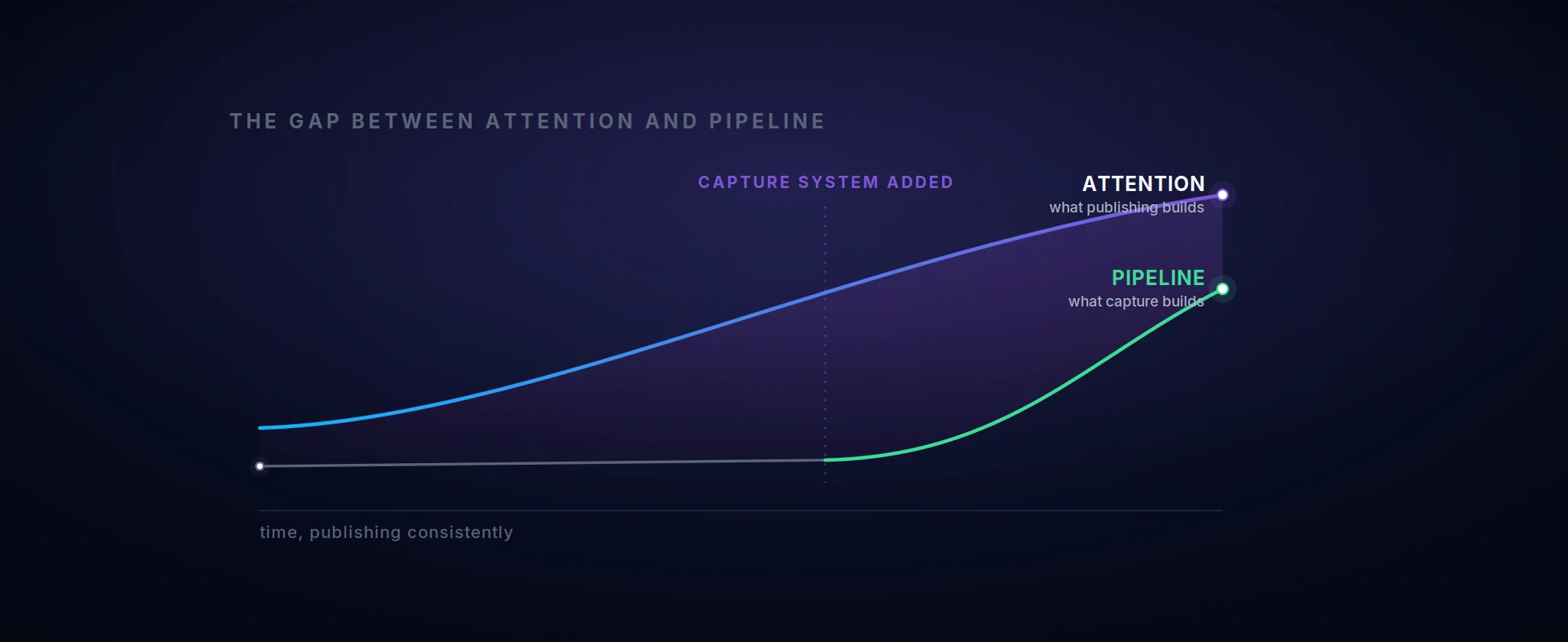
The bigger failure is the one you control. What happens after you hit publish? The post goes out, you get reach and a line in the report about brand awareness. A prospect who is actually in-market gets no next step. You never connect the lost deal back to the content that started it.
We call this piece the orchestration gap. It's the missing system between content that earns attention and a sales motion that converts it. It inolves three specific parts. First, no signal capture, so the warm audience exists but stays invisible. Second, no follow-up window, so engagement cools for two weeks instead of being worked quickly (very often within 24 to 72 hours). Third, no connection to an overarching narrative, so the content supports one story while outbound pitches another and the buyer meets two different companies.
Earlier than your funnel admits, and mostly out of sight.
6sense's 2025 Buyer Experience Report, built on roughly 4,000 buyer interviews, found buyers are 61% of the way through their journey before first contact with any seller, about 95% of purchases go to a vendor who was on the shortlist from day one, and the first vendor a buyer contacts wins 77 to 81% of the time.
So the deal is decided by who earned a place on a list you never see, compiled by people you have never spoken to. Thought leadership is the mechanism that puts you on that list, and pipeline surfaces a quarter later as an inbound conversation. It is a lagging indicator of market education, which is why we treat teaching, brand, and distribution as one motion rather than three distinct jobs.
A download is one signal. A working system listens much wider, and the cleanest taxonomy sorts signals into three sources:
Signal taxonomy adapted
The difference matters commercially. A third-party trigger describes the company; a first-party signal describes a person choosing to spend attention on you. Our own data says that difference decides everything: cold sequencing on third-party triggers produced zero meetings across nine runs in one client engagement, while first-party signals worked fast are the cheapest meetings we buy.
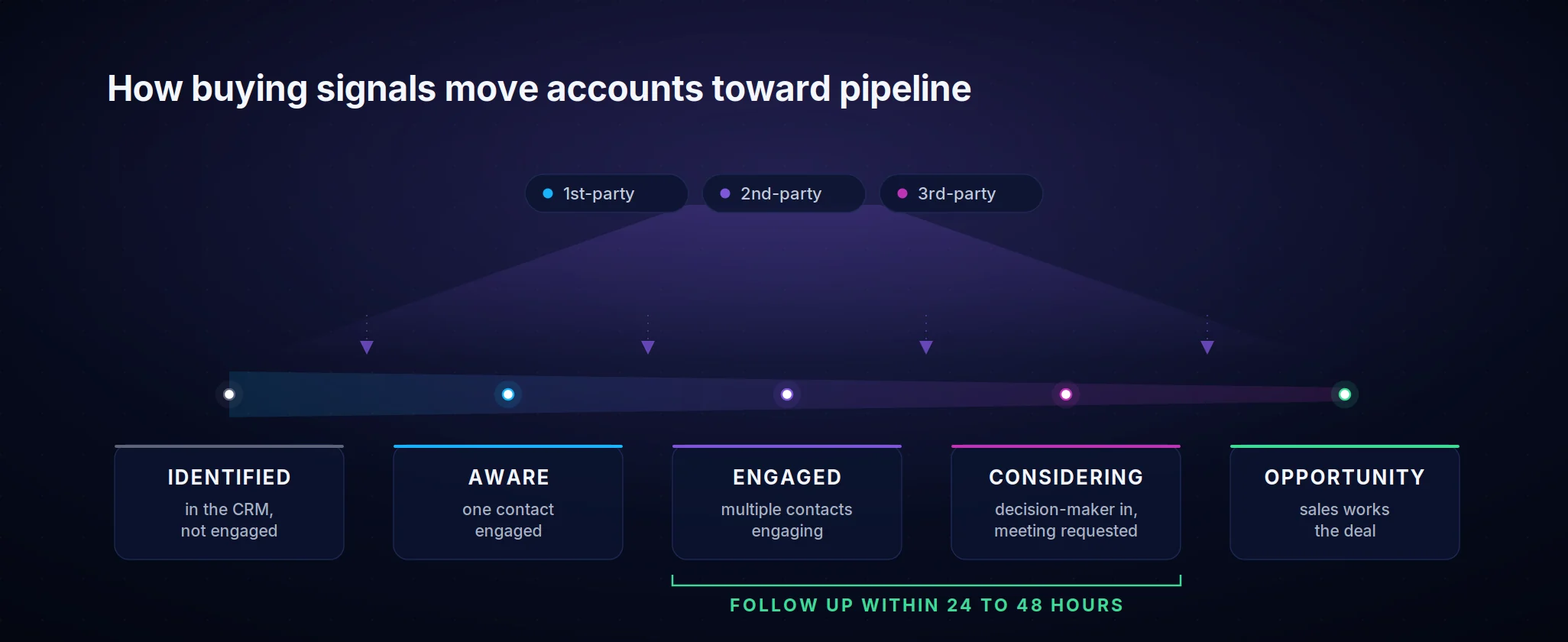
Signals only become useful when they roll up to the account level, because B2B buying is group behavior. The model we now borrow and adapt from MKT1's rules of engagement stages every target account by observable engagement: Identified (in your CRM, no engagement yet), Aware (one contact has engaged), Engaged (multiple contacts engaging), Considering (a decision-maker is involved and a meeting is requested), and Opportunity (sales is working the deal).
Two scores decide the play at each stage. Fit, how well the account matches your ICP. And warmth, an intent score aggregated across first, second, and third-party signals, with a side glance at buying-committee completeness, meaning how many of the people who will decide have actually engaged. High fit plus rising warmth gets a human touch optimally within 24 to 48 hours. The same fit with no warmth gets mapped content, since that is exactly what your thought leadership is for. Low fit gets left alone, whatever its warmth, because attention from the wrong room flatters you into wasting quarters.
Notice what this does to the thought leadership question. Every post becomes a signal: each comment, profile visit, follower, and download from an ICP account nudges that account from Identified toward Engaged, visibly, on a scoreboard sales respects. Publishing stops being a faith-based activity the moment engagement is monitored and scored per account.
A lead-magnet-led ABM program from our work produced 1,100+ qualified signals and 110 booked meetings. We produced three main pieces of thought leadrship content mapped to the interest of the buying committee, paid distribution put it in front of them, and every signal triggered follow-up while it was warm.
A different program produced 42 qualified senior-buyer downloads at roughly EUR 35 each, mostly CTOs, and booked zero meetings, because follow-up depended on a human remembering during a busy month. Same asset quality (benchmark report), opposite outcomes. The variable was orchestration, and we paid for the lesson.
You need these five parts: 1)V a defined ICP and buying committee, 2) a point of view worth repeating, 3) distribution to the committee, 4) signal capture across all three source types, and 5) the 24-to-48-hour follow-up motion. Parts four and five close the orchestration gap, and they are the cheapest parts to build of the entire system. Skipping them is expensive and it's proven to be detremental on success.
Pipeline per content motion, on a 90-day lag: signals captured per week by account tier, accounts moving Identified to Aware to Engaged, signal-to-conversation rate, and the share of new meetings that mention your content. Account penetration and reach, rand followers are inputs. They say the machine has fuel, and nothing about where the vehicle went.
One thing you can do, and I mean this literally: pull the list of every person from an ICP account who engaged with anything of yours in the last 30 days. Comments, downloads, webinar seats, profile follows. That list is the room you have already earned entry to. When we restarted our own lead magnet with a follow-up motion attached, that list became 3 meetings in two weeks. Yours is holding something similar right now.
If you want to see which of the five parts your system is missing, the GTM scorecard maps it in less than three minutes.
Does thought leadership actually generate B2B pipeline?
Yes, when it is connected to distribution and follow-up. Edelman-LinkedIn 2024 data shows 86% of decision-makers invite companies into RFPs based on thought leadership, and 6sense 2025 data shows about 95% of purchases go to day-one shortlist vendors. Publishing without signal capture and follow-up produces trust but no conversations, which is the orchestration gap.
Why does my B2B content get engagement but no leads?
Because attention is being earned and then abandoned. The three usual breaks areno signal capture beyond form fills, no follow-up window while engagement is warm, and no narrative connection between content and sales outreach. Start by capturing every ICP engagement, then work it within 24 to 48 hours.
What counts as a buying signal beyond content downloads?
Signals come from three sources: first-party, actions on your surfaces like repeat visits, LinkedIn engagement, webinar attendance, and tool runs; second-party, partner and ecosystem data; third-party, external market data like job changes, hiring, tech stack, and funding. First-party signals mark a person choosing to engage, which is why they convert best.
How do you score and prioritize buying signals?
Roll signals up to the account and score two things: ICP fit and warmth, an intent score aggregated across signal sources, plus buying-committee completeness. Stage each account by observable engagement, from Identified through Aware, Engaged, and Considering to Opportunity, and let fit plus stage decide the action. High-fit accounts with rising warmth get human follow-up within 24 to 48 hours.
How long does thought leadership take to produce pipeline?
Expect first signals in 60 to 90 days and meaningful pipeline on a one-to-two-quarter lag. Buyers are 61% through their journey before contacting sellers (6sense, 2025), so this quarter's teaching surfaces as next quarter's inbound conversation.