Last updated: June 2026
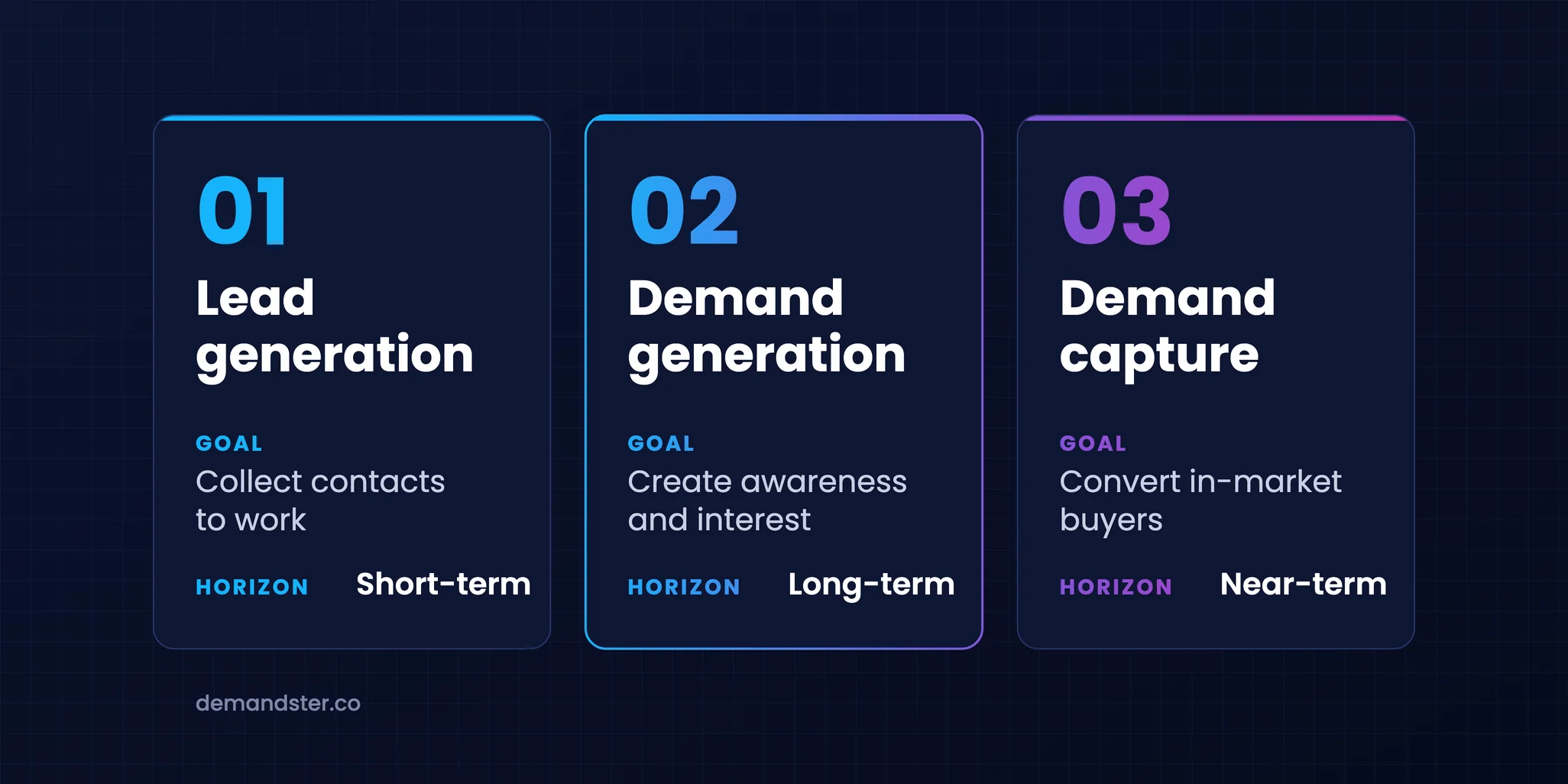
Lead generation is the process of identifying and contacting potential buyers in your ICP to book meetings, measured mostly by lead volume. The tactics lean on volume: paid ads, gated PDFs with sales follow-up, cold email and LinkedIn, and product-led webinars. It is short-term and sales-focused.
When implemented effectively, lead generation tactics can still be highly successful today. The risk is treating volume as the only goal, which fills the pipeline with contacts that never convert.
Demand generation creates awareness and interest in your category and brand without selling directly, measured by pipeline and inbound quality rather than raw leads. The tactics are educational: thought leadership, content, events, and social. It is a long-term strategy that makes every later conversion cheaper.
Its focus is building interest in your business as a whole rather than targeting specific accounts. By educating your audience and earning trust, you position your company as a credible player before anyone is ready to buy. Striking the balance between short-term lead generation and long-term demand generation is what we see working for B2B companies with complex sales.
| Lead generation | Demand generation | Demand capture | |
|---|---|---|---|
| Goal | Lead generationCollect contacts to work | Demand generationCreate awareness and interest | Demand captureConvert in-market buyers |
| Buyer stage | Lead generationTargeted, not yet in-market | Demand generationBefore in-market | Demand captureActively searching |
| Tactics | Lead generationAds, gated PDFs, cold outreach, webinars | Demand generationThought leadership, content, events, social | Demand captureSEO, paid search, intent data, landing pages |
| Metrics | Lead generationMeetings, MQLs, signups | Demand generationPipeline, inbound quality, branded search | Demand captureConversion rate, CPL, ROAS |
| Horizon | Lead generationShort-term | Demand generationLong-term | Demand captureNear-term |
Demand capture converts buyers who are already searching for a solution, measured by conversion rate, cost per lead, and ROAS. The tactics include SEO, paid search, intent data, landing pages, and forms. Demand capture harvests existing demand; it does not create new demand.
By optimizing demand capture, you turn the demand your marketing creates into pipeline and closed deals. The catch is that capture only pays off when demand generation has created demand worth capturing. Skip the generation work and you compete on price for the small slice of the market already in-market.
These are not competing choices, they are three stages of one system. Demand generation creates the interest, demand capture converts the buyers who act on it, and lead generation collects and works the contacts in between. A connected demand generation engine runs all three as one motion measured on pipeline, instead of disconnected campaigns. If you want to see where yours stands today, get your GTM score.
Demand capture is the practice of converting buyers who are already looking for a solution, through channels like SEO, paid search, intent data, and landing pages. It is measured by conversion rate, cost per lead, and ROAS. Demand capture harvests existing demand rather than creating it.
Demand generation creates awareness and interest before a buyer is in-market; demand capture converts buyers who are already searching. Generation is long-term and measured in pipeline and inbound quality. Capture is near-term and measured in conversion rate and cost per lead. You need both, but capture only pays off if generation has created demand to capture.
Lead generation is the broader process of finding and engaging potential buyers to create leads. Lead capture is the narrower step of collecting a prospect's details, like a form fill or a download, at the moment of interest. Capture is one mechanism inside a lead-generation or demand-capture program.
Use both, in balance. Lead generation produces short-term, sales-ready volume. Demand generation builds long-term awareness and trust that lowers the cost of every later conversion. B2B companies with complex sales win by pairing a steady demand-generation engine with focused lead capture, not by picking one.
A demand generation engine is a connected system that creates first-party demand and converts it: content and thought leadership at the top, signal capture in the middle, and fast follow-up at the bottom, all measured on pipeline. It replaces disconnected campaigns with a repeatable flywheel.
Written by Aleks Atanasov, co-founder of Demandster.