A founder almost walked away from a demand gen retainer with us, and the price was not the main issue. He had put five or ten thousand into this kind of work before and watched it disappear, and he wanted a good reason to believe this time it would turn into pipeline. And that's not a surprise, that is the instinct you’d expect from a good CFO.
Before you sign a B2B demand generation retainer ask these five questions:
The answer to those five questions will reveal if you’re investing in a retainer that builds an asset or one that rents you activity and noise. If you are the marketing or revenue leader that runs marketing, you can expect these or similar to them.
The CFO is mainly interested in the business case. To borrow words from the positioning strategist April Dunford: what would we do if this retainer did not exist? Dunford calls those your competitive alternatives: what a customer would actually do if your offer didn’t exist, which is often the status quo (current way of doing it), other processes or maybe workflows, or a competitive agencies. For a demand gen agency partner there are three main alternatives. Hire in-house and build the function yourself. Buy the tools and run it with the team you have. Or keep doing what you are doing. Compare the value of retainer against those, not against a number floating in a vacuum.
The part finance leaders miss is that the safe-looking option, keeping things as they are, is usually the most expensive one, and it never shows up on an invoice. Matthew Dixon analysed 2.5 million recorded sales conversations for The JOLT Effect and found that 40 to 60 percent of B2B deals are lost to customer indecision rather than to a competitor. Standing still is a line item you are already paying, quietly, every quarter the pipeline stays flat.
The Five-Question Test is built to expose which kind of retainer you are being offered.
Make the vendor compare the retainer to your real alternatives, out loud. A senior in-house demand gen hire is a salary, benefits, tooling, and a six to nine month ramp before the first system is live. A stack of tools is cheaper on paper and only works if someone already knows how to use and orchestrate them. Doing nothing costs you the deals lost and a pipeline your leadership team is not happy with.
A good agency will do this comparison transparently, including the cases where hiring in-house is the better call. The wrong one will tell you they are cheaper than a hire and stop there, because being cheaper than the obvious alternative is the easiest way to avoid the harder question of what each option actually buys you. The reason a retainer can beat a hire is speed and expertise: quicker traction rather than a hire who is still ramping in month nine. If the vendor cannot articulate the trade offs against all three alternatives, they have not earned the comparison.
Here is a comparison side by side:
The monthly fee is the easy column to compare. You can pinpoint the real cost in what you own afterward, and how easily you can leave.
Ask them to put the definition of a qualified lead in writing and if it holds. This is where most retainers drift. The engagement starts aimed at pipeline and qualified meetings, and by month two the dashboard is full of downloads and MQLs, because those are easier to produce than qualified conversations with a relevant person in your buying committee.
The numbers explain why that drift is expensive. Forrester found that a lead-centric process converts inquiry to closed-won at less than 1 percent, and that 93 percent of B2B buyers move as a group of two or more people, so a single marketing qualified lead rarely reflects the real decision. First Page Sage's 2026 benchmarks put B2B SaaS MQL-to-SQL conversion around 13 percent. A retainer reporting on lead volume is reporting on the weakest signal in the funnel. A retainer reporting on qualified pipeline and sales conversations that have happened is reporting on the things your CFO actually cares about. Demandster reports on pipeline and qualified signal, not MQLs, for exactly this reason, and the definition is agreed before the work starts so it cannot soften later.
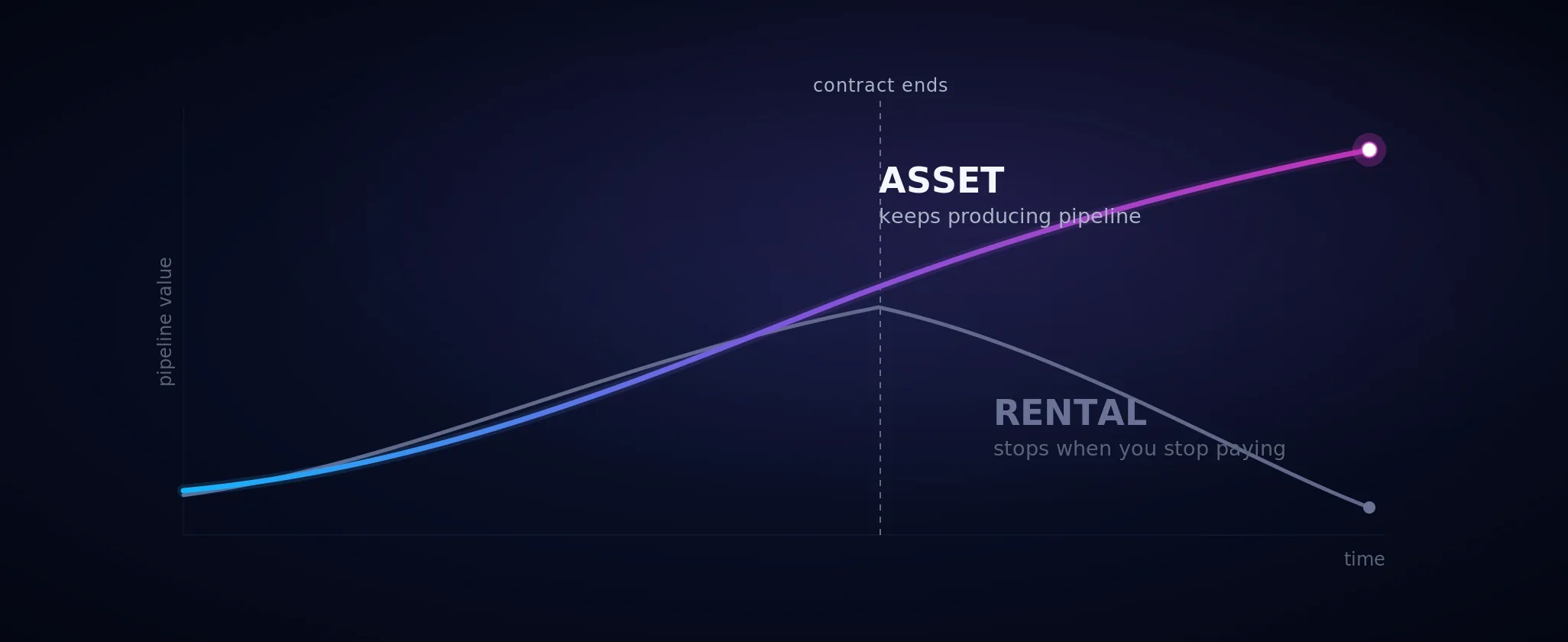
This is the question that separates an asset from activities from the agency you’re potentially hiring. If everything you built stops producing the moment the invoice stops, you were renting activity. If the positioning, the lead magnet, the signal-capture system, and the follow-up motion keep working after the engagement ends, you were building an asset that compounds.
The distinction matters more than it sounds, because of how B2B buying actually works. Research from the Ehrenberg-Bass Institute gives us the 95-5 rule: at any given moment, only about 5 percent of your buyers are in-market, and the other 95 percent are still forming their view. Good demand generation will capture some of the 5 percent who are ready and builds the assets and the memory that make you the obvious choice when the rest enter the market later. A retainer that only rents activity captures whatever is in-market today. Ask what you will still own in twelve months.

Ask what happens if they miss the date, and get it in writing. A vendor who answers only that they'll keep working at it is moving the goalposts while the invoices continue. A real commitment names a date and a consequence.
An agency confident in its system will put a line in the agreement something along the lines that if there are no qualified downloads by day X (say day 75), the next month is extended at no cost. The specific terms matter less than the principle. A team that has done this before will take a dated checkpoint without flinching, because they expect to deliver results. If they resist putting a date on it, that tells you how well their system actually works. That hesitation is the answer, so watch for it early.
Ask the exit question before the entry question. What does it cost to leave, in notice period, in lock-in, and in the work you would have to rebuild elsewhere. There are always switching costs. Client-agency relationships now average years and reports claim that more than double the 3.2 years of a decade ago. Some of that loyalty is earned. Some of it is the inertia speaking and the sunk-cost feeling that ditching the agency means admitting the first payments were wasted.
That feeling is exactly what a long lock-in is designed to use. When the exit is painful, the vendor has less reason to keep proving value. So the healthiest structures do the opposite. A good demand generation agency runs a short pilot, then goes month-to-month with 30 days notice, and keeps ad spend disclosed as a separate line rather than buried in the retainer. An agency that makes leaving easy is one that plans to keep earning the stay. Price the exit first, and the entry price starts to make sense.
A CFO's job is to refuse the spend and the budget that has not earned its place in the plan. These five questions are how you can gauge their thinking and have a good business case when you work with an agency. A good vendor welcomes them, because a buyer who asks hard questions at the start is a buyer who usually stays when the answers turn out to be true. If the agencies you’re speaking with get vague when you ask what you will own, or what happens if there is no reslt, or what it costs to leave, has answered the only question that mattered.
When you walk into that budget conversation bring the answers to these five. They all point at one thing: does this retainer build you a pipeline system you own, or rent you activity that dies the day you stop paying? Sign the one that keeps producing pipeline after the contract is over.
How much should a B2B demand generation retainer cost?
Agencies typically quote demand gen retainers in a broad band, often from around $2,500 per month at the entry level to $15,000 or more for a full-service scope, with ad spend usually budgeted separately at one to three times the retainer. No authoritative body publishes a precise benchmark, so treat any single number as directional. The more useful question is what the retainer is priced against: an in-house hire, a tool stack, or doing nothing.
Is a demand gen retainer worth it, or should we hire in-house?
It depends on speed and expertise that is ready on day one. A senior in-house hire carries salary, tooling, and a six to nine month ramp before a system is running. A retainer can give you a proven system faster, in the range of 60 days, and is easier to exit if it does not work. Hiring in-house tends to win once the motion is proven and you want it owned permanently. The honest vendor will tell you which case you are in.
What is the difference between a qualified lead and an MQL?
An MQL is a marketing-qualified lead, usually one person who took an action like a download. Qualified pipeline reflects a real opportunity, often across a buying group of several people. Forrester found lead-centric processes convert to closed-won at under 1 percent, and that 93 percent of B2B buyers move as a group, which is why reporting on qualified pipeline beats reporting on MQL volume.
How do you know if a demand gen agency is actually working in the first few months?
Look for leading signals of qualified demand within about 60 days, reported as pipeline and qualified conversations rather than lead volume, and a written remedy if those signals do not appear by a fixed date. If the only thing growing by month two is a dashboard of downloads, the definition of success has quietly drifted.