Scroll your feed for two minutes and count the posts that could have been published by any company in your category. Most of them came out of an AI that knows the category and nothing about the company.
Your agent has never read your ICP, your positioning, your proof, or your rules about what you refuse to say. That leaves it one source: the same internet everyone else's agent is reading. Run it across your blog, your outbound or your ad copy, and you are publishing average content under your own brand.
Agentic AI will make a lot of B2B teams worse at demand generation before it makes them better. Gartner expects AI agents to outnumber human sellers ten to one by 2028, and fewer than 40% of sellers to report that those agents improved their productivity. Buying the agents is the easy part. Getting a return out of them depends on what you feed them and who checks their work, and that's where teams are losing.
Agentic B2B demand generation means AI agents doing real go-to-market work (research, drafting, qualification, follow-up, analysis) from your business context written down where they can read it, with a person approving the work at set points. It differs from marketing automation in one major aspect: decisions. A workflow follows rules you wrote. An agent makes calls inside boundaries you set.
Large part of the content on this subject today is created from companies selling agents. This article comes from running our own delivery on them, which makes for a less exciting story with more usable parts. Where our evidence is still thin, I say so explicitly.
Automation executes a script: form filled, send email two days later. It breaks the moment reality goes off-script, and B2B reality goes off-script a lot.
An agent gets an objective, context and constraints. Here's one example of what that looks in practice:
1. Objective. A VP of Sales at a 200-person SaaS company downloaded the benchmark report this morning. Decide whether the account is worth outreach today, and if it is, draft it around that trigger.
2. Context. Our ICP and buying committee, our positioning, our proof points with sources, our voice and our refusal rules.
3. Constraints. Use only proof points from the file, with the source attached. Skip anyone already in an open deal or contacted in the last 30 days. If the signal is thin, come back with a no rather than a reason to proceed.
Let the agent absorb the variance. You keep the quality bar, the send button, and the budget.
"AI agents can take on more of the searching, synthesizing, drafting, and administrative work, while sellers focus on relationship building, problem solving, and judgment-rich customer conversations." "This shift does not make the human side of B2B sales less important. It makes it even more valuable."
- Alexander Dierks, Isabel Huber, Maria Valdivieso de Uster, Richelle Deveau, The future of B2B sales: How growth champions rewire their playbooks with AI
Agents take that same shape across go-to-market use cases. Let me give you another simple example. An agent researches an account before you reach out. It works out why last month's campaign flopped. It drafts the next sequence from what the last one taught, and checks a new download against your ICP in seconds. You review the work and decide what happens next.
Authority stays with the person who has to defend the number.
More widely than the sceptics think, less deeply than the vendors claim, and further along on the buyer side than the seller side.
McKinsey's State of AI survey (1,993 organisations across 105 nations, fielded June and July 2025) separates the two, and the gap is the story. Almost every company and organisation uses AI somewhere: 88% of organisations, up from 78% a year earlier. Agents are a much smaller slice of that. 23% report scaling an agentic system, another 39% have begun experimenting, and close to two thirds have not begun scaling AI across the enterprise at all.
Salesforce's 2026 State of Sales (4,050 sales professionals across 22 countries, August and September 2025, a motivated vendor with the largest sample available) reports 54% of sellers have used agents, with nearly nine in ten planning to by 2027. Gartner expects agents to intermediate more than $15 trillion of B2B spending by 2028.
Now the number that should change what you do this quarter. 6sense's 2025 Buyer Experience Report surveyed just under 4,000 B2B buyers, and 94% reported using LLMs during their buying process.
It's worth knowing what the sample is, because the figure gets quoted without it. Technology and services companies made up 80% of respondents. Nearly half were VP level or above, and 52% were the final decision maker on the purchase. The biggest revenue bands were $10M to $100M and $100M to $500M, median deal size ran $200,000 to $400,000, and 40% sat in Europe. That is a mid-market technology and services sample, which is the market most B2B SaaS teams are selling into.
Your buyers went agentic before your GTM team did.
Read the rest of that report before you panic about it. The same research puts LLM use in the middle of the journey rather than at the start or the end, and finds 85% of buyers already have prior experience with the vendors they evaluate. So the AI is helping them compare a shortlist they already had. In many cases the shortlist was built earlier, out of who they had heard of, worked with, or read.

That splits the job in two. Being quotable by AI engines gets you into the comparison. Being known beforehand is what puts you on the shortlist, and that's still won with reputation.
And hold every prediction loosely, including the ones I have quoted. In March 2026, Gartner published a survey of 646 buyers reporting that 67% prefer a rep-free experience. Six months earlier, the same firm predicted that by 2030, 75% of B2B buyers will prefer sales experiences that prioritise human interaction over AI. Their research principal put it plainly.
"After several years of increasing interest in self-serve and AI-driven sales, we're now beginning to see a reversal, with more buyers expressing a desire for authentic human engagement, especially in complex or high-stakes transactions."
- Colleen Giblin, Research Principal, Gartner
Both readings survive together. Buyers want to self-serve the tedious parts and want a person for the risky parts. The finding I would build on sits underneath both: in that same Gartner survey, confident buyers were twice as likely to report a high-quality deal. Buyer confidence is the thing you are actually competing for. You earn it with clarity and proof, and no agent can manufacture it well on your behalf.
The stack most teams run was designed around a CRM: a database of records that humans update, with channel tools bolted on around it, each holding one piece of the picture. Sequencer, ads manager, enrichment, analytics, content calendar. Three things make that architecture hard for an agent to work in.
The context is nowhere in writing. Your market intelligence, ICP, positioning, narrative, proof points and voice live in decks, docs and founders' heads. An agent inherits none of it. Point an agent at your CRM and it learns your records. Point it at nothing and it writes like everyone.
The tools do not share state. Each channel tool sees its own piece. No layer knows that the account which opened three emails also ran your scorecard and viewed pricing twice. An agent can act only on the picture it can assemble, and the stack was never built to hand it one.
Your rules exist only as culture. Things like "we never discount," "we anonymise client names," "we quote a range, never our best week" are understood by everyone on the team and written down nowhere. An agent needs them in writing, or it breaks them at machine speed.
The context layer is your commercial truth, created in a form both people and agents read before they act.
Three practitioners built this for three different jobs, and none of them built the same thing. They agree on the sequence.
Kieran Flanagan is a former HubSpot CMO who now runs agentic GTM and systems there, and co-wrote Loop on this shift with HubSpot's CMO, Kipp Bodnar. He splits an agentic GTM into three layers: context, where customer understanding lives; action, the agents themselves; and coordination, the routing, governance and handoffs between people and machines. His sequencing claim is the useful part. Most teams start by building an agent, and the teams that sustain results built the context layer first.
"Agents in silos plateau. Agents with shared context compound."
- Kieran Flanagan, SVP Agentic GTM and Systems, HubSpot
A company does not build a senior role around a term it expects to fade.
Matteo Tittarelli builds it as a folder spine 1. System of context, 2. System of skills, 3. System of orchestration and 4. System of integrations.
Velocity comes from skills, the producers. Coordination comes from agents, the coordinators. But compounding lives in the contextual spine and folder structure.
- Matteo Tittarelli, founder of Genesys and co-founder of GTM Engineer School, writing in Growth Unhinged
Nicolas Finet builds the other half of it as account memory. One record per company holding every signal, every message, every reply and every outcome, so an account you have chased twice is never treated as cold. He is blunt about which part carries the system: memory is what separates a brain from a mail merge.
Emily Kramer at MKT1 named the role this creates, the Gen Marketer, an AI-fluent generalist who orchestrates end to end rather than owning one channel.
All four sell something adjacent to the argument, so weigh them accordingly. The convergence is the interesting part. Four people solving different problems built the same layer.
Three disciplines decide if yours works.
Refresh it on a schedule. Stale ICP and broad positioning is GTM debt, and it compounds the same way the good version does, against you. Tittarelli's cadence is the spine monthly, running win-loss into competitors into ICP into messaging, and positioning quarterly.
Attach sources and dates to everything. If the inputs lie, everything downstream lies with them, at volume and in your voice.
Encode every correction. When you override an agent, the override goes into the context rather than into your head. Otherwise you make the same correction every week until you stop using the thing.
What you know about the market (ICP and buying committee, competitors, positioning, messaging in your buyers' own words, and what you refuse to say) stops an agent sounding like everyone else. What you know about each account (every signal, every message you sent, every reply, every outcome, in one place) stops it treating a company you have chased twice like a cold one.
The unit of advantage moved from the prompt to the context.
Demandster partly runs on this architecture for our demand gen and in service delivery. Several knowledge bases, one for each part of the business we keep learning about: winning clients, content, paid, outbound, engagement, and the operators we learn from. A written record of how we operate, built as an AI second brain, so a new agent and a new hire/contractor start from the same standards. An agent scans for signals and hands back a ranked shortlist with a reason attached, not a list. Another checks a new download against the ICP. Before anything is published, one agent argues against the draft and another traces every number to a primary source, including every number above this line.
Research, drafting, QC and reporting that used to take days now take hours. Every flop feeds the scorecard, so we don't repeat each mistake.
What I cannot claim: that agents source pipeline end to end without us. The meetings still come from the system the agents accelerate, which is content, signal capture and fast follow-up. We measure that engine's cost per meeting every week, because an experiment you refuse to measure is a story.
Agentic demand generation in 2026 is an operator amplified by agents that have read the business first. Anyone selling you autonomous pipeline is selling ahead of the evidence.
A tool that lets your agents read its data stays in the stack. A tool that keeps its data behind a screen becomes the thing your team works around.
Kyle Poyar surveyed 200 Growth Unhinged readers on how they use AI for go-to-market. What came back is that the context layer was the single most critical part of the setup, and everything else ran downstream of it. So build that, and build it from the bottom.
Gather three things first. Your sales call recordings and transcripts, won and lost. A list of closed deals from the last year with size, industry, and who signed. And the URLs for your own site plus your three closest competitors. That is the raw material, and you already have it.
Then have your AI produce the files in this order, one at a time, reading each before you let it start the next:
The sequence matters more than the polish. Resist letting the model write all six in one pass, because an AI with no win-loss file will invent an ICP that reads well and describes nobody. Each file is the input to the next, which is also why a weak file three propagates into everything under it.
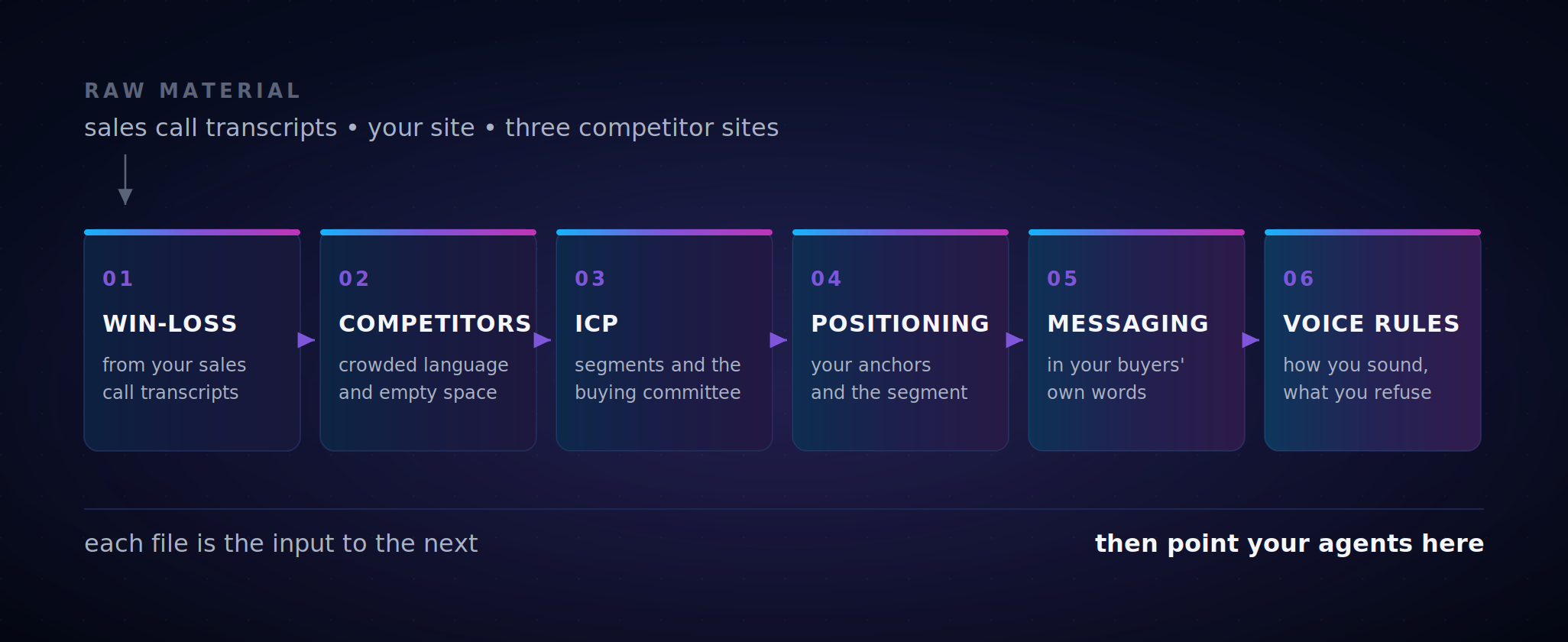
Then point your agents at those six files instead of at a blank prompt, and put the refresh in the calendar before you close the laptop.
If AI feels like a treadmill, shift focus from more agents to better foundation.
What is agentic B2B demand generation?
Agentic B2B demand generation is AI agents doing go-to-market work (research, drafting, qualification, follow-up and analysis) from your business context written down where they can read it, with a person approving the work at set points. It differs from marketing automation in that agents make decisions within boundaries you set, while workflows follow fixed scripts you wrote.
Is agentic AI in B2B marketing actually being adopted?
Yes, unevenly. McKinsey's 2025 State of AI survey found 23% of organisations scaling an agentic system and 39% experimenting, while close to two thirds have not scaled AI across the enterprise. Salesforce reported 54% of sellers using agents in 2026 with nearly nine in ten planning to by 2027. Gartner predicts agents will outnumber sellers ten to one by 2028, yet fewer than 40% of sellers will report productivity gains from them.
Why do AI agents produce generic marketing output?
Because they run without context. An agent that has never read your ICP, positioning, proof points and voice rules writes from the same internet as everyone else's agent. The fix is a context layer, meaning your business written down in files agents read before acting, plus a scoring step that checks output against your own standards before a person reviews it.
What is a context layer in GTM?
A context layer is your commercial truth written down in a form both people and agents read before they act: ICP and buying committee, competitors, positioning and narrative, messaging in your buyers' own words, and brand rules including what you refuse to say. Every claim carries a source and a date. It is the difference between AI that multiplies your point of view and AI that dilutes it.
Do B2B buyers use AI to research vendors?
Yes. 6sense's 2025 Buyer Experience Report surveyed just under 4,000 B2B buyers, 80% of them at technology and services companies and nearly half at VP level or above, and found 94% used LLMs during their buying process. The nuance matters: buyers use LLMs mid-journey for comparison and synthesis, and 85% already have prior experience with the vendors they evaluate. Being quotable by AI engines gets you into the comparison, and being known to the buyer beforehand is what puts you on the shortlist in the first place.
Will AI agents replace SDRs and marketers?
The work redistributes rather than disappearing. Agents absorb research, drafting and triage, while humans keep judgment, taste, strategy and relationships. Gartner's own prediction cuts both ways: agents outnumber sellers ten to one by 2028, yet fewer than 40% of sellers are expected to report productivity gains, which says the tooling arrives faster than the operating model that makes it useful.