We have lost count of how many B2B teams show us the same picture. You list everything in motion. Started a newsletter, running paid ads, bought an ABM tool, added a new SDR. Four reasonable moves, and pipeline that stays stubbornly flat. Then someone asks the only question that counts: so where is the pipeline?
I have sat in that meeting from both sides of the table (as a marketing leader and now agency founder), and the cause is almost never the tactics.
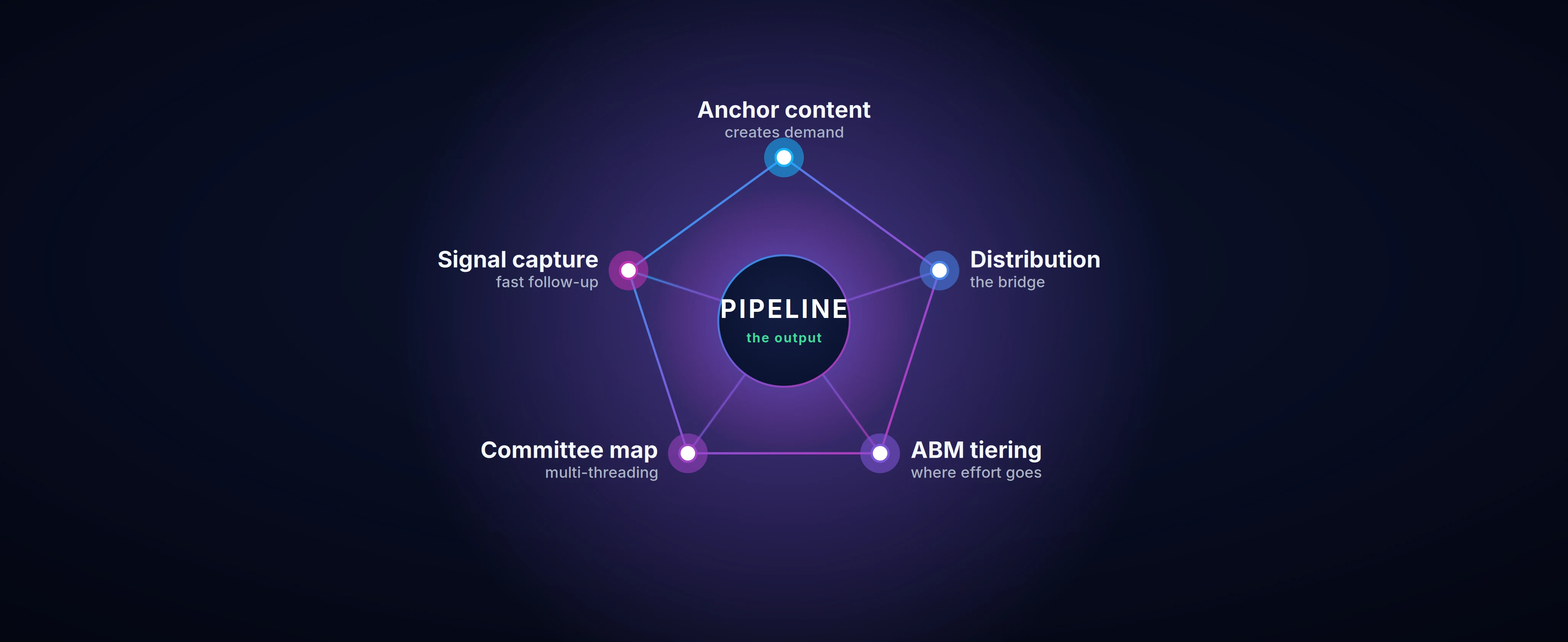
A demand generation engine has five connected parts. Thought leadership content that educates the market. ABM tiering for target accounts that decides where the effort goes. Buying-committee mapping that makes the pursuit multi-threaded. Distribution that puts it in front of the accounts you have chosen. Signal orchestration with fast follow-up that turns engagement into pipeline.
If you look at these only as tactics to execute on, you fall into the trap of staying busy. Integrate them and connect all parts into one loop and you get a fairly decent chance of producing a sales pipeline on ABM programs you can forecast.
Donella Meadows spent a career on how systems behave, and it boils down to the following main lesson. A system's behaviour lives in the connections between its parts, far more than in the parts themselves. Let's take the example of a a car engine. A carburettor, a spark plug, a piston, laid on a workbench, make exactly zero power. Bolt them together in the right order and you get torque. Demand gen is identical. The parts are fairly cheap today, and anyone can start a newsletter or buy a tool. The connections are the engine, and they are the only thing that separates a strong demand generation system from random acts of marketing with better logos.
Read along for the short summary on how they connect, and how I would build the whole thing in 60 days.
Valuable thought leadership content is where most teams underinvest, because a heavy asset is slower to make than a daily post. Pick one or two a quarter and make them genuinely useful: a research report, a definitive guide, a benchmark, a recurring webinar. It is one asset, but it fullfills three jobs. It earns authority, it pulls the whole buying committee in at the top, and it hands you a warm reason to reach out.
Back in my time as a head of marketing, we ran demand gen on three research reports and one guide a year, and each one paid for itself three times over. It owned the category narrative. It pulled senior buyers who showed up to the first call already pre-convinced. And it cut the sales cycle. If you take one idea from this piece, take that one. The daily-content treadmill is the failure mode this first part exists to escape.
Distribution is the bridge, and the job is to really focus so narrow that you almost have that feeling that it hurts. An anchor asset only you and your team can see earns nothing. So invest in paid ads on LinkedIn and Meta at your ICP-fit accounts, run organized outreach into the named buying committee, take the newsletter or podcast slot that reaches the same buyers. The temptation is to broadcast. The discipline is to reach the specific accounts you have already decided to win, and don't expand from there.
Segment the market into your ICP, then tier the ICP. ABM tiering decides where the effort goes, and skipping it is how small teams burn out. Treat every account the same and you spread four people across four hundred accounts, thinly and badly. So segment the market into your ICP, then tier the ICP. Tier one earns personalised outreach and full pursuit. Tier two gets a lighter cadence. Tier three runs on automation. Done right, tiering is what lets four people run a programme that looks like forty.
A single lead is rarely a single decision. Forrester found that 93 percent of B2B buyers move as a group of two or more, and 71 percent as a group of four or more, and yet your CRM usually holds one name. Map the rest, the champion, the economic buyer, the blocker, the technical evaluator, and the deal becomes multi-threaded enough to survive your champion changing jobs, which they eventually will.
This is the part that turns the other four into pipeline. Every engagement with your anchor content is a signal, and every signal earns a multi-channel follow-up, email, LinkedIn, and a phone call, inside 24 to 72 hours. Speed is the whole edge. A signal decays fast, and in a feed drowning in automated outreach and spamming, the human call is the thing that makes a difference and cuts through.
Timing beats volume here. The Ehrenberg-Bass 95-5 rule says that only about 5 percent of your buyers are in-market in any given quarter, and the other 95 percent are still forming a view (learning and exploring). Great thought leadership content builds the familiarity and memory that makes you the obvious choice when they enter the market. Signal orchestration catches the 5 percent who are ready now. The former plays for later, the later closes today.
Read the last column top to bottom. Every line is a place the engine leaks demand, and when three or four leak at once you get the state I see most: a team busy in every channel and flat on the only chart that counts. No new tactic patches that. The connection does.
You can start with the team you have.
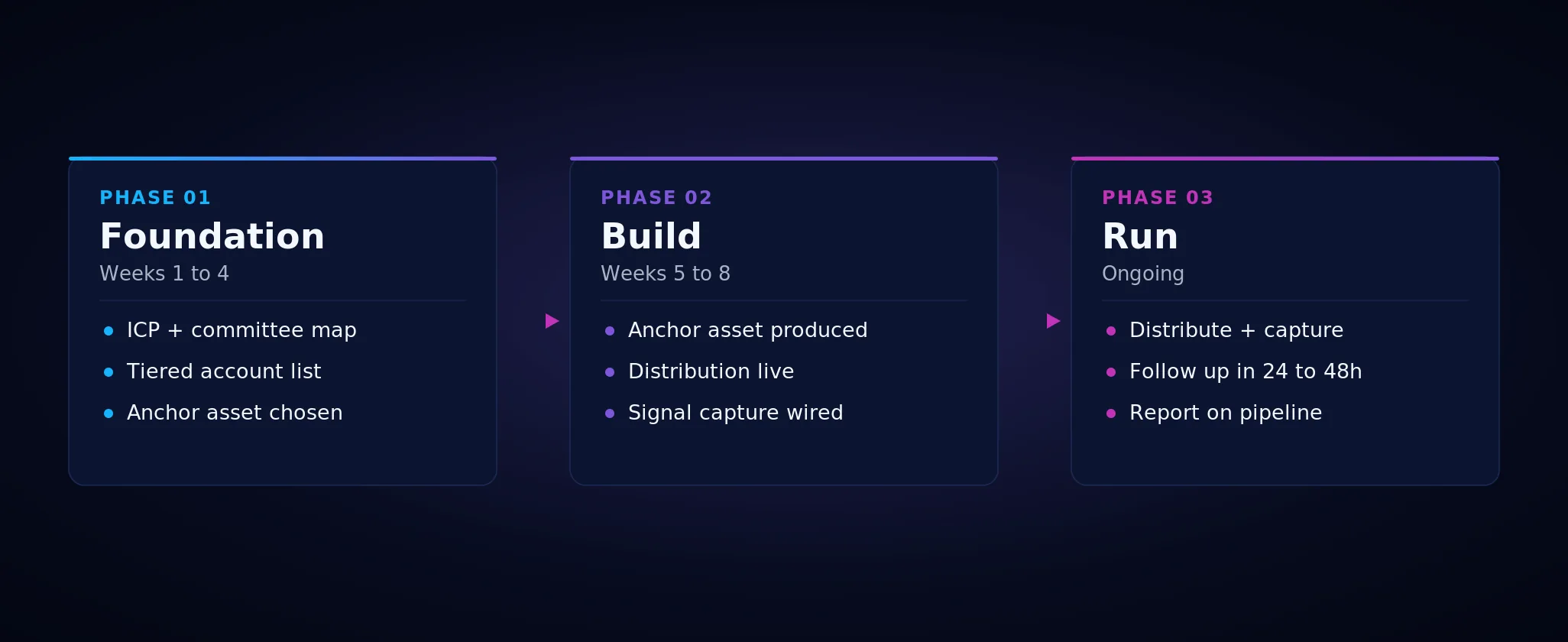
Weeks 1 to 4, foundation: map the ICP and the buying committee, build the tiered account list, pick the one anchor asset. Weeks 5 to 8, build: produce that asset, plan for distribution, wire signal capture and follow-up. From week 9: distribute, catch signals, follow up inside the window, and report on pipeline instead of lead volume.
We built exactly this for a 3D visualisation company that arrived with multiple channels active like content, ads, and outbound, and none of it compounding. We updated the programs, but more importantly connected the channels they already had. Three pillar assets, distribution tied to the tiered list, a phone call inside 24 hours of every signal. Over nine months the engine produced more than 1,100 qualified signals and 110 booked meetings, and the sales cycle shortened because buyers arrived already educated. Their content output barely moved. What moved was that the parts finally talked to each other.
That is what the far side feels like. Pipeline you forecast instead of pray for. Buyers who show up warm. A team that has stopped sprinting between disconnected campaigns, because the engine is integrated now.
The problem is rarely the tactics. It's that five good parts run as five separate projects. So do the unglamorous work. Pick the main content piece and asset, tier the accounts, map the committees, and give every signal a 24 to 72 hour window. Connect the five and the engine turns. Leave one part on the workbench and you keep paying the random acts tax, quarter after quarter - busy with activities, but your sales pipeline is flat.
Want to see which of the five your go-to-market is missing? Run the Demandster GTM scorecard. It maps it in a few minutes.
What is a B2B demand generation engine?
A demand generation engine is a connected system that creates demand and captures it in one loop, rather than a set of separate tactics. In practice it has five parts: anchor content, distribution, ABM tiering, buying-committee mapping, and signal orchestration with fast follow-up. The value comes from integrating them together so engagement turns into a more predictable pipeline.
How long does it take to build one?
About 60 days to a working system if you build in with the right steps and sequence: roughly four weeks of foundation (ICP, buying committee, tiered list, anchor asset chosen), four weeks of build/production (asset produced, distribution live, signal capture wired), then run from week nine. You get traction in weeks, not the nine months a senior in-house hire takes to ramp.
Do I need a big team or an ABM platform to run it?
No. A lean team can run the engine, because it is about the system, not headcount: one owner, a tiered list, one anchor asset, mapped committees, and fast follow-up. Third-party intent tools and an ABM platform come later, once the motion is already booking meetings.
How is a demand generation engine different from lead generation or demand capture?
Lead generation collects contacts, demand capture converts existing in-market intent, and demand generation creates the demand in the first place. The engine holds all three: the anchor content creates demand, distribution and tiering position it, and signal orchestration captures it. See demand generation vs demand capture vs lead generation for the full distinction.