Last month we sat on a Foundation call with the founder of a Series A B2B SaaS. €4M ARR and a GTM team of nine. He was still running sales himself. We asked which of the four components of a working revenue engine his team had actually installed.
His pipeline had been unpredictable for six quarters, and the main reason is that his GTM system missed two critical components.
Across the 20 audits we have run this year, nailing two of four components is the default. Three of four shows a competent team. All four installed and connected is something we rarely find. The work that's disguised like progress, content and outbound, lives inside the two components teams already have. The missing two components are quiet, but they cost way more.
A revenue engine breaks where a component is missing. Missing one produces near-zero output in the parts of the system that depend on it. A team with two of four components can run hot for a month, cold for a quarter, then hot again. But that system has no stability.
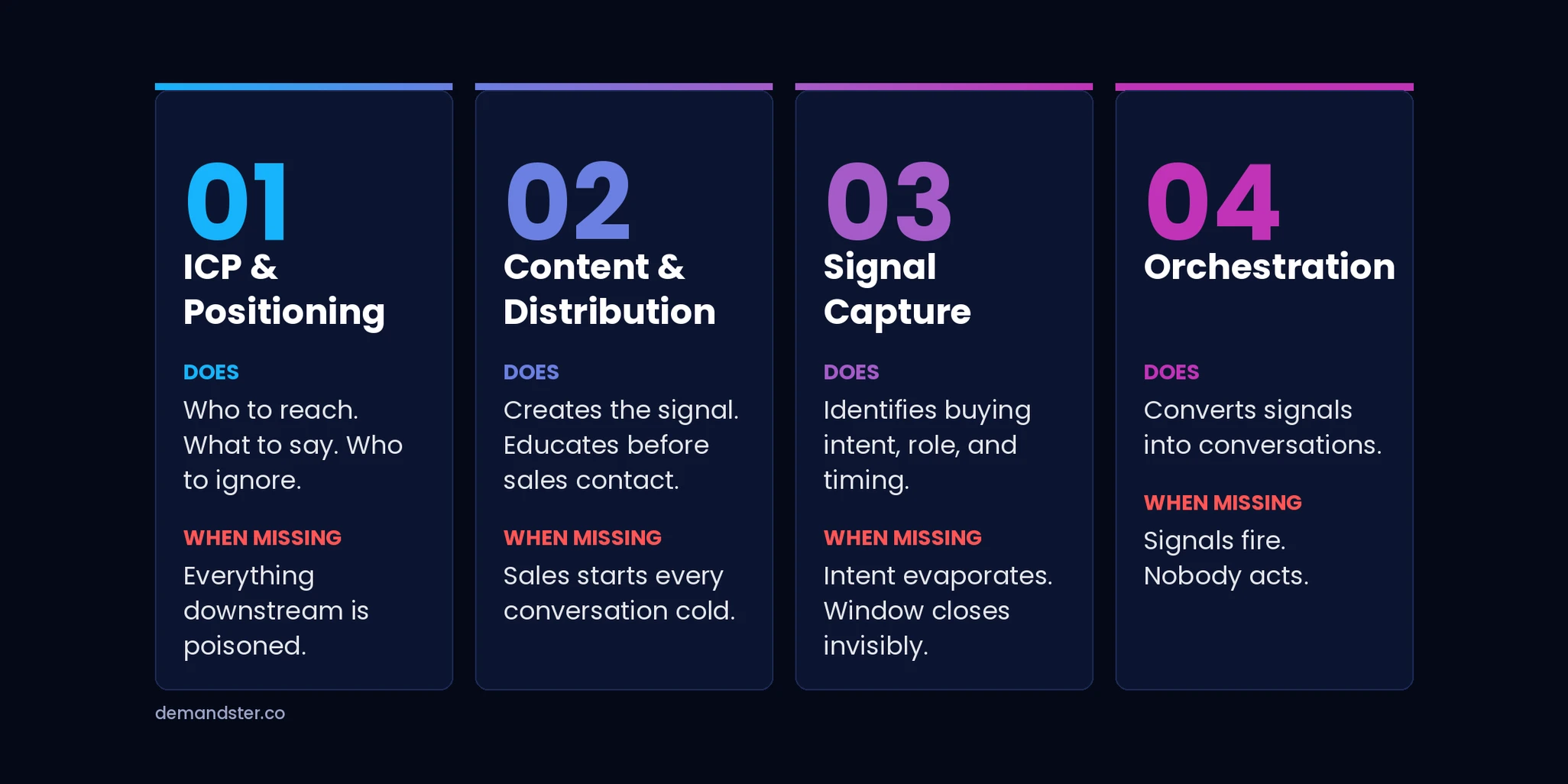
All four components of a revenue engine have to be connected. Each does a distinct job, and your commercial results compound only when all four are doing their function.
ICP (a.k.a Ideal Customer Profile) and Positioning is the first component and it tells you who to reach, what to say, and who to ignore.
When it is present and sharp, everything downstream benefits. The campaign audience is precise and you cut waste from campaigns. The content speaks to a specific buyer at a specific growth stage with a specific problem. The sales team qualifies quickly because the criteria are documented and shared.
When it is vague, everything downstream is in a way poisoned. Marketing reaches a broad audience. Ad spend burns across contacts who will never buy. Sales receives leads they cannot close.
Broad targeting: 400,000 contacts, ~5% ICP fit, €180 CPL.
Precision targeting: 12,000 contacts, 60%+ ICP fit, €47 CPL.
The gap is not creative. It is not bidding strategy. It is the precision of the ICP definition that was applied before the first ad went live.
ICP and Positioning is the upstream variable. The other three components compound only when this one is sharp.
Content and Distribution is the component that creates the signal. It educates the buyer before any human contact is made.
Content educates the buyer before the first sales conversation. A buyer who has read the company’s best thinking before the first meeting arrives already sold on the problem framing. The sales conversation moves faster because the education has already happened.
The Content Marketing Institute reports that 74% of marketers say content helps generate demand and leads, and 62% say it nurtures audiences. Content that addresses the specific questions of a defined ICP builds credibility before sales ever makes contact.
Distribution is the part many teams get wrong. The channel choice depends on two questions: where does your ideal buyers actually spend time, and what marketing advantages does the company hold. A B2B SaaS whose ICP lives on LinkedIn has a different answer than one whose ICP reads vertical trade press. The channel is chosen because the right people will see it there, not because it is fashionable.
A unified GTM motion activates content across multiple touchpoints. From LinkedIn ads and organic posts to email, outbound sequences, and retargeting, the ICP encounters a consistent narrative wherever they are. Marketing Week data shows the average overlap between marketing and sales reach in B2B is 16%. A unified approach closes that gap. When marketing and sales reach the same accounts with the same message, the combined effect compounds.
Distribution without content is spam. Content without distribution is a diary.
Signal Capture is the component that identifies which accounts are showing buying intent, which role is engaging, and when.
B2B buyers search, read, and re-visit pricing pages. Each action is a signal that says an account is in a buying window right now, if you have the infrastructure to see it. The signal is there. The infrastructure to capture it usually is not.
The buyer journey in B2B is not linear and rarely visible. A VP of Marketing who is about to evaluate a new demand gen agency does not announce the evaluation. They search. They read guides. They re-visit competitor comparison pages. B2B buyers search, read, and re-visit pricing pages. Each action is a signal that says an account is in a buying window right now, if you have the tech infrastructure to see it.
First-party signals: pricing page visits, content downloads, engagement from named company domains, LinkedIn activity from contacts already on the target list.
Third-party signals: Bombora topic surge data, G2 category research patterns, competitor comparison page visits, and job posting patterns. A company actively hiring a Head of Demand Generation is signalling budget allocation, GTM intent, and growth stage simultaneously.
The 24 to 48 hour window between a buying trigger and a meaningful first conversation is the most commercially valuable window in B2B. Without Signal Capture, that window is invisible.
Orchestration is the component that converts signals into conversations.
Teams call this "follow-up" and run it as a fixed sequence. That approach doesn’t work. A buyer who downloaded the pricing page yesterday and a buyer who downloaded it two months ago receive the same email on day three. One is in a buying window, and the other is past it. But many drip followups treat them identically.
The Demandster model runs follow-up within 24 to 48 hours of a qualified signal. Multi-channel, simultaneous: LinkedIn message first, personalised email second, phone call within 24 hours. Each touch references the specific signal, the specific asset the prospect engaged with, and a commercial observation about what the account is demonstrating right now.
Gartner reports the average B2B purchase involves 6 to 11 stakeholders. Orchestration cannot be single-threaded. Single-threading loses deals because the roles the champion cannot persuade alone never see the case.
Building a revenue engine works the same way a strength program works.
The load gets heavier every quarter. More pipeline targets, headcount, and bigger board expectations. The system tolerates the increased load because every component carries some of the weight. When one component is weak, the load goes through the others, the others fail, and the lift stops.
The squat collapses when the core gives out, and the session ends with it.
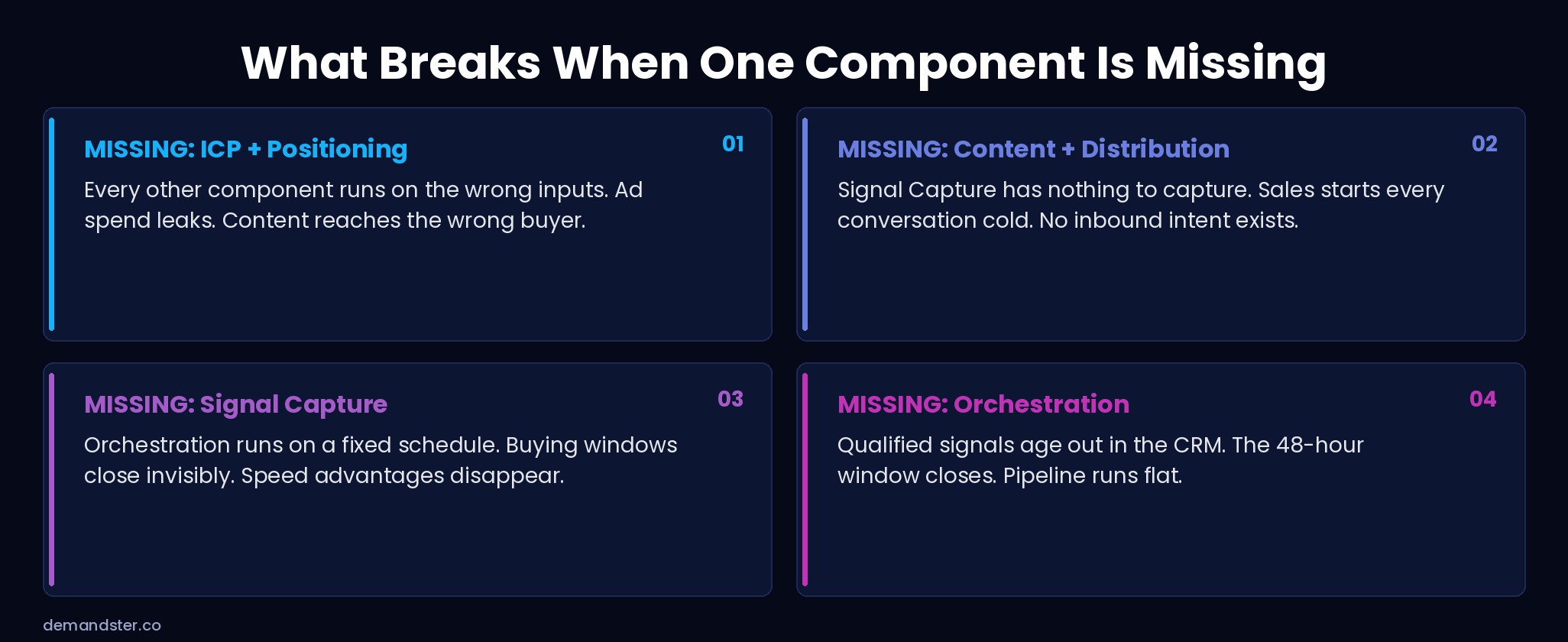
A revenue engine is the same. With weak ICP and poor positioning, every other component runs on the wrong inputs. You write content for the wrong buyer. Signal Capture logs signals from accounts that will never close. Your Orchestration follows up with the wrong people. The engine just produces activity (in many cases a lot of work) but the pipeline stays flat.
The Enhance XR engine ran all four. Built and connected over nine months: 1,100+ qualified signals, 110 meetings booked, strong pipeline creation. Four components running together is what compounded the output. Content alone produces views. Targeting alone produces a clean list. The compounding came from all four moving at once.
Before next quarter's planning cycle, ask this question:
Which of the four components is the weakest link in your current setup?
Which component, if absent or weak, explains the pipeline problem most directly. Investment level is downstream of that diagnosis.
Is ICP vague and the targeting is broad?
You have existing content but haven't found your main distribution channels?
Signal tracking active but SDRs don't act inside 48 hours?
The follow-up runs the same sequence for every account?
There are many parts to look at and the answer to that question is GTM architecture. Invest time in diagnosing your architecture first. You can only improve it if that diagnosis is correct.
Run the full version at scorecard.demandster.co. Takes about 2-3 minutes, and it tells you which of the four components is the weakest link, and what to do next.
If ICP is the gap, the ICP builder at icp.demandster.co is the first move.
A B2B revenue engine has four components: ICP and positioning (who to reach and what to say), content and distribution (the part that creates the signal), signal capture (identifying which accounts are showing intent), and orchestration (converting signals into conversations). Each does a distinct job, and results compound only when all four are installed and connected.
Most underperform because one or two of the four components are missing. Across 20 audits this year, two of four is the default and all four connected is rare. A system with gaps runs hot for a month and cold for a quarter, because the missing component starves everything downstream that depends on it.
ICP and positioning is the upstream variable. When it is sharp, targeting is precise, content speaks to a specific buyer, and sales qualifies fast. When it is vague, ad spend burns on poor-fit accounts and sales gets leads it cannot close. In one example, precision targeting moved CPL from 180 euros to 47 euros with no change to creative or bidding.
Within 24 to 48 hours. The window between a buying trigger and a meaningful first conversation is the most commercially valuable window in B2B. Orchestration runs multi-channel and multi-threaded inside that window and references the specific signal, because the average B2B purchase involves 6 to 11 stakeholders and single-threading loses deals.
Compounding output, not isolated activity. When all four components run together, content creates signal, capture sees it, and orchestration converts it. One connected engine produced more than 1,100 qualified signals and 110 meetings booked in nine months. Content alone produces views; targeting alone produces a list; the compounding comes from all four moving at once.