The short version. Build one precise, tiered target account list, a few hundred accounts per ICP. Publish one pillar anchor content that genuinely teaches your market something. Track only a handful of signals and skip the other forty-five early on. Follow up with speed within a specific time window (24-72h). Integrate marketing and sales as one team, and judge the whole program on pipeline produced first, revenue next.
One of the best account-based programs I’ve seen this year is orchestrated by only four people, one lead magnet, and five signals.
That is against where the conventional wisdom and where conversation has gone, so let me be fair to the other side first. The best content we’ve found on this is Emily Kramer’s three-part account-driven GTM series at MKT1. We read all three when they came out, and it’s the best practical guide to account-based marketing. Her case is simple, but very thorough and correct: mapping your whole market into the CRM, enriching it, tiering it, tracking intent everywhere, all of that has become affordable now and you can do it efficiently. She’s right.
When everyone can map the market and reach every account, reach stops being worth much. The competitive edge moves to judgment, taste, and creative campaigns and plays. The decision on which accounts, and why now. Tools in the tech stack can’t give you that.
Emily warns about “random acts of signal-based marketing,” the itch to build a play for every signal you can possibly track, until you’re right back in the R.A.M. trap. Random acts of marketing. We’ve been fighting that same condition in our work. Now Emily is warning about it from inside the account-driven playbook.
Account-driven GTM is the right and smart direction for any company with a sales-led motion. However, the full apparatus is too heavy for a lean, post-PMF team, and trying to run all of it is how a small team marches straight back into random acts. What works at this size is the stripped-down version. You’d still need an account list (and tiers help), because one-to-many needs volume to work. You just start from that list instead of the entire TAM (total addressable market) universe. Marketing and sales operate as one integrated team. Marketing owns demand creation, SDRS own follow-ups and account executive teams own intelligence sharing. And the entire team will agree about one rule of what is considered as success.
The full setup has clear steps: define your TAM and ICPs, tier your accounts, map the whole TAM into your CRM, then choose signals and campaigns per tier. Track first, second, and third-party intent. Replace lead scoring with account stages and rules of engagement. Unify marketing, sales, and CS around the account.
Where a lean team gets off the bus is the heavy half. Mapping the entire TAM into the CRM before you have a single campaign live, buying multiple intent-data sources, and deploying numerous signal-based plays. At your size it is not an edge, it is a way to be busy.
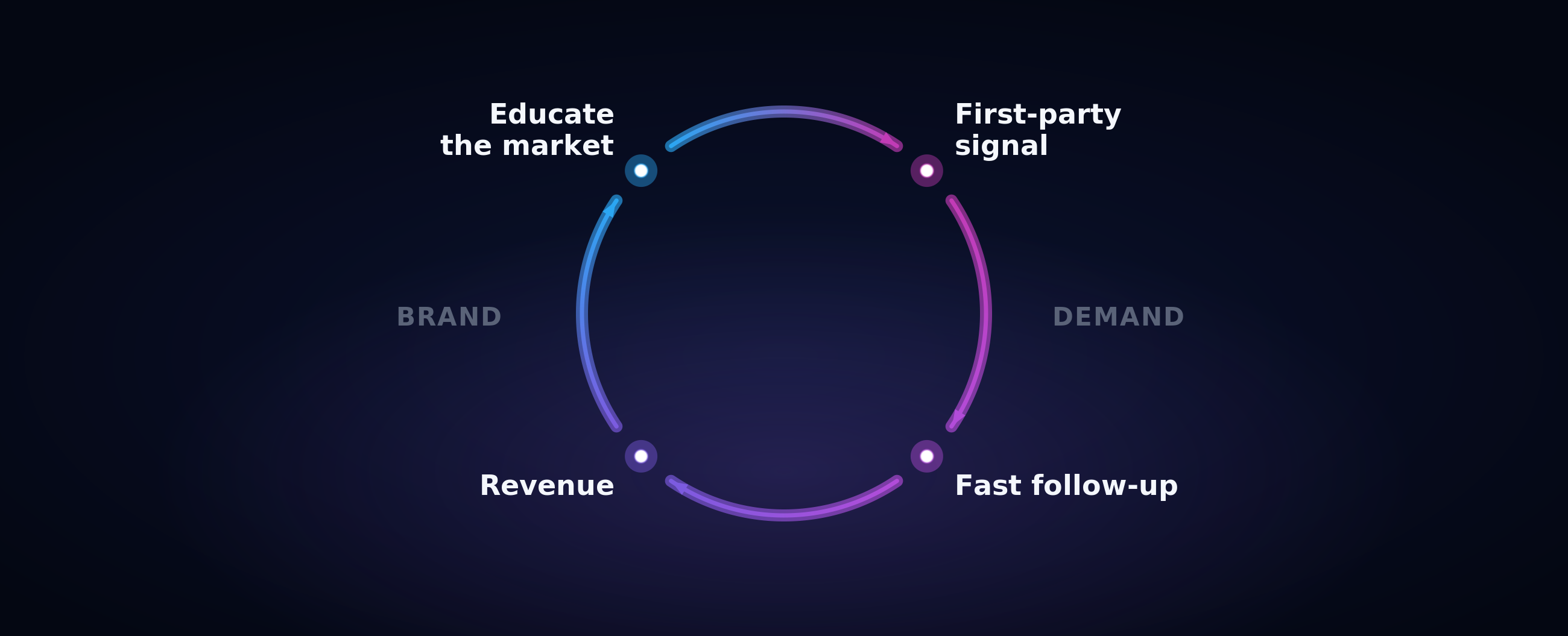
The deeper divergence is around the signals to act on. The full account-driven model leans on intent signals that already exist in the market, and competitors are racing to reach the same accounts at the same time as you do. A lean team cannot win that race on speed or data spend. So we invert it. Rather than chase signal that is already public, we create demand by educating the market. A strong lead magnet strategy and thought leadership content that genuinely teaches the buyer earns trust, goodwill and mind share. The signal is the byproduct of a content that’s insightful. That flywheel, teaching that earns attention and follow-up that captures it, is the lean team's advantage, and the part the enterprise version underweights.
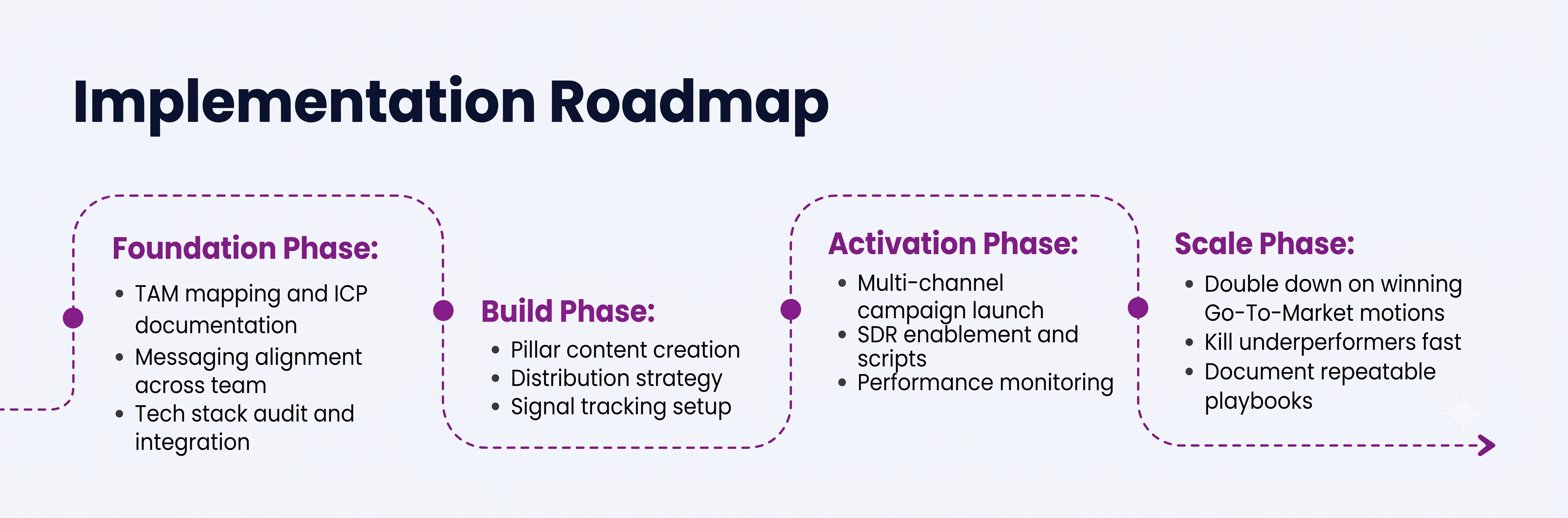
Here are the components, in order, with how they actually run.
1. One accountable owner, one integrated team. A single directly responsible individual owns the program and the number. On our live programs the campaign strategist is the DRI. Marketing owns demand creation, the sales team owns follow-up and feedback, and the two work as one team GTM. Compare that vs a program with four part-time contributors, separate lists, and nobody accountable. It produces activity, not pipeline.
2. A precisely defined ICP and a tiered account list. Do TAM later. Define the company shape, the buying committee, their pains, and the triggers in detail, then build a target list with enough volume for one-to-many to work, at least a few hundred accounts per ICP. Then tier it. On one enterprise program we ran, that was roughly 325 accounts: a Tier 1 of the top 100 by revenue and fit that earns 1:1 effort, and the rest worked one-to-many. You map and run this list rather than the entire market. You can always map the full market once the motion works.
3. One narrative. A single point of view about the buyer's problem that you want the market to adopt. It is built on the few beliefs you want to own, what we call perceptions, and it becomes the through-line that every asset, ad, and follow-up expresses. The goal is to shift what the market believes, so demand starts forming around your way of seeing the problem. Get it right and one story carries the whole program. Skip it and you just pay to amplify noise or a message that’s not compelling for the market.
4. One pillar content piece that educates the market. A lead magnet or a real piece of thought leadership, built to a quality bar that survives a skeptical buyer. This is the top of the flywheel. Taught well, it earns brand equity and share of mind with the exact accounts you care about, the kind of preference that has a buyer thinking of you before they are in-market. The engagement it draws is first-party signal you can act on, and that is the bonus, not the reason you publish. The asset turns an anonymous account list into accounts that are familiar with you, and people on the buying group you can follow up with.
5. Let the results pick your paid channel. Put the pillar in front of the mapped accounts on both LinkedIn and Meta, then let the actual results decide where the budget goes. For one client we assumed LinkedIn would carry the program because the targeting looked perfect on paper. LinkedIn spend was around 1,667 euros before we move things around the meetings came from Meta instead. On a separate ABM program, the winning Meta creative held a 3.46 dollar CPC and produced CTO-level downloads at roughly 29 euros each. Test, iterate, and learn quickly.
6. A named signal taxonomy and rules of engagement. This is the piece most lean teams skip and the piece that makes account-driven actually run. You do not need 30+ third party signals from Apollo, Clay or your sales intelligence provider. You need five that you can easily find, route to your team, and put a clock to act on. The set we use:
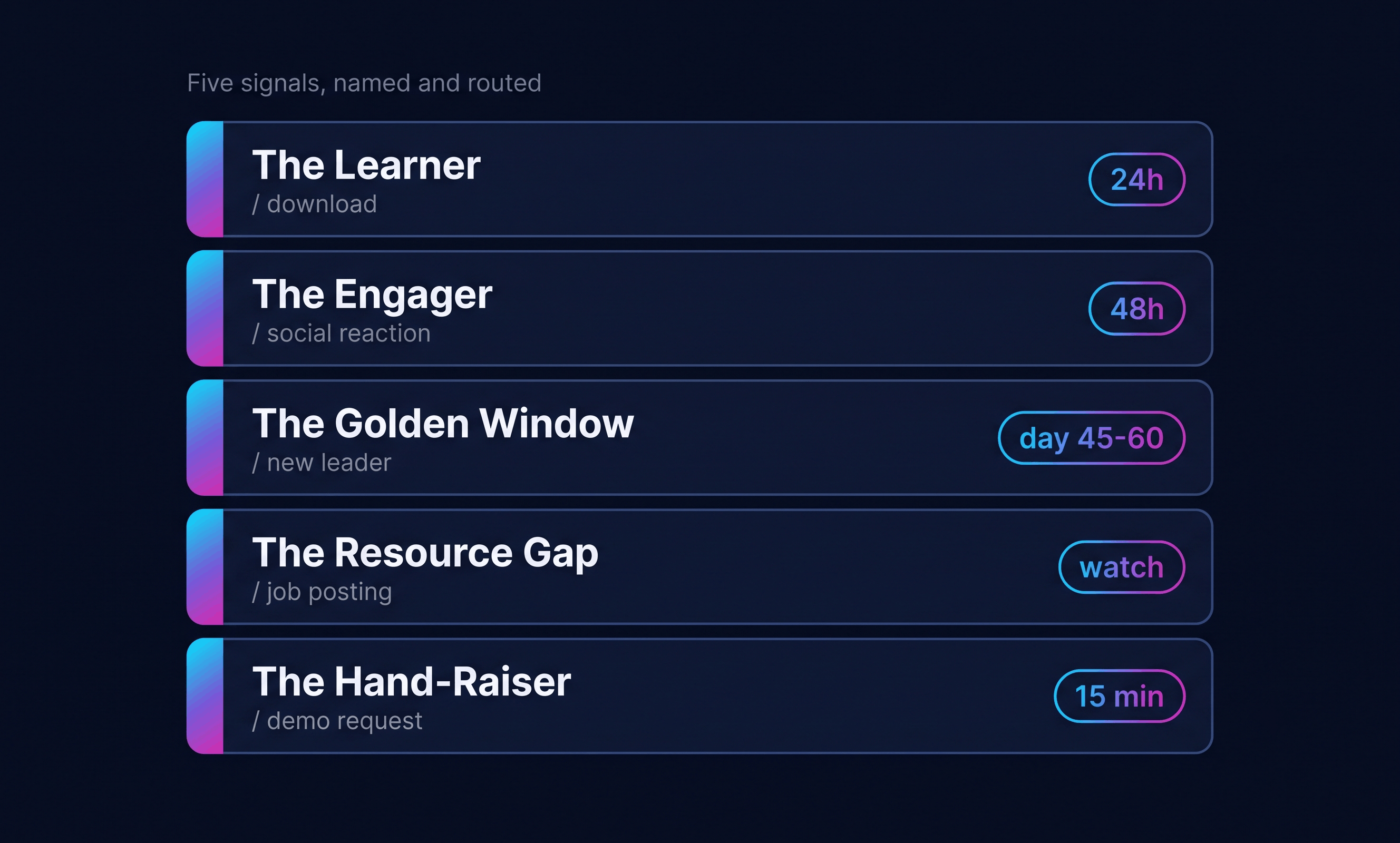
7. Fast, human follow-up. When a contact downloads your lead magnet and thought leadership content, respond inside the window, across email, LinkedIn, and phone, and use that touchpoint in the call. For the top tier, a thirty-second personalized video at the right moment beats another templated email.
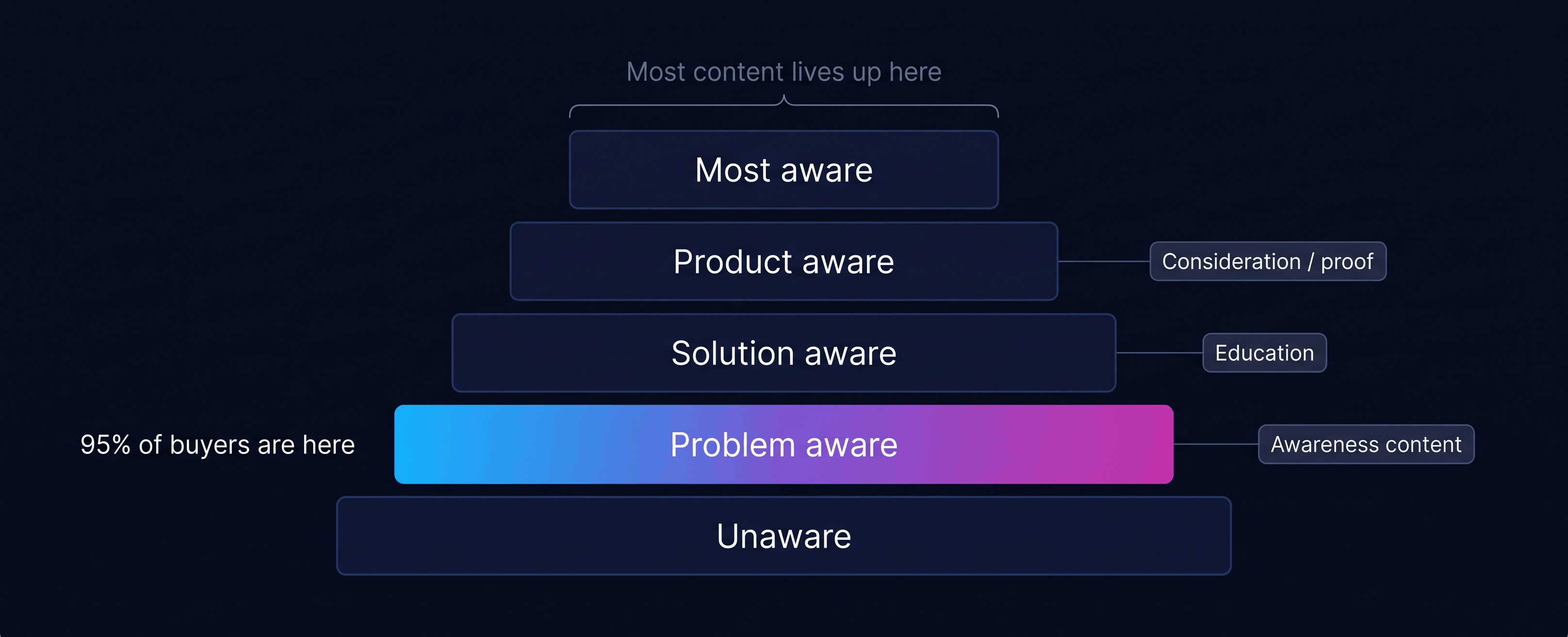
Before you write a word, answer: how aware are your buyers of their own problem? Eugene Schwartz mapped this decades ago as the five stages of awareness, and it still decides how well your content resonates.
The job of your copy changes completely at each stage, and so does the narrative you tell, the positioning style you pick, and the content you ship. Get the stage wrong and even great writing bounces.
Here is how we map it to content in B2B:
Now the reason so much B2B content fails to convert, and it is simpler than people think. The content ends up in stage 4 and 5, the case studies and comparison pages and product story. The buyers, though, are mostly sitting in stage 2. Roughly 95 percent of them are not at the buying step yet, the 95-5 rule in plain sight. The content is talking to a room that is mostly empty.
When you have a solid budget, the smart move is to map your buying journey and run a content engine for every stage, and you should (including customer marketing). A lean team cannot, so it wins on creativity instead.
One strong content asset can do two jobs at once. I've seen a single thought leadership content pull this off: an original research report that ranked the top 100 players in a space and sourced expert opinion to build it. On one side it was pure thought leadership. It educated the market and built brand awareness at the problem level, where most of the audience actually lived. On the other side, because it was dense and high-quality, it drew in people much further along, the ones already exploring solutions or in-market, and for some of them it was the final nudge that got them to accept a conversation. That is what a strong lead magnet does when it is designed well. It bridges the stages instead of serving just one. But you have to put in serious and intentional effort in understanding your audience, research, and write the best content only you can do.
A content-led engine only earns its budget if you can show which activity produced revenue. Closed-loop attribution is how you connect the two. What gets measured gets managed, and on a lean budget you cannot afford to manage what you cannot trace. Skip the enterprise attribution stack. Three things will do the job:
First-touch to closed-won tracking. Follow the buyer from the first touch to the signed deal, so you can see which assets and messages create pipeline vs meaningless clicks.
Channel contribution. See which channels consistently produce qualified pipeline, then move the budget there. On the program from earlier, that read is what told us to pull spend off LinkedIn and put it behind Meta.
A weekly scorecard and report, not a quarterly deck. Attribution is a habit. Each campaign feeds the next one with tighter targeting and better decisions around spend. Miss the loop and you are guessing again by the next quarter.
Close it by monitoring directly sourced revenue as a result of the ABM play and influenced revenue.
What is the difference between ABM and account-driven GTM?
ABM traditionally means concentrated effort on a small list of named accounts. Account-driven GTM, structures the whole go-to-market around accounts and signals rather than a single list. For a lean team the practical answer is a simplified account-driven motion: a real but focused, tiered account list plus a handful of named signals, not the full enterprise apparatus.
Do I need intent data tools or an ABM platform to run this?
No. As a lean post-PMF team you need a deep mapped ICP, one pillar thought leadership content piece that educates the market and earns first-party signal, paid that follows the data, and five named signals with response times. Third-party intent feeds and an ABM platform are refinements you add once the motion already books meetings.
How many signals should a small team track?
Five, named and routed, beats fifty. Emily Kramer warns that chasing every possible signal lands you back in random acts of marketing. Pick the few that map to real buying behavior, give each an owner and a response window, and only add more once those are converting.
How do I know if my account-driven program is actually working?
Marketing-sourced and marketing-influenced revenue from in-tier accounts is the real scoreboard, with booked meetings as the leading indicator you steer by while the deals close. Downloads and engagement look like progress but convert to nothing if the follow-up and targeting are weak. Judge ROI at the quarter-plus mark, since B2B cycles run six to nine months.
How small can a team be and still run ABM?
Four people can run it, and the best programs we have seen operate at about that size. ABM at small scale is about the system, not headcount: one accountable owner, a tiered account list, one pillar asset, five named signals, and fast follow-up. What you cannot skip is a single owner and marketing and sales working one list.
Is ABM the same as demand generation?
No. Demand generation creates demand across a market, while ABM concentrates effort on specific accounts. They work together: you create demand with a pillar asset, then run account-driven follow-up on the accounts that engage. For the fuller distinction, see our explainer on demand generation vs demand capture.
If you want to see which of these components your team is missing before you spend on ads or commit to a hire, run the GTM Diagnostic at scorecard.demandster.co.