When your VP of Sales says marketing leads aren't qualified, they mean one of three things: wrong profile, wrong time, or wrong handoff. The first two are definition problems, fixed on one page that marketing and sales write together. The third is an execution problem, and it hides on every dashboard because the lead looks fine.
You've heard the sentence in a pipeline review. Said flat, half sigh, half accusation, somewhere between the forecast slide and the silence that follows it.
The thing is, your VP of Sales is usually right.
The fight behind the sentence is as old as the two departments. It survives because the phrase not qualified is shorthand for three different complaints with very different price tags. Founders who never translate it end up refereeing the same argument every quarter. This article is the translation, and the work of aligning marketing and sales that follows from it.
Because the numbers are on their side, and the rep has lived them.
Forrester's own analysts argued for retiring the MQL altogether: fewer than one percent of leads convert to closed deals, which the analysts describe as a failure rate that would normally be unthinkable. Any other department posting a one-percent yield would be dissolved by Friday. Marketing explains most of it as brand awareness and demand creation, and sometimes marketing is even right about that. Sales still has to make quota on the other ninety-nine.
The pattern has a name in the academic literature.
Back in 2013, four researchers followed 461 sales reps across four companies for the Journal of Marketing and found reps never pursued 70% of marketing-generated leads. They called it the sales lead black hole. Thirteen years and one AI revolution later, the black hole is still open, and you will find yours inside your own CRM.
Trade places with your rep for a minute. Two lists open on a Monday morning. One list of people who asked to talk. One list of downloads that went cold last quarter. A quota with a date on it. You would make the same call they make, every time. This is simple human nature and game theory, and no amount of pipeline-review theater beats incentives.
From marketing, usually with the best intentions. I know because I did it.
Years ago my team built a guide I'm still proud of. We interviewed experts and packed it with the best use cases we had ever collected. The downloads came. Then we labeled the qualified downloads as MQLs and asked sales to follow up on all of them.
The guide had one job: educate people early in their journey. It was built to teach, and teaching is exactly what it did, to an audience months away from any shortlist, in some cases a year. Sales called, heard that the prospect was only researching, and marked lead after lead unqualified.
They weren't wrong. Our definition was.
A lead is a person with a problem, a budget, and a reason to talk to you now. A contact is a person who traded an email for something useful. That trade reveals something about the account, and it belongs in your picture of the market. It entitles no one to a discovery call. We had taken contacts and dressed them as leads, and sales did what any sane team does with a costume: they looked past it.
Ask ten founders what their sales leader means by unqualified and you get a platter of examples. They reduce to three, each with its own price tag.
Wrong profile. The company is too small, or the contact will never touch the buying decision. It usually means sales and marketing never agreed on a definition of qualified together, so marketing chased volume and sales inherited the noise. The bar is higher than one name in a database. Forrester's 2026 survey of nearly 18,000 business buyers counted the room: on average, 13 internal stakeholders and nine external participants influence a buying decision. Your CRM scored one individual. The decision belongs to a committee. Price tag: every call made to someone who was never going to sign.
Wrong time. Right company, genuine interest, still learning. Calling them today produces a polite not now, and the CRM swallows another unqualified flag. This one is subtle, because the contact is early rather than worthless. Punish marketing for their existence and marketing learns to stop educating the market, which is how you vanish from the shortlists that get written months before any demo request. The learners you keep teaching this quarter become the buyers who ask for you two quarters from now. Price tag: next year's pipeline, invisible on this month's dashboard.
Wrong handoff. Right person, right time, worked too late or too thin. The one that hides best, because on every dashboard the lead looks fine. It didn't convert because nothing measures the window between the signal and the first human touch. Price tag: the deal itself, and you never see the invoice.
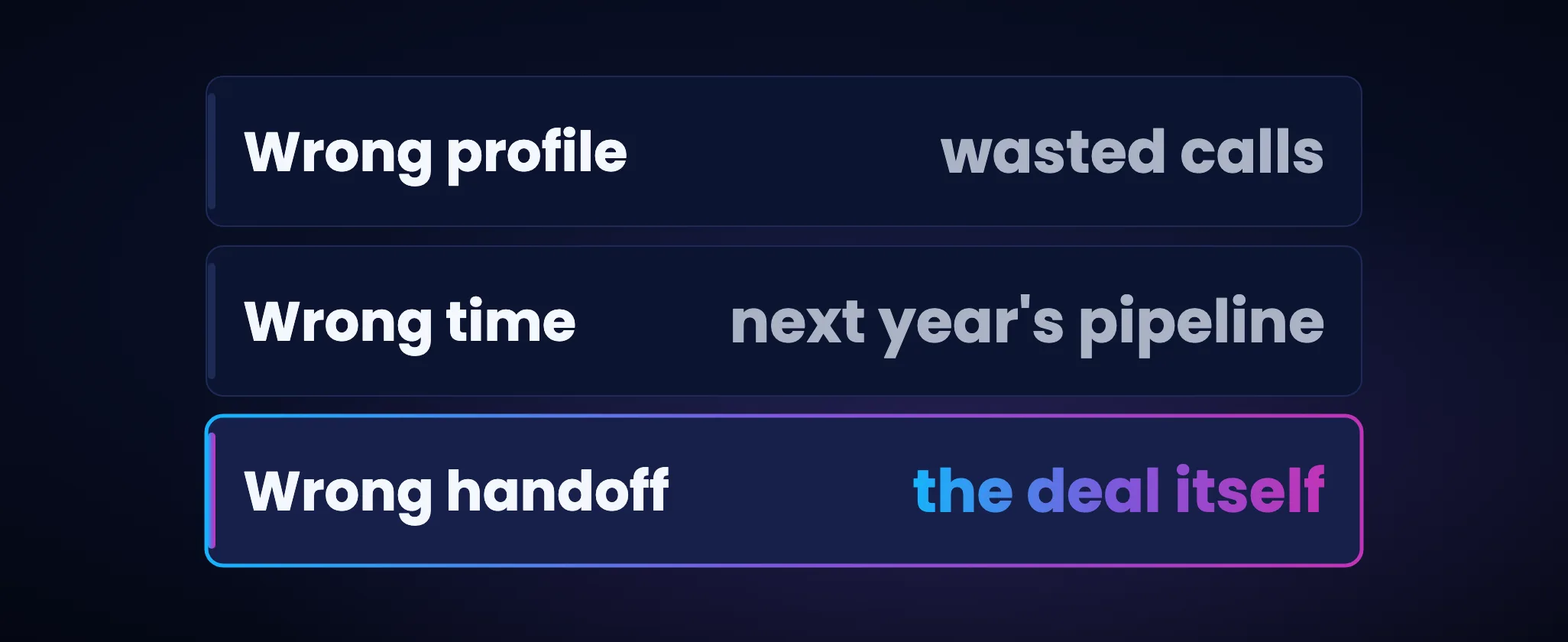
The first two are definition problems; you fix them in a document. The third is an execution problem, and I've watched it burn more pipeline than the other two combined.
Because teams keep buying faster legs when the race is decided in the exchange.
At the 2016 Olympics in Rio, Japan took silver in the men's 4x100 relay in 37.60 seconds, an Asian record, on a track crowded with faster individual sprinters. The United States crossed the line third and was disqualified: the baton touched Justin Gatlin's hand before it reached the exchange zone, where passing is illegal. One bad race is bad luck. Since 1988, the American men's squad, the deepest pool of sprint talent on earth, has been disqualified or failed to finish eleven times, against twelve medals, almost every one a botched handoff. Japan spent years drilling an underhand pass their sprinters could receive at full speed, blind, without breaking stride.
Your pipeline works the same way. Marketing sprints its leg: campaigns, content, signals. Sales sprints the anchor leg: calls, meetings, closes. And you keep buying faster legs, better ads on one side, better reps on the other, while the baton gets passed outside the zone, or dropped, or handed over three days late to someone who never saw it coming.
We call that window the exchange zone: the days between a buying signal arriving and the first human touch, where a lead is either received at full speed or dropped. You are coaching sprinters. The medal is in the exchange.
Faster than your routing rules assume.
Outreach pulled the numbers from its own platform data this year: five to seven touches to reach a contact for the first time, and opportunities with a live meeting close their cycles 32 days sooner. Every day the baton spends in the air, both numbers move against you.
Our own data says the same thing from the other direction. On a 13-month lead-magnet program for a visual-tech SaaS client, every ICP-matching signal triggered a documented next step across email, LinkedIn, and phone inside one to three days. More than 1,100 worked signals produced 110 booked meetings, at roughly €170 per meeting. The programs where the follow-up stayed templated produced signals of the same quality and almost no meetings. The full cost breakdown is in what a B2B buying signal costs.
Alex Hormozi tells a story I keep coming back to: he employed a person whose entire job was to call new leads the moment they arrived, and it worked wonders. There is no mystery in it. A hand raiser asking for pricing or a demo is the best lead in your building. Route them like a ticket queue and you are behaving like a nine-figure corporation, without the nine figures to absorb the waste.
One definition, one number, one sheet, reviewed every week by marketing, sales, and customer success together.
In 2021 I moved my own reporting line. I had spent three years reporting to the CEO as head of marketing; I switched to the Chief Revenue Officer, joined his revenue team, and asked him to mentor me on top of it. What changed was less the org chart than the furniture around it. One scorecard, with marketing, sales, and customer success metrics on the same sheet, first touch through retention and expansion. Weekly revenue meetings. Coordination that grew into camaraderie, because when a big win happened, everybody celebrated it. Morale compounds the same way pipeline does.
Where marketing should report has become the hot new debate again, and I hold my position lightly. The reporting line mattered less than the shared sheet and the standing meeting. A shared definition creates a shared number. The shared number creates a shared target. The shared target creates one pipeline, instead of two versions of it argued over quarterly.
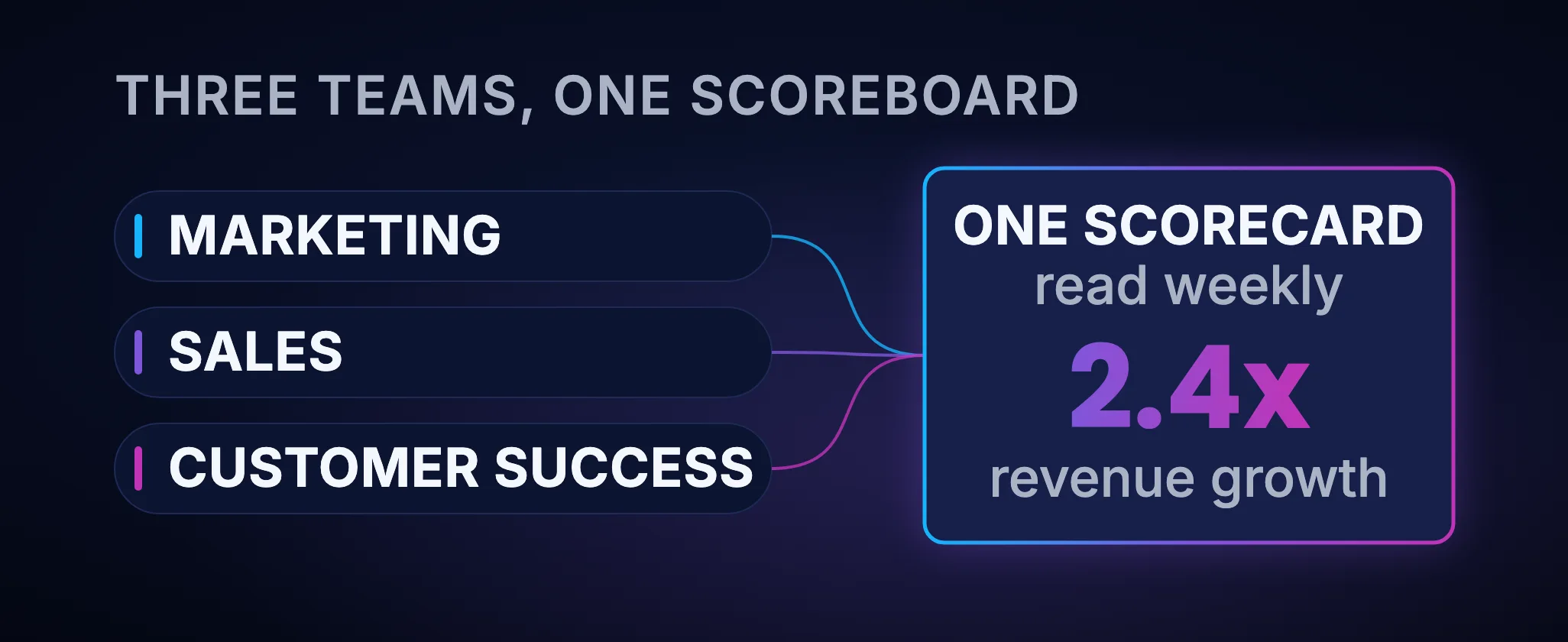
The prize is on record. Forrester measured what alignment is worth: 2.4 times higher revenue growth and twice the profitability growth for companies whose customer-facing functions pull in one direction. Gartner added the buyer's side this year: 74% of B2B buying teams show unhealthy conflict inside their own decision process, and the groups that reach consensus are 2.5 times likelier to call the deal a high-quality one.
Both findings say the same thing. Agreement wins. Inside your company, on what a qualified lead is. Inside the buyer's company, on what to buy. The vendor who makes the second agreement easier is usually the one who gets the deal.
Each side has to accept one thing that feels wrong.
For marketing: be omnipresent. I've argued this with marketers who want frequency caps on everything, worried about tiring the audience. Then our sellers came back from trade shows repeating the same line from prospects, that we seemed to be everywhere. LinkedIn, the feed, YouTube, ads. Psychology has a name for the mechanism, the mere exposure effect, documented by Robert Zajonc in the sixties: familiarity itself builds preference. Rotate the offer, refresh the creative, stay interesting, and never cap your way out of relevance, resonance, and exposure. The mechanics are in building a demand generation engine through thought leadership.
For sales: the handoff has to be an engineered system, and engineered is a word few sales leaders love hearing about their craft. When an account heats up, the response is multithreaded and multichannel by design: several people from your side, LinkedIn, email, phone, one-to-one ads on that single account, sequenced, timed, and increasingly orchestrated by AI agents. Maniacal focus on presence. Winging it is a choice, and it photographs well on a dashboard right up until the quarter misses.
Because buyers do more of the journey alone every year, and now they do it with AI.
Matt Dixon and Brent Adamson have been measuring the shrinking window longer than almost anyone. Back in 2012, CEB, the research firm behind their Challenger series, published the number the industry never forgot: the average B2B buyer was already 57% of the way through the purchase decision before contacting a supplier. In The Framemaking Sale, published with Karl Schmidt in 2025, Adamson reports that 75% of B2B buyers would rather buy a complex product without speaking to a sales rep at all, a preference rather than a behaviour, and that the buyers who do go it alone report 23% higher regret about what they bought.
Now put 2026 next to that. Semrush surveyed 622 US B2B professionals this spring and found 83% say AI influenced their final vendor decision; for one in three, the influence was major. The homework that took your buyer weeks in 2012 takes an afternoon with a chat window today.
Your prospect does the research alone, asks an AI to compare the vendors already on their list, and talks to a seller last, if at all. Whichever process reaches them first, and most usefully, will probably win that deal. There are fewer batons than there used to be, and the exchange zones keep getting shorter. You win the race to attention together, or you watch a competitor teach your buyer what to want. The reason outbound alone stopped working is the same reason, and we measured it in why outbound stopped working.
In one sitting, with both leaders in the room, and it fits on a single page.
If you want the fight to continue, the recipe takes four moves: count MQLs in a tool sales never opens, make sales requalify every lead from scratch on gut feel, keep the definition of qualified in everyone's head and in no document, and celebrate marketing's wins in one channel and sales's wins in another so no win ever belongs to both.
Aligning sales and marketing takes one page, written together:
Forrester found that companies replacing lead-level metrics with buying-group metrics saw meeting-to-closed-won conversion climb by half. The page is the practiced pass. It is what lets sales receive at full speed, blind, without breaking stride. If your last marketing test ended with a founder who could not point at what it built, the trust structure for the next one is in a B2B demand generation strategy for founders who distrust marketing.
Japan did not out-talent anyone in Rio. They out-drilled everyone, inside the twenty meters where the medal is decided. You will not lose the relay race if you care about the details, even the way you tie your laces.
Aligning marketing and sales means a shared definition of a qualified lead, a shared number both teams report, and a shared weekly review, so the two functions work one pipeline instead of arguing over two versions of it. In practice it fits on one page: the definition, who touches an account inside what window, which channels in what order, and one scorecard. Forrester found aligned customer-facing teams report 2.4 times higher revenue growth than unaligned ones.
An MQL is a contact marketing has scored as worth attention, usually because of a download, a webinar, or repeat visits. A sales-qualified lead is a person sales has confirmed has a problem, a budget, and a reason to talk now. The gap between the two is where most of the fight lives, since fewer than one percent of MQLs become closed deals according to Forrester. The fix is a written definition both teams sign, then applied contact by contact.
Minutes for a hand raiser who asked for pricing or a demo, and one to three days for a content signal, late enough that the asset got opened and early enough that the interest is still warm. Outreach's 2025 platform data shows it takes five to seven touches to reach a contact for the first time, and deals with a live meeting close 32 days sooner, so every day the handoff waits, both numbers move against you.
The reporting line matters less than the shared sheet and the standing meeting. Marketing that reports to the CEO but shares one scorecard and one weekly review with sales and customer success will out-perform marketing that reports to the CRO and works from its own dashboard. Pick the structure that gets all three functions reading the same numbers every week, then hold the meeting.
Because incentives beat process. A rep with a quota spends energy where meetings appear fastest, and a list of leads that historically went nowhere gets skipped. Research in the Journal of Marketing found reps never pursued 70% of marketing-generated leads. The cure is a definition of qualified that sales helped write, so the list they receive is one they trust, and a handoff window short enough that the lead is still warm when it arrives.