We hear this question on calls all the time. People and prompts also type it into Google, as shown in our Search Console results.
"I feel like our thought leadership function and our demand generation function are running completely separately, and I don't know how to connect them."
If you recognise yourself in this feeling and question, you're not alone. To connect thought leadership and demand generation, start by understanding the buying journey. You create demand with thought leadership when you help your market see a problem more clearly and what it costs, and lead people toward a way to solve it. Then agree with your sales team on who follows up on the moments that matter, such as a download, a webinar sign-up or a comment, and how fast.
I wrote this for marketing leaders and their teams, and for founders who still can't connect the dots of why all those efforts don't produce meaningful revenue.
Key takeaways
Some of you may recognise this. Your posts get comments and reactions, and a few months later you realise none of it led to a sales call or a deal.
In Forrester's 2024 Buyers' Journey Survey, the average purchase decision involved 13 people, and Edelman and LinkedIn found that 71% of the hidden buyers in a deal, the people who weigh in without meeting sales, have little to no contact with sales reps. For most of the people who make purchase decisions, your content is the only conversation they have with your company. If your follow-up system doesn't work, you lose them without ever knowing they were there.
A signal is anything a person does that shows interest in (1) your thinking or (2) what you sell. First-party signals are the ones you see on your own channels, such as sign-ups, downloads, comments and visits to your pricing page.
I'm still surprised how often I see that interest fade away in the handoff between marketing and sales. In 2024, Gartner found the two teams work together on only 3 of 15 commercial activities. The interest dies because these teams have no shared definitions and no rules of engagement. Marketing should qualify the signals, and sales should act on them according to their quality. That's a topic for another day, but the solution starts there.
When someone does follow up, you can see the difference. A few weeks ago, I wrote a LinkedIn post about a free library of AI skills for go-to-market (GTM) work that Swan AI put together with Pavilion. I kept 8 of the skills and credited each creator by tagging them. LinkedIn showed the post more than 45,000 times, and about 230 people saved it within two weeks. Six of the people who engaged with it ended up on calls with me. One of them, a growth leader at a consultancy, commented and asked for one of our articles. I sent it to her by DM, she downloaded our guide, and four days after her comment she booked a call herself. The others started with a connection request or a reply to a message I'd sent, and I followed up with each of them myself.
The people behind those signals need different things, so marketing and sales have to agree on rules of engagement and routing: who follows up on each signal, when and how (what's the message).
This article breaks down the connection between thought leadership and demand generation, including how long it takes, what an AI agent can do and how your team can integrate them.
Demand generation is the umbrella term for the full-funnel growth engine that creates, captures and converts demand into pipeline and revenue. I use the term the way many practitioners do, including Evan Hughes at Refine Labs, while some teams mean the same thing when they say "demand gen" and "demand creation". Our explainer on lead generation and demand generation covers how we see the two differ.
Some marketers argue that brands can't create demand, and that only the market or the category can, a debate Marketing Week covered in 2024. The way I see it, while it's true that your market creates the demand, your thought leadership can shape it and influence what people look for.
Thought leadership is original thinking you share with your market: a strong point of view built on your experience, your proprietary data and know-how. We cover this topic in more depth in why your thought leadership is not producing pipeline as well. The name has two words that carry meaning. You have a thought, and you lead people somewhere with it. You share your original thinking, your advice and your expertise, and you light the path toward answers to the problems your market thinks about.
Thought leadership also helps you capture demand. I've seen it work best when you help people solve a problem they already know they have, even when the answer is someone else's product. Give the companies you want to sell to enough value, and they'll come back to you when it's time to buy. That's why I call thought leadership the best SDR you'll never hire.
Peter Drucker set the bar for this work over fifty years ago.
"There will always, one can assume, be need for some selling. But the aim of marketing is to make selling superfluous."
- Peter Drucker, Management: Tasks, Responsibilities, Practices
When you do this well, you get close to Drucker's aim. You get shorter sales conversations, more precise and more concrete, but someone on your team still has to start them.
Yes, and the main reason is how well your commercial teams are integrated. We often see each team take care of only its own stage of the buying journey, and that happens when the definitions and the handoff between marketing and sales aren't clear. The best teams we've worked with share one scorecard gravitating towards sourced pipeline. Many teams that struggle report on separate numbers.
Marketing and sales have fought over this for at least twenty years. In 2006, Philip Kotler wrote about the war between them in Harvard Business Review.
"When sales are disappointing, Marketing blames the sales force for its poor execution of an otherwise brilliant rollout plan."
- Philip Kotler, Neil Rackham and Suj Krishnaswamy, Harvard Business Review
While both teams argue over whose job the follow-up is, the people who showed interest are still waiting. I label this wait the handoff gap: the time between someone showing interest in your thinking and a person on your team following up.
Once you see the handoff gap, you'll spot it in every pipeline review from now on.
When I led marketing in-house four or five years ago, we left plenty of that interest waiting. A like or a comment on a company post counted as good engagement for the account, and we moved on. We never questioned or tracked the buying stages per account, and that changes a lot, including how you follow up.
Today we log every reaction from a target account in the CRM, next to its buying stage.
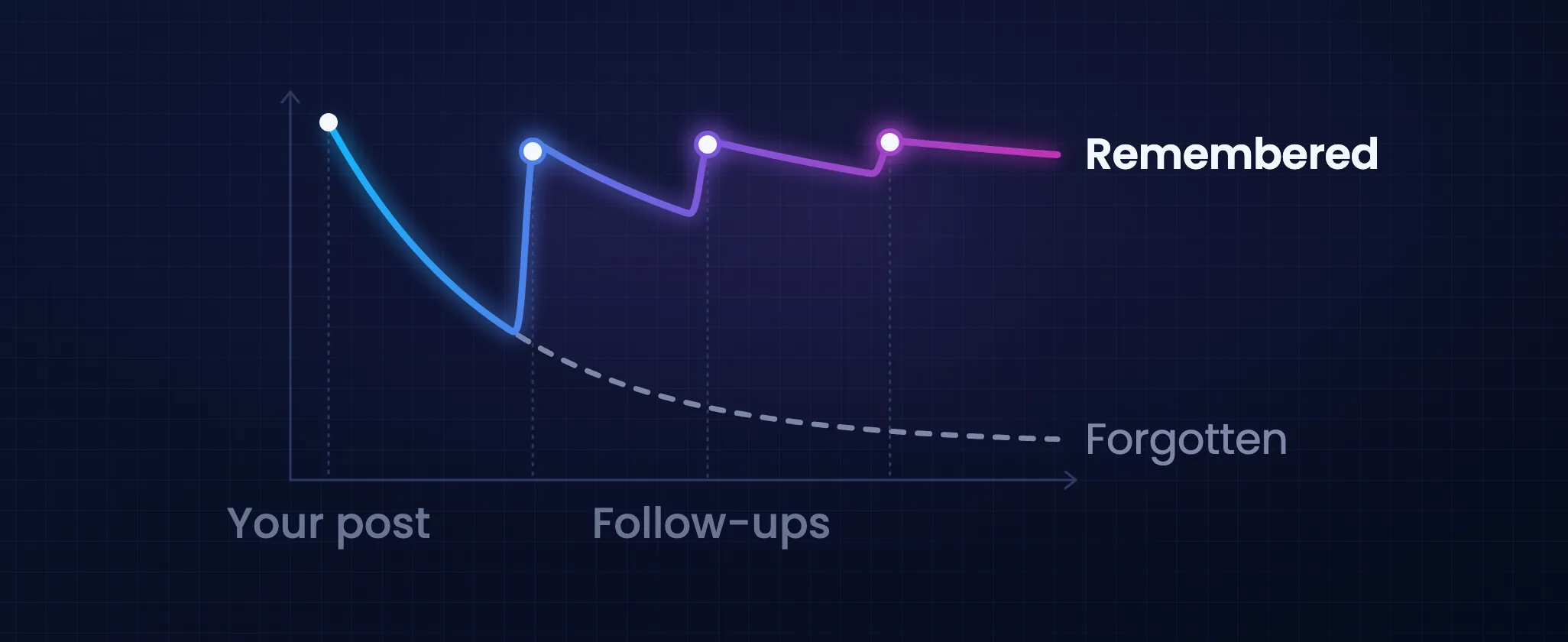
Psychologists have studied forgetting since Hermann Ebbinghaus tested his own memory in 1885. In 2024, Gabriel Radvansky and his colleagues at the University of Notre Dame pulled together 256 papers and 916 data sets on how people forget, from nonsense syllables to novels. People forget something they saw once quickly and steeply. They remember meaningful material they meet again for much longer, and sometimes their memory holds steady or even improves. Your prospects aren't memorising word lists, but I see the same pattern after every post. Someone who comments today remembers you clearly this week, and if you don't reach out and don't remind them through your content and messaging, they may forget you before they're ready to buy.
Every useful follow-up is a second encounter, and second encounters are what people remember.
Thought leadership creates demand among the people who are considering a purchase without meeting your sales team, and it makes them more likely to shortlist your solution and later buy from you. Edelman and LinkedIn call these people hidden buyers in their 2025 thought leadership report. We cover the wider effect in how thought leadership impacts B2B demand generation.
You can earn that on purpose. My GTM skills post used five of Robert Cialdini's seven principles of persuasion, one of the most useful frameworks I know for this:
Good content makes people open to hearing from you, and your job is to follow up.
Thought leadership is a long-term play. In some markets you'll work on it for months, sometimes years, before your ideas earn a place in people's minds and hearts. I think of it as two main things. You earn mind share by showing up everywhere your market spends time, again and again, and that takes distribution: a good growth marketer and a smart paid strategy behind your best ideas. You earn heart share more slowly, when your thinking helps people do their jobs better, and that's what you build with thought leadership. Les Binet and Peter Field found a similar split in their research for LinkedIn's B2B Institute: emotional messaging works better over the long term, and rational messaging works better in the short term.
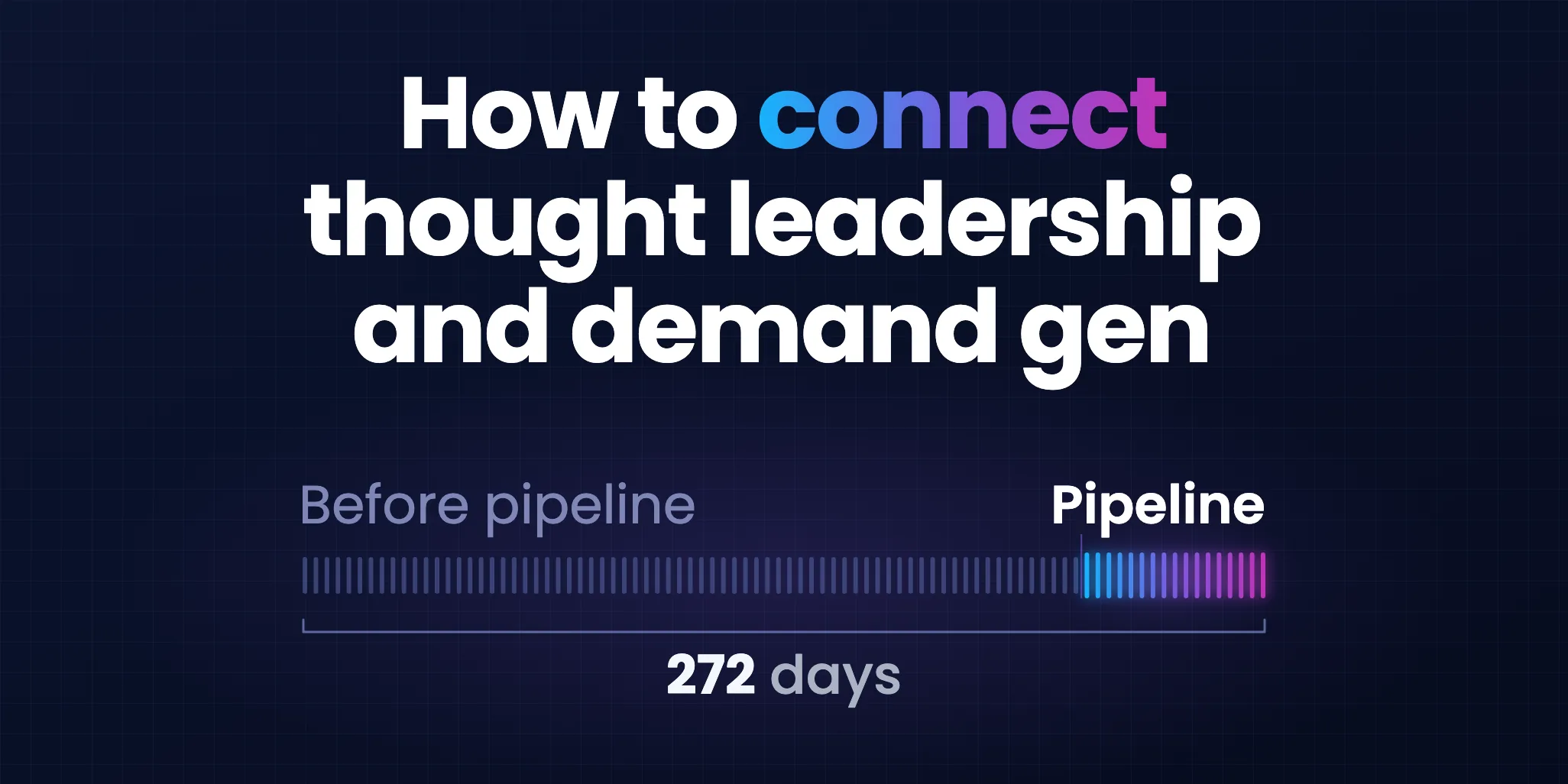
The numbers show how long the road is. Dreamdata's 2026 benchmarks, built on 3.5 million B2B customer journeys, counted 88 touchpoints and 10 stakeholders in an average deal. The journey took 272 days from the first marketing touch to closed revenue, and 81% of it happened before the sales pipeline began.
So publish for the long term, distribute your best ideas for reach and follow up on every signal along the way.
Publishing consistently is hard when your experts don't have time to write. That's why we built Studio, a content brain that learns your point of view, proof and voice. It drafts your LinkedIn posts from a few short answers, and you approve or edit the content before it goes out, which kicks off its learning loop. Places open in small cohorts, so join the waitlist if you want one.
There are four steps to connecting thought leadership and demand generation, and together they make sure people meet you a second time while they still remember you. You map the buying journey, detect the signals, score them and route them to a person, or add them to nurture.
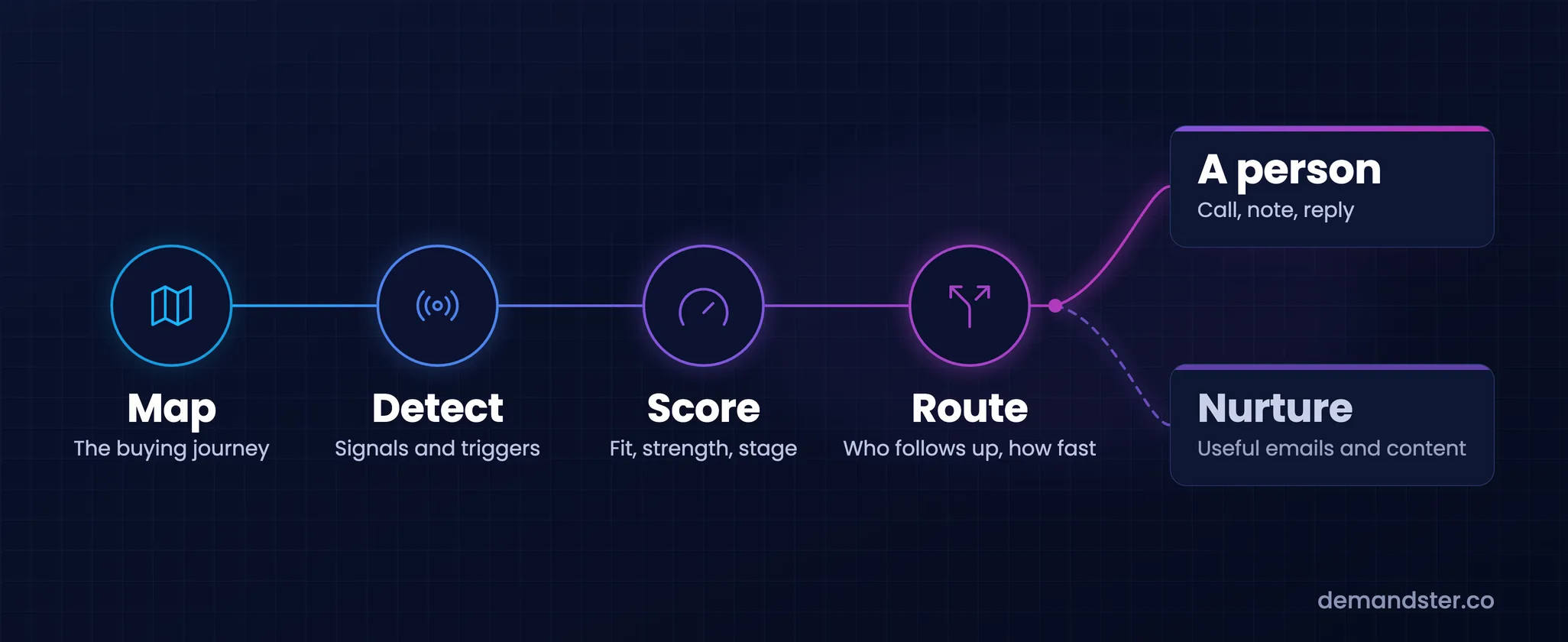
When you sell to a narrow total addressable market (a case for account-based marketing), route the signals to the sales development rep (SDR) or account executive (AE) who owns that account, with specific rules of engagement. We cover how to split that work in how to build a B2B demand generation engine.
A signal you don't work isn't pipeline, it's just a contact list.
Follow up as fast as the signal calls for. When someone asks for a demo, you call them within minutes. For content downloads, it's 24 to 72 hours, and you answer a newsletter reply or a question from a webinar sign-up the same day. Wait too long after a demo request, and you hurt the overall purchase experience and the chance to win a customer.
"Buyers are choosing a preliminary winner much earlier than they have in the past."
- Kerry Cunningham, head of research at 6sense
Sadly, people who ask for a demo rarely get a call within minutes. In 2011, three researchers audited 2,241 US companies for Harvard Business Review. Only 37% replied to a test web lead within an hour, and 23% never replied at all.
After a download, send a short email first and call afterwards, because a prospect with familiarity (from the inbox) reacts better when you call.
Reach people within days, while your post is still on their mind. These times work for us, so adjust them to your team.
If you don’t have an SDR, the founder or whoever the content is attributed to is the owner and handles newsletter replies, comments and downloads. When a target account keeps coming back to your site, find the right person there and send them something useful. When someone signs up for your webinar, send the recording and a question about their situation.
Today, AI agents can qualify inbound leads, research accounts, score sales calls, draft follow-ups and handle signal detection and monitoring, then route each signal to the right person. Keep a human in the loop on every key touchpoint with your prospect.
People spot an AI-generated message from a mile away, and they may remember who sent it. In a 2026 Gartner survey, 69% of B2B customers said they turn to sales reps to validate what AI tells them.
Spend the hours saved by the use of AI agents on research and intelligence for your top accounts: who to contact, what to say and when. Here's how to hand work to AI one stage at a time.
With thought leadership content, you create demand, because you give your market a new way to see a problem. With demand capture content, which many teams call demand gen content, you help people who are already looking choose you.
You also measure these differently. Demand capture content gets the credit when someone fills in a form. Thought leadership rarely gets that last click, so count every meeting and deal where the person read, watched or commented on your content before they first spoke to sales.
People who engage with thought leadership are still learning, so you give it a different call to action (CTA). You point them to the next thing worth their time, such as a guide, a webinar or your next post.
Teams that turn thought leadership into pipeline treat every piece of content as the start of a buying journey, and they build a nurture and follow-up system behind it.
Let me give you an example from a B2B tech client of ours. Over about a year, their team promoted free guides with paid ads and booked 110 meetings from more than 1,100 signals. They qualified every download, and someone on the team contacted each prospect who fit the ICP within one to three days, by email, LinkedIn and phone.
More than 441 people have downloaded our Random Acts of Marketing guide so far. The sales conversations on record started when a download met a second touch, such as one of our posts or our newsletter.
If you lead marketing, here are three moves for this week, so the people who engage with your content hear from you before they forget you: agree on routing rules with your head of sales, map one buying journey and choose how you'll educate your market.
Start by checking how your marketing works today. Ask yourself three questions:
If any answer worries you, take our free Random Acts of Marketing Scorecard.
Measure influenced pipeline: the meetings and deals where prospects engaged with your content before the first sales touch. When Refine Labs compared 620 conversions in their own funnel, software credited web search with 78% of them, while customers gave 85% of their own mentions to podcasts, communities and word of mouth. Ask every new prospect how they found you, and log the answer in your CRM.
Earning mind share and heart share in your market takes months, and in some markets years, so treat thought leadership as a long-term play. In my experience, you book your first meetings from content within a month or two of publishing, if your team follows up within days. Review your routing rules after a few weeks, and keep publishing every week.
Give each signal type one owner, agreed with your sales team. The author owns comments and newsletter replies, marketing follows up on downloads within 72 hours, and the account owner follows up on repeat visits. Without a sales development rep, the founder or author covers comments, replies and downloads. Put signals, owners and response times on one page that both teams sign.
Thought leadership is a strong, original point of view you share with your market, built on your experience, data and know-how. You use it to help prospects see a problem and what it costs, and to lead them toward a way to solve it before they start shopping. Start with one idea your best customers would quote back to you.