"Your advantage comes from teaching AI more about you."
- Kieran Flanagan, The Creative Context OS
To turn founder expertise into thought leadership with AI, give the model what it can't guess: a content brain. Its company layer holds your ICP, positioning and narrative, its profile layer holds your core ideas, proof and voice, and its taste layer shows what good looks like to you. AI drafts from it, and an editor keeps the ideas yours.
- AI writes fluently about anything and has no idea what you think, so without your context it returns the average version of your idea.
You ask your favourite AI to create a LinkedIn post for you, and it gives you something grammatically correct and fine. The structure looks okay, but you'd never post it, because it doesn't sound like words you would have typed into your keyboard.
The amount of AI slop out there is becoming unbearable, and readers notice it and feel it. Some people even have a name for this style: Claudish, with GPTese as its ChatGPT cousin.
If you create organic or thought leadership content, one of these probably sounds familiar.
1. You know exactly what you want to say, and you never find the time to put it into words. The ideas pile up in your notes and voice notes, and the posts never go out.
2. Your leadership team agreed to post more. They believed in the plan, but they didn't have time to post consistently, and it stopped after a few weeks.
3. You post a lot, and the activity looks great on paper. Then you check the KPIs that matter, and there's no meaningful progress.
I've felt all of this myself. I've rejected more AI drafts than I can count. Even with our positioning, our voice rules and our skills loaded into Claude, very few drafts are worth publishing without edits. The rest don't sound as good as a strong copywriter's work, or as good as my own. We realised an editor, and often a copywriter, are needed in the mix in the mix, and that's still the final step in our workflow today.
That frustration is a big reason we built our own productised service and content engine. Today it hands us more ideas and inspiration for content than we have time to publish.
What we've learned is how to bridge that gap with the right setup and process. You can close most of the distance between a poor first AI-assisted draft and one that reads like strong work. In the spirit of the argument, our brain drafted this article from my answers to an interview. It still took six rounds of my voice notes before I was happy with it, and I want you to see that number.
Founders feel this pain more than anyone. They want to be the thought leader, the voice and the authority in their category. But very often they don't have the time, the know-how or the capacity. That was the main reason we built our own workflows and an AI brain, besides our frustration with the poor quality of content we see everywhere.
If you're the marketer who has to make your founder's voice show up every week, this system is for you too.
Before you read on, think of three things you believe about your market that a competitor would argue with. Keep them in mind, because we'll come back to them at the end.
AI can write fluent, grammatically correct text about anything, and it has no idea what you think.
Give any model a topic without context, and it goes for its own safe version of that topic. That version is safe but not useful. It won't give you a strong hook on its own. Good hooks come from years of experience in marketing, from studying psychology, and from using it in ads, emails, newsletters and content. They come from studying the top creators who have built large audiences, and from knowing which words make your buyer stop scrolling.
What the model is missing is you. It’s your beliefs, your expertise, your exact situation and what you've lived through, who you're talking to and what bores them.
Without your context, AI does what people did in a Cambridge experiment almost a century ago: it turns the unfamiliar into the familiar.
In 1932, the psychologist Frederic Bartlett gave students a Native American folk tale called The War of the Ghosts and asked them to pass it on from memory, from one person to the next. Each new version drifted toward what the students already knew. Canoes became boats along the way. A strange line about something black coming out of a dying man's mouth turned into his last breath. The story grew shorter, and the odd details, the ones that made it worth telling, disappeared first.
Bartlett's explanation was that we fill the gaps in what we hear with templates of what we already know. He called those templates schemas.
A model works the same way. Its template is the average of everything it was trained on, so your most distinctive idea comes back in a familiar shape, Claudish or GPTese, with every "canoe" turned into a "boat".
The same drift happens inside your company. An idea from the founder passes to marketing, then to sales, and each version loses a detail that mattered. A content brain gives everyone on your team, your marketers, your sellers and your AI agents, your schema to work from.
A content brain is the set of files that gives AI your template instead of its own, built in three layers: the company, the profile and taste.
People tend to start with their voice and skip everything else, so their AI copies how they sound without saying anything they think.
Break down your ideal customer profile. Who do you want to reach, and who are you happy to ignore? What are the fears and pains of the people who matter? In B2B that means the whole buying committee, and in B2C it means your main buyer. A full ICP goes further, into company size and stack, the roles in the committee with their KPIs and decision criteria, and the trigger events that signal a company is ready to buy.
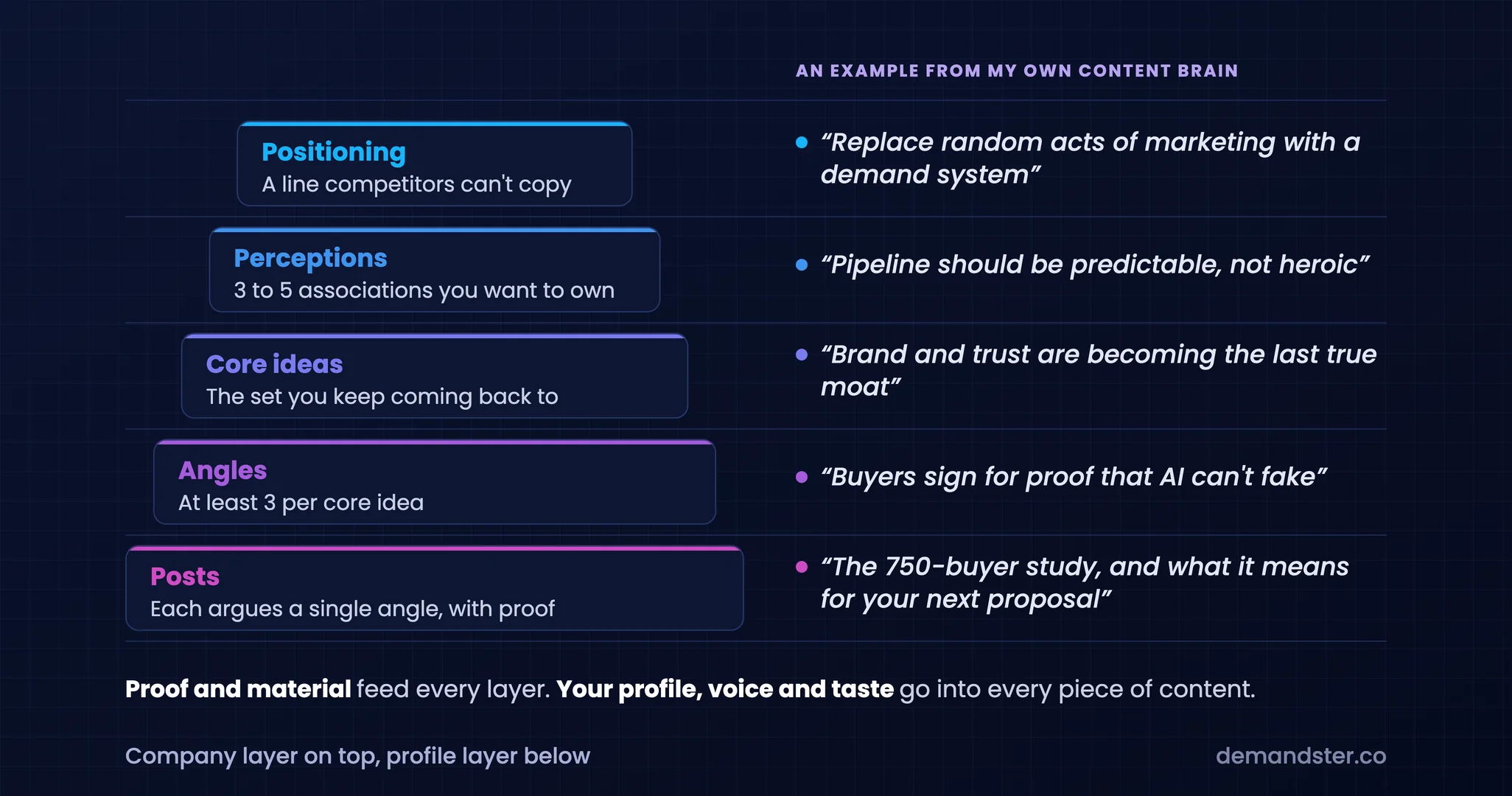
Then define your positioning in a single sentence. Say what you are, for whom and why you're different, in words a competitor couldn't put on their own homepage. If you want to go deeper, April Dunford, Anthony Pierri and Emily Kramer are the positioning thinkers I learn from most.
Then think about your strategic narrative and the perceptions you want to own. These are the associations you want buyers to have with you after six months to a year of consuming your content.
These strategic assets and this foundational work keep your content tied to revenue, and they’re the missing piece when thought leadership isn't producing pipeline. I learned what happens without it the hard way. For more than a year we worked with a visual commerce startup, and the calendar kept filling with meetings and revenue pipeline. The problem was that only a handful turned into customers, because there was no product-market fit in the market we were attacking, and nothing in our loop caught it early enough. Every thought leadership piece and every content release was well made. We kept telling a good story to what was probably the wrong market. It cost us focus and attention, and today time is the most expensive resource any of us has.
The company layer also shapes the writing itself: which awareness stage a reader is at, from unaware of the problem to ready to buy, where a piece belongs in your content pyramid, and which format carries it, such as a success story, a framework or a playbook.
Collect your core ideas into an album. Dan Koe calls it your album of greatest hits: a small set of ideas you keep coming back to, each time with a new frame. Richard Feynman kept a version of his own. According to Gian-Carlo Rota, he held a dozen favourite problems in mind and tested every new trick he heard against them.
Let me give you a sneak peek into mine. I've collected twelve core ideas over years of arguing with founders and marketing leaders, and they come back in a lot of what I publish. Here are six of them:
I expect the strongest pushback on the second and third. Pushback is a good sign, because an idea everyone agrees with can't set you apart.
Support each core idea with several angles. Koe makes the point in the same letter: good articulation comes from a small set of ideas you've already refined, far more than from improvising on the spot. Each core idea can carry many angles, and each post takes a single angle and argues it. This article takes an angle on my third idea.
Back most of your content with proof. You don't need a number in every post, though the majority should carry a source or a story you lived. Proof gives your content credibility. It's what makes people stop scrolling and keep reading, and it's the first thing AI invents when you leave it out.
Feed your material library every week. Voice notes, call transcripts, interview answers, notes from a client meeting and links you saved are the raw material your angles and proof come from. In our engine, the material library is where all of it goes, and it keeps the brain from repeating itself.
Build your voice from what you've already said. A voice described as conversational but insightful fits thousands of LinkedIn profiles, so adjectives teach the model very little. Pick five to ten pieces you'd be happy to see repeated, and ask the AI to pull out how you open, how you argue and how you close. That becomes your voice profile, and it keeps improving as the system learns from your edits.
Paul Graham argued in Taste for Makers that good taste can be learned, because some work is better than other work, and you can train your eye to see the difference. AI has made ability cheap, which leaves taste as the scarce skill.
Kieran Flanagan keeps taste in its own file, with the reason behind each example. These are some of the people who shaped my thinking, and they go into my taste file (among others) as the work I keep coming back to:
They're plain text files in a single folder, and your AI reads them before it drafts any content.
Kieran's lean version uses three files: creator, audience and taste. Our workspace holds a lot of files, because a post that sounds like you still has to move a buyer. Here's a simplified map of what we use:
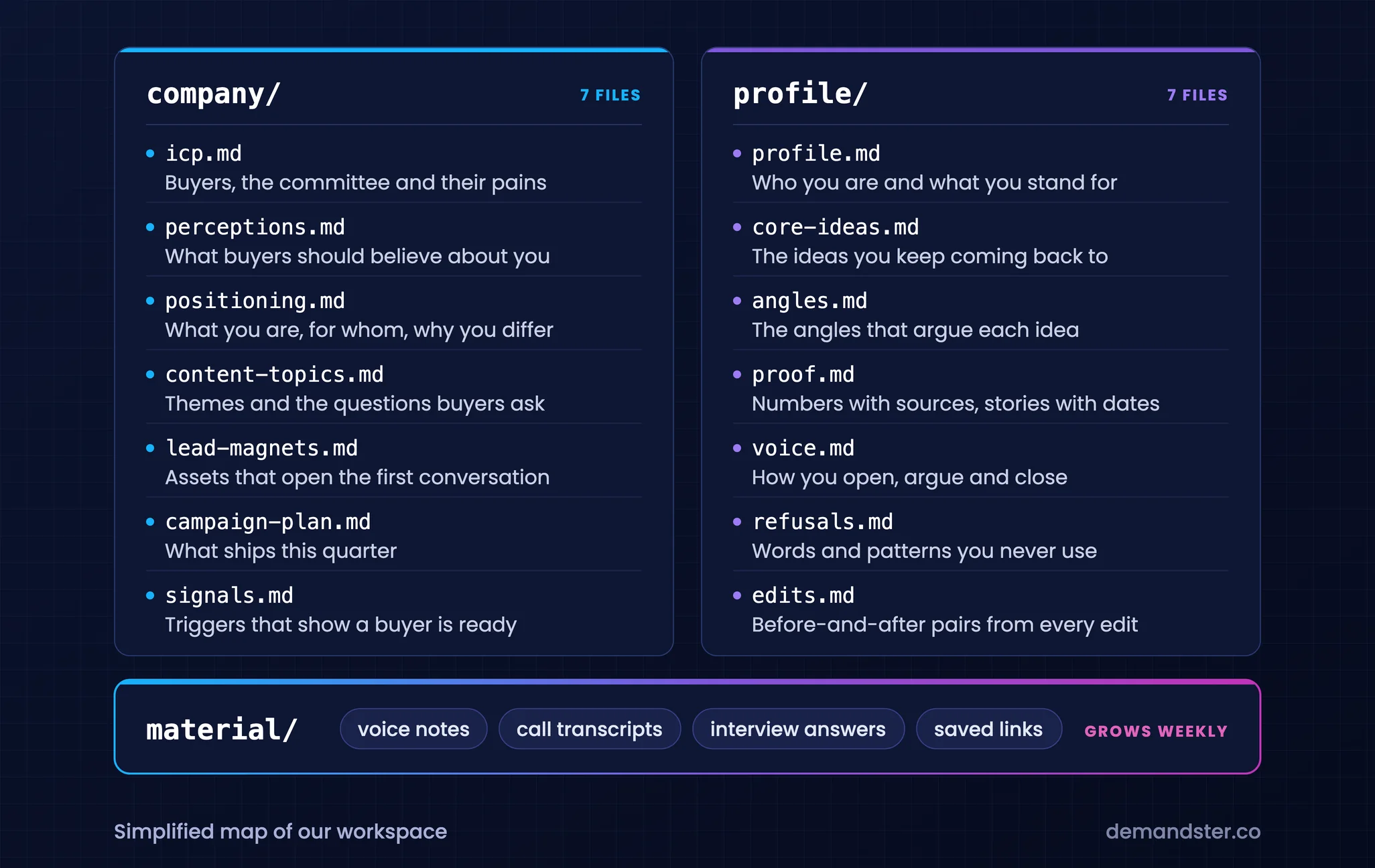
Here's what a single entry in our core-ideas file looks like, using my third idea:
- Why I believe it: AI made speed free for every vendor, so buyers choose who they trust.
Treat every edit as data. When you change a sentence, save the before and after in an edits file, because that file is how the system learns you.
Keep the editor in the loop, because someone has to check which details survived.
If you're the founder who wants your team visible, make it safe and lower the cost of their first post until saying no feels harder than saying yes.
Your leaders and sellers usually have plenty of ideas. They stop creating content because a post takes time and a lot of work before it feels right. Some don't want the public exposure, and some start because they feel pressure to, then see the benefits. It's that first and second step that pushes them over the line.
A shared brain removes the bulk of that friction and makes executive thought leadership a team habit. You or your marketing team build the company layer once, so everyone works from the same story. Each leader and seller then adds their own core ideas, proof and material on top, and their first drafts arrive ready for a light edit.
A founder we work with started posting once the brain took the blank page off his desk.
Final note here: don't chase vanity numbers while people learn. I've seen a post with ten reactions from the right people book a meeting that a hundred likes from the wrong ones never would.
The biggest risk is slop, and slop is what costs you trust. A post that sounds like everyone else's tells your buyers you outsourced your thinking along with the typing. With a brain behind you and an editor in the loop, your readers meet your beliefs and your proof, and AI only does the assembly.
The second risk is invented proof. A model fills every gap you leave, so a missing number or story comes back made up. Keep a proof bank with sources and dated stories, and give the model nothing else to cite.
Founders also tell me they don't have time to build all of this. You build it in stages, and the first version is a page or a file per layer.
Attention stays fixed while the supply of content has no ceiling.
Daniel Priestley says there's a closing window for building a personal brand that cuts through. On The Diary of a CEO he compared it to fog at an airport: the planes already in the air keep flying, and the ones still on the ground stay there.
Steven Bartlett, a different Bartlett from the Cambridge one, offered a fair counterpoint on the same show: the gap between his best and worst posts keeps growing, so the algorithms reward today's best piece more than yesterday's follower count. I'm not mad at the algorithms, and my answer is more high-quality content. Exactly because there's so much content, the market will reward the people who know what is valuable in their world.
With a brain like this behind you, you keep producing content that's true to your style and beliefs, and relevant to the people you're trying to reach.
Go back to the beliefs you thought about at the start.
If each one maps to a core idea with angles and proof underneath, you have the start of a content brain, and AI can work from it. If you struggled to name three, that's your first job, and no model can do it for you.
If you want to go further, apply for the founding cohort on the waitlist. When your place opens, you'll work with the same engine that drafted this article, and we'll hand-pick the founders we onboard first. Every other Friday I also share the systems behind this work in my newsletter, End the Heroics.
Any of the three works when it starts from a content brain, and none of them works without one. A ghostwriter needs regular interviews to learn what you think, an AI tool on its own returns the average version of your ideas, and an agency needs your positioning and proof to say something only you could say. Build the company, profile and taste layers first, then choose the option that fits your time and budget, and keep an editor who knows your beliefs as the final step.
The first version takes a page or a file per layer: your ICP and positioning, your core ideas with their proof, and a short list of the work that shaped your taste. You build the rest in stages, adding angles, proof and voice rules every week from your voice notes, call transcripts and edits. The brain improves fastest when you log every edit as a before-and-after pair.
Founders keep a consistent presence by capturing material instead of writing from a blank page. Record voice notes and save call notes and links each week into a material library, let AI draft posts from that material and the content brain, and spend your time on a light edit. A shared company layer lets leaders and sellers post the same way, so the founder isn't the only voice.
AI can come close to your voice when you build a voice profile from five to ten pieces you'd be happy to see repeated, instead of describing your style with adjectives. Ask the model to pull out how you open, how you argue and how you close, then log every edit you make as a before-and-after pair so it learns from you. Voice alone isn't enough, so add your core ideas and proof, or the AI will sound like you without saying anything you think.