"When trust goes down, speed will also go down and cost will go up."
- Stephen M. R. Covey, The Speed of Trust
To build trust with B2B buyers, compete on what AI can't compress. Buyers sign for proof you'll deliver, relief from past failures and a choice they can defend to their boss. Back your claims with signals that cost something to fake, be useful every week before you ask, and point AI at the work buyers never see.
A few weeks ago I finished a discovery call with the VP of Marketing at a UK data company. I moved on to other work, and in less than an hour Claude had:
Two years ago that would have been a lot of work for our team. This time it took only a few voice prompts, and I didn't open a single dashboard.
Afterwards I went back to my notes. She took the meeting because our email reached her the day after her team posted a job ad, and it spoke to exactly what the ad described. She told me that if we had written two weeks later, she might not have replied.
The VP didn't buy on that call either. She asked for another meeting to talk about how we could help. AI made my work faster, but it didn't change how quickly she could decide.
Your team probably became faster this year as well. Your buyers didn't, and that gap is where B2B deals now fall through.
Before you read on, pick the last deal you lost to no decision and keep it in mind. By the end of this article you'll know what your buyers need to trust you before they sign, which of those needs AI can't speed up, and what to do about it this month.
B2B buyers pay for a result and for believing they'll reach it. In $100M Offers, Alex Hormozi gave us one of the best formulas for an offer, with four variables at its core.
Value = (Dream outcome × Perceived likelihood of achievement) / (Time delay × Effort and sacrifice)
Every extra week and every hour the offer asks of their team lowers the value. That holds for a gym membership and for a six-figure software contract.
In B2B I'd add two more variables, because I've seen each of them close deals or help them over the line.
The first variable is relief. Some buyers don't sign for a dream. They become your customers because the fire finally stops. They've been burned by separate tools, agencies and teams, and they want the problem gone more than they want the upside.
The second is safety, which is what status looks like in B2B. LinkedIn's B2B Institute asked 750 senior buyers what makes a vendor easy to choose (June 2025). Being able to defend the decision ranked slightly above confidence that the product works. Your buyer has a boss, a board and a career. The person who picks you bets their reputation on you.
That gives the six-variable value equation I use with clients: value rises with dream outcome, perceived likelihood, relief and safety, and it falls with time delay and effort. It's the first thing to check when a deal stalls.
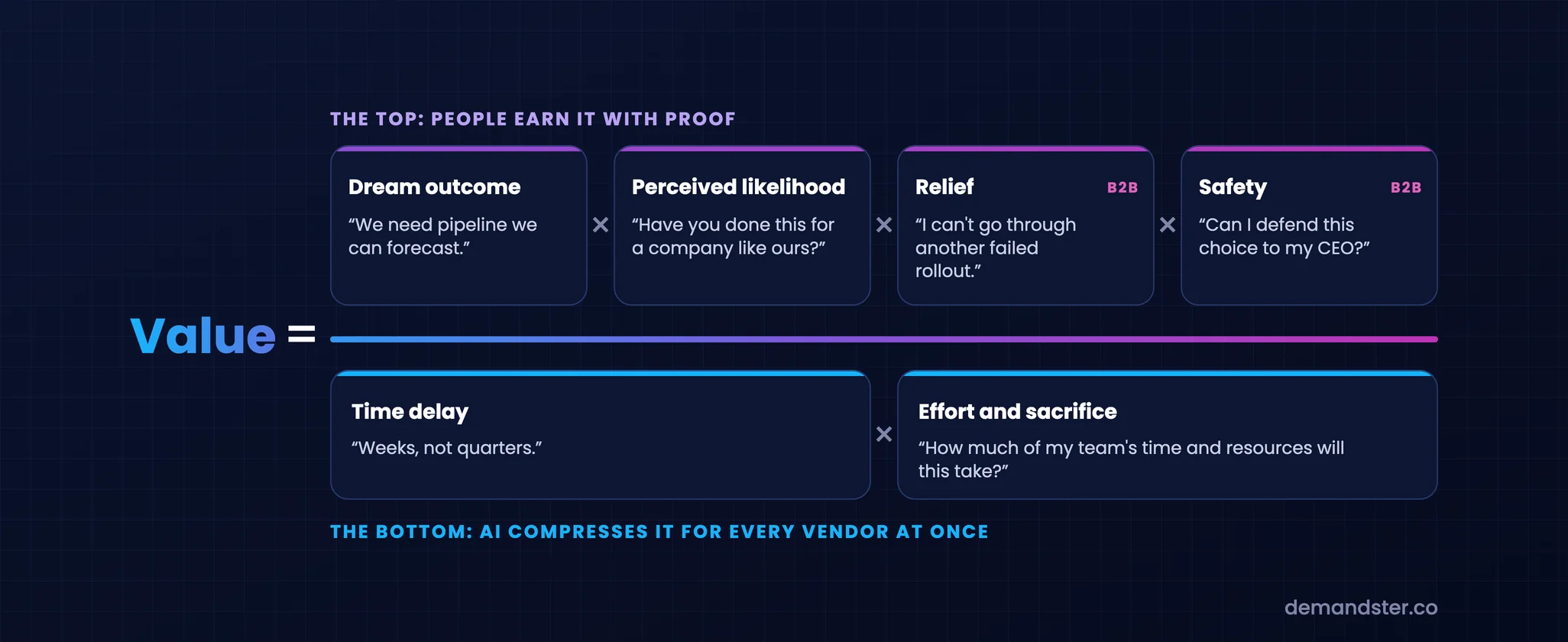
AI speeds up the bottom of the equation, which is time delay and effort. It reduces the time and cuts the effort, which is what every AI demo shows you: faster research, faster drafts, faster follow-up and fewer people.
The top of the equation is where AI struggles. It can help you describe a dream outcome, but it can't make your buyer believe you'll deliver it. Belief is built from proof, and proof takes time to exist.
The bottom of the equation is becoming a commodity. The top is where you compete now.
Trust is harder to earn because AI made speed and polish cheap for every vendor at once. Open any vendor's homepage and you'll read some version of weeks, not quarters. When every vendor makes that promise, buyers stop counting it.
Signalling theory shows why that promise stops counting. In 1973, the economist Michael Spence showed that a signal only persuades when it's costly to fake. A degree tells an employer something because a weak candidate can't easily earn one. London has a version you can hail. A black-cab driver spends three to four years learning the Knowledge, around 25,000 streets and thousands of landmarks, tested in person. Many passengers trust the driver without checking a map, because that much work can't be faked.
Clean copy, a smart deck, a personalised first line and a fast reply now cost almost nothing to produce, so they no longer prove anything. Four recent buyer studies, each produced by a vendor or platform, show that buyers have noticed.
You might say your AI outreach still earns replies. Some of it does, for a while. When I rank the channels we use from S tier down to F tier, automated outreach still ranks last. Templated sends with fake personalisation are the cheapest signal there is, and they train buyers to ignore your whole category. Buyers can tell from the copy, and they can tell from the approach. It's one reason cold outreach reply rates keep falling.
When a B2B deal ends in no decision, the buyer's fear of getting it wrong is usually the cause. Covey's line comes from a book about organisations, not sales, and it still describes how most pipeline reviews go. Low trust works like a tax. The buyer adds a stakeholder, asks for another reference and requests another pilot. High trust works like a dividend: the same deal moves with fewer steps.
Psychology explains why that tax is so high. In their 1992 work on prospect theory, Amos Tversky and Daniel Kahneman found that people in their experiment weighed losses about 2.25 times as much as equal gains. For your buyer, the pain of a failed rollout outweighs the upside of a good one by roughly two to one. I think that's why defending the decision ranked above confidence in the product in the LinkedIn research.
Matthew Dixon and Ted McKenna measured the result in The JOLT Effect. Across 2.5 million recorded sales conversations, 40 to 60% of lost deals ended in no decision, with no vendor chosen at all. The authors trace much of that to the buyer's fear of getting it wrong, more than to a preference for the status quo. LinkedIn puts a number on the same fear from the buying group's side: 40% of deals stall because the group can't agree.
David Maister gave trust a formula in The Trusted Advisor (2000), with Charles Green and Robert Galford:
Trust = (Credibility + Reliability + Intimacy) / Self-orientation
Credibility means your words are believable. Reliability means you do what you said. Intimacy means the buyer feels safe telling you the truth about their problem. The bottom of the formula is self-orientation: how much you seem to care about your quota, your demo and your pitch. The higher it climbs, the less the buyer tends to trust the rest.
AI can raise your output, and it can also inflate your self-orientation. When you send a thousand messages about yourself, buyers hear a thousand pitches.
The buyers most ready to trust you have been burned once or twice in your category. That's my own hypothesis from the deals I've watched, and I'd bet on it.
Imagine a curve that tracks how many times a buyer has been burned in your category. Someone who has never tried to fix the problem isn't ready yet, because they don't know what it costs them.
A buyer burned once or twice is at the top of the curve. They've tried separate tools, an agency and an internal hire, and none of it worked. They've felt the cost of the problem, and relief becomes the main reason to sign.
A buyer burned too many times has fallen off the other side. They carry so many scars that they won't try anyone in your category again, however good your offer looks.
The same history that makes a buyer ready also makes them suspicious. The deal turns on the top of the equation: do they believe this time will be different?
You build lasting trust by being useful to the same buyers every week, long before they're ready to buy. Marketing is sales at scale. A seller builds trust buyer by buyer. Marketing builds positive associations with thousands of future buyers before any of them talk to you, so buyers already know you by the time sales calls. That's the job of thought leadership buyers remember, and it's also why I write here every week.
Game theory explains why that works. Think of a restaurant next to a tourist attraction. Most of its diners will never come back, so it has little reason to cook well. A restaurant on a residential street lives on regulars, so every plate is an investment in next week. Economists call the first a one-shot game and the second a repeated game. Robert Axelrod, who spent years studying why cooperation lasts, wrote the line I'd put above every GTM plan.
"For cooperation to prove stable, the future must have a sufficiently large shadow."
- Robert Axelrod, The Evolution of Cooperation
A cold AI sequence is the tourist trap of B2B. A stranger asks for time and offers nothing back, so the buyer expects you to be gone next month, and silence is their safest answer. Content, community and a consistent presence make you the neighbourhood restaurant. You give first, every week, and buyers learn you'll still be there next quarter. Both sides win: the buyer receives value before paying anything, and you earn the right to ask.
The research backs this up. LinkedIn's B2B Institute reports that 81% of purchases went to vendors almost everyone in the buying group already knew, and buyers are three times more likely to choose a vendor a peer recommended over one promising a better product or a lower price. In TrustRadius's research, 53% of buyers spoke to a peer before buying, while use of analyst reports fell to 13%, down 63% since 2022.
Buyers believe the trust signals that cost you something to fake. Signalling theory tells you where to invest, and the three groups we build with clients are proof, authority and commitment.
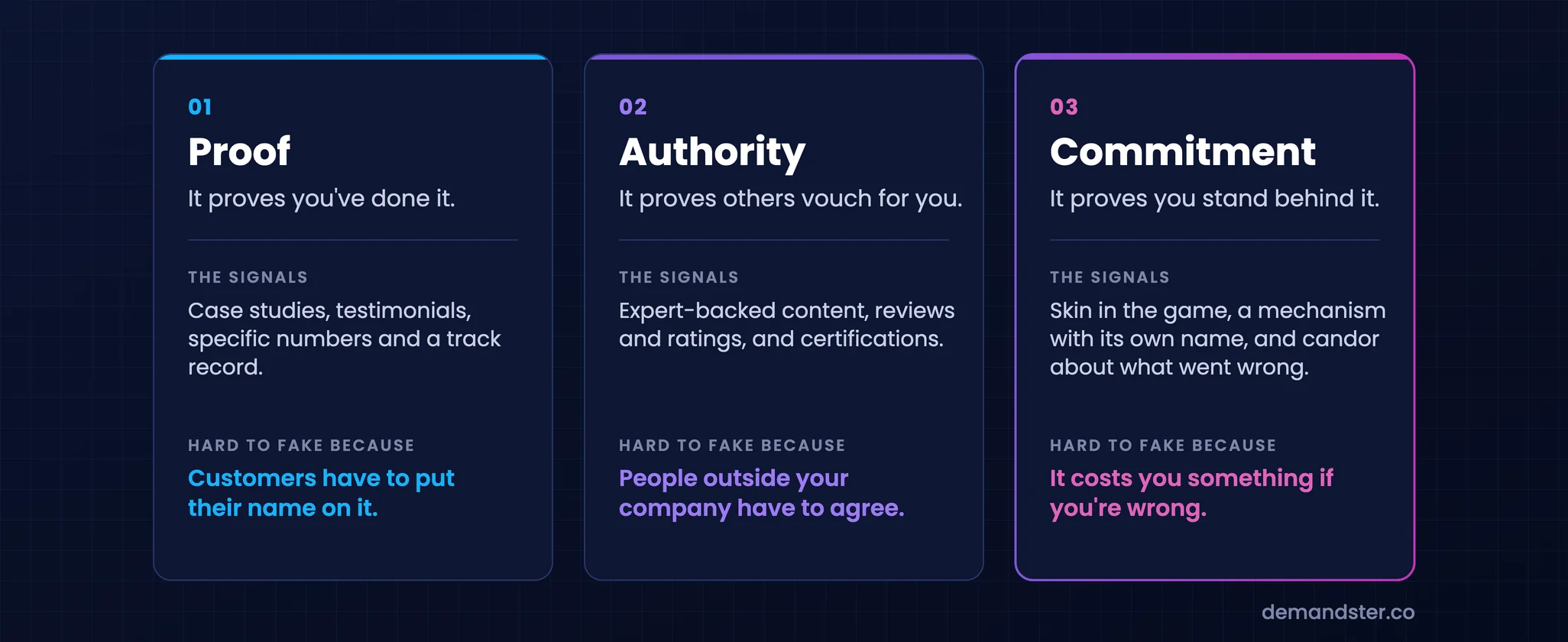
Nassim Taleb wrote a whole book about the third group.
"Don't tell me what you think, tell me what you have in your portfolio."
- Nassim Nicholas Taleb, Skin in the Game
A guarantee, a fixed price, a first phase you'll refund if it misses the date: these are costly signals, so buyers believe them. Candor is the one your rivals won't copy, because it means admitting what didn't work.
Status belongs on this list too, because your champion has a career riding on the decision. Give your champion something that makes them look good for choosing you: a business case they can present without you, a benchmark their CEO hasn't seen, a result they can put their name on. You're helping a person win trust and respect inside their company, and ideally a promotion.
Point AI at time and effort, and keep people on proof, relief and safety. I use AI for almost everything at Demandster, and any knowledge worker who doesn't is already behind.
Two things surprised me this year. The first is how much you can do without a dashboard. You need three layers:
With those three in place, you describe the job in plain words, often by voice, and the AI does it. Marc Benioff said it on X in April, when Salesforce opened its whole platform to agents as Headless 360. We wrote more about building that context layer for agentic demand generation.
"No Browser Required! Our API is the UI."
- Marc Benioff, on X, 17 April 2026
Everything AI did after that discovery call came from this setup.
The second surprise is where AI stays slow. Writing is still the hardest part to compress. We edit every draft, and the gap between an AI draft and a piece I'd put my name on is where the hours go. We close that gap a little every week, and it isn't closed.
Can you automate your whole go-to-market this quarter? Not yet, in my experience, although well-funded teams are working on it. Monaco, an AI-native sales platform backed by Founders Fund, has raised more than $85M. Swan is building an AI go-to-market engineer for signal-based outbound. The direction is clear, and full end-to-end orchestration isn't here yet.
Let AI find the moment and draft the message, and let a person decide what goes out. Our own outreach is a good example of that split. We stopped sending cold sequences and built our own version of signal-based outreach.
We tested an earlier, fully handwritten version of the approach in a small experiment with 31 emails, written at ten to fifteen a day. Three people replied, two of them positively, and one reply became the discovery call I opened this article with. On that call the VP told me that what she respected most was how quickly the email followed her job ad.
This month, score your offer on the six variables, back your favourite claim with proof, give AI the work buyers never see, be useful to your best accounts every week and give your champion something to defend.
1. Score your offer on the six variables. Take your pitch and your last three proposals, and rate how well each moves the dream outcome, perceived likelihood, time delay, effort, relief and safety. Ask yourself which variable your buyers doubt most. If it's perceived likelihood, stop adding speed claims and start collecting proof.
Done looks like: a single page, with the weakest variable circled.
2. Back your favourite claim with proof a competitor can't copy. Open your homepage and your last deck, and find the word you use most, such as fast, easy or tailored. Every competitor uses it too, so on its own it proves nothing. Replace it with something only you can show. If you say fast, quote a customer who went live on time, with the date and their own words. Or put a date in writing and refund the first phase if you miss it. Then ask yourself if a competitor could publish the same line tomorrow. If they could, it isn't proof yet.
Done looks like: your most-repeated claim, backed by a customer quote, a number or a guarantee, live on your homepage this month.
3. Give AI the work your buyers never see. List every task in your pipeline that costs time or effort without building trust: research, notes, routing, first drafts. Automate those tasks before anything else. Ask yourself if each automation frees a person to spend more time with buyers. If it doesn't, you've only made the noise cheaper.
Done looks like: a list of automated tasks, and the hours they give back to your team.
4. Give your best accounts a reason to expect you next week. Choose the accounts you want in two years, and be useful to them every week, before you ask for anything. Ask yourself if those buyers would notice if you stopped. If they wouldn't, you're still playing a one-shot game.
Done looks like: eight weeks of scheduled value for your top accounts, and the first reply that references it.
5. Give your champion something to defend. Build the business case, the benchmark or the one-pager they'll forward to their boss. Ask yourself if your champion could win the internal argument without you in the room. If they couldn't, that's your next asset.
Done looks like: an asset your champion forwarded, and a reply from someone above them.
Go back to the no-decision deal you picked at the start, and ask which variable you failed to move.
If it was time or effort, AI can probably help next time. If it was perceived likelihood, relief or safety, no tool would have saved it, because that buyer needed to believe you before they could buy from you.
Every vendor in your market now has the same AI tools you have. Fast production stopped setting you apart, even though a fast, relevant reply still matters. Trust is what will separate you now.
Let AI do the work your buyers never see. Spend the hours it gives back where they can see you: in the proof you publish, the promises you stand behind and the weeks you keep turning up with something useful.
When your next buyer is ready to decide, they won't pick the fastest vendor. They'll pick the vendor they already believe.
Make the message impossible to send to anyone else. Open with something specific you noticed about their company this week, name the problem that moment usually creates, and ask a question about their situation instead of asking for a meeting. Let AI find the signal and draft, but have a person check the facts and edit the note until it reads like it came from someone who understands their business.
Mostly because the buyer is afraid of getting it wrong. In The JOLT Effect, Matthew Dixon and Ted McKenna analysed 2.5 million sales conversations and found that 40 to 60% of lost deals ended with no vendor chosen, and they trace much of that to fear of a bad decision more than loyalty to the status quo. Reduce the risk the buyer carries, with proof, a guarantee and a case their champion can defend, and more of those deals move.
Lower their self-orientation and raise their proof. Buyers trust sellers whose expertise is visible and whose words match what happens next, so bring a specific insight about the buyer's business, do exactly what you promised after every call, and back claims with customers on record. In LinkedIn and Ipsos research with about 900 buyers, 86% said a seller's expertise drives their trust, while only 45% described the sellers they meet as trustworthy.
Usually because the champion can't win the internal argument yet. After the first meeting your contact has to sell the decision to a buying group that never met you, and the LinkedIn B2B Institute found that 40% of deals stall because the group can't agree. Give your champion a business case, a benchmark or a one-pager they can present without you, so the decision feels safe to defend.