
A B2B content pyramid sorts your topics into layers that follow the stages of awareness of your audience, from prospects at the top who are looking to buy to your widest audience. To build yours, you need to set a goal, select your core content ideas, prepare a brief for every piece of content, recycle your main anchor content into many pieces, then distribute religiously.
Key takeaways
Your competitors can buy the same tools you use. What they can't copy is your context: who you sell to, the core ideas you want them to remember, your proof and your voice.
People notice when the posts in their feed are AI-generated.
I understand why people publish those posts anyway. It's part of human nature to look for shortcuts, and we live in the attention economy.
You spend 10 or 15 minutes with AI, sometimes an hour or two, and you've produced a post that looks nice to you. You expect reactions, maybe a few inbound messages and people who notice how brilliant you are.
Creating good content doesn't work like that. It didn't in the past, and it's getting harder and harder now.
During the summer, LinkedIn added a "seems like AI slop" option to the menu on each post. More than a million people clicked it in the first two weeks, according to its chief product officer. In the same post, LinkedIn's product chief says content the platform classifies as slop drew 40% fewer views than a few weeks earlier.
I wouldn't be surprised if people grow even more annoyed with the brands behind these posts. That goes for companies and for personal brands.
Yes, you do need AI. You use it to research faster, to draft and to tell the story. It's an important step in how we write now.
But you also need a system behind it, and that system starts with a winning context.
And the conversations I've been having confirm it.
A GTM engineering agency founder I spoke with recently builds this for a living. He calls it a home for a company's brand context. With that home in place, the whole team works from the same source in every tool. "Brand context is going to be extremely important," he told me.
A fractional CMO who spent years as an industry analyst goes further. He expects HubSpot to win in B2B go-to-market. "Because it's native, it's part of your world," he told me. It can also "read all of your customer responses" and learn from them.
And you need more than brand context. You also build context for your strategy, your clients and your content. That takes taste, expertise, experience and deep knowledge.
So where does your context start?
Ours starts in a content pyramid. And the pyramid starts with the stages your market moves through before it buys. They go from unaware of the problem to most aware of your offer.
You can use it for every format you publish: posts, articles, newsletters and lead magnets.
In this article, I'll show you how to build yours, step by step, the way we'd build it with a client. You'll leave with a plan for what to publish, for whom and why. Then you can turn the attention you earn into conversations with the people you want to sell to.
"...the cracked marketer is more in demand than the cracked engineer."
- Greg Isenberg, on X
Many founders believe it's very easy to create a lot of good content at speed today, and I couldn't disagree more.
They're technical, they've found a powerful technology, and they expect it to crack marketing for them all of a sudden.
New assistants, agents and browsers keep shipping, and yes, they help. But they only help once you have the right context.
Building software works the same way. Teams now ship websites, tools and even full software products every week, and we do it ourselves. Shipping is fast now, but how much of what you ship holds up as you grow?
So here's the question that matters more: how many of you are happy with your business results?
We ask ourselves that question most about content, because content is our work. I won't pretend we've cracked the code. But we do understand thought leadership, and we've seen what it does for demand generation.
I call thought leadership a sales accelerant. You have a thought, and it starts with your expertise, your opinion and your original data. Then you lead people somewhere with your advice and your view of the world. I go deeper on that in how thought leadership drives B2B demand generation.
When I was head of marketing, we did that with original research reports and expert-led content. The best of them worked on two funnels at once. The companies ready to buy asked to talk, and the rest gave us their attention and remembered us later.
At any moment, most of your market is in that second funnel. Rebecca Thorburn put the problem as a question in a recent note:
"We know how buyers behave. Why is it so difficult to change how we market to them?"
- Rebecca Thorburn, in a Substack Note
To reach that second funnel, you need context: what your market believes, what worries it and what you can prove. We build that context with clients today, and now I'm bringing the same playbook to our own agency. I'm doing it because I believe a personal brand can support your thought leadership, your demand generation and the growth of your business.
Production is much faster than it was. It still takes a team to choose what to share, interview customers, enable sales and push an opinion.
Our ideal is a post a day on LinkedIn and two a day on X. We're not there yet, because we want to crack the quality first.
The brands that are winning do both: quality and volume.
Two teams can pay for the same model, on the same subscription, and publish posts of very different quality.
It all comes down to the context each team has built around it.
And context is a bigger thing to build than it sounds. I'm a big sports fan, so let me borrow two stories from football and Formula 1 to show what I mean.
Manchester United have hired seven permanent managers since their last Premier League title in 2013. From the outside, each of them brought his own idea of how to play and whom to buy.
The lesson for me is that it's never only about bringing in a new manager.
But Mercedes took the long road. After eight constructors' titles in a row, they spent four seasons behind their rivals. This season they finally won both Formula 1 titles. Kimi Antonelli took the drivers' title after coming up through their own young driver programme.
Toto Wolff, who leads the team, called that title "nine years of development".
You can't explain their success with the engine alone, either. In 2024 McLaren won the constructors' title with a Mercedes engine, while Mercedes finished fourth.
Think of the model as the engine, and your context as the car you build around it.
That agency founder I mentioned can afford to type lazy prompts. He has already built the context his tools need.
I see United's pattern in software companies. They change their agency, their tools and their plan each year, and they start from scratch each time.
Some companies between startup and scale-up make maybe four to six million dollars in annual recurring revenue (ARR). They have eight to ten marketers on the team, and they still grow only 10 to 15% a year.
Is that a skill issue? I ask myself the same question, with no funding, a tiny budget and a much smaller team than theirs.
Hiring more people doesn't fix it by itself. But you still need smart people, because the tools can't solve everything.
And a new hire starts from a blank page until you give them your ideas, your proof and your voice. I show how we give ours to the model in our post on how to turn founder expertise into thought leadership.
The next model won't close the gap for you. It will write cleaner sentences, but your competitors have access to it too.
The future belongs to the winning context layer.
Here's how you can build yours.
A B2B content pyramid is a plan for what you publish, with your topics in layers by how close each audience is to buying. Search for the term and you'll mostly find a repurposing plan: one core asset at the top, mid-size pieces in the middle and short posts at the base. We use that as Step 5 below. The version here adds the four steps before it, starting with a goal and about 10 core ideas.
Let me walk you through it the way we would if you were a client. I'll use our own pyramid as the worked example, so you can see how we fill in each piece.
We keep our context in a single folder, and the model goes through that folder before it drafts anything for us.
In our first issue, I showed you the content brain behind our writing. It holds the company files, the profile files and the material we collect every week. I also promised you a separate article on the layers, so you know where each piece goes and who it speaks to. You're reading that article now.
Here's what that folder looks like today:
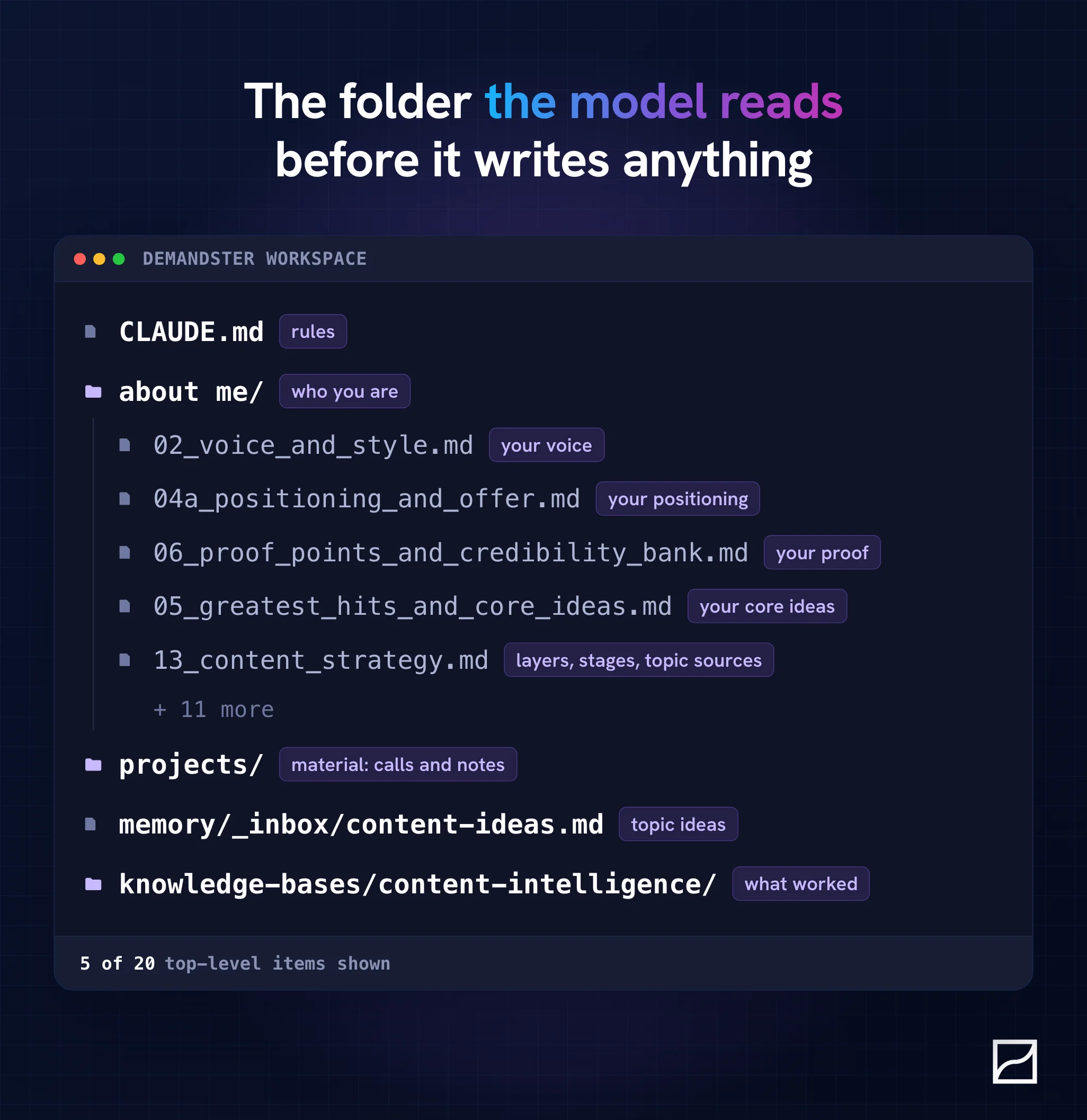
The voice, positioning and proof files come from the first issue. They tell the model who you are and what you believe.
Your 10 ideas go in a file of their own. We put the layers, the stages, the card and the topic sources in the content strategy file. The model then knows where each piece belongs and who it's for. We also keep our call notes, topic ideas and a record of what worked.
We start with the stages your market moves through on its way to buying. Eugene Schwartz described five stages of awareness in the 1960s, and we still plan with them:
Here's why that matters for your plan. At any moment, only a small share of your market is comparing options, and the rest are at earlier stages.
So the bulk of what you publish should help people see their problem more clearly. A smaller share should help the few who are comparing options choose you.
Keep these stages in mind, because you'll use them in each step below.
You build it in five steps: set your goal, choose about 10 core ideas, give each layer a share of posts, brief every post with a bet and turn each big idea into five pieces.
Set your goal before you pick a format. What are you trying to achieve this quarter?
Three questions help you answer that. What outcome do you want? What reputation do you need to reach it? And what kind of content builds that reputation?
Then you choose your bets. In any given period, I'd expect one or two major campaigns to bring most of your marketing-sourced pipeline.
Think of them as your blockbusters for the quarter. A blockbuster could be an original research report, a creator programme or a series of executive dinners.
A bigger company can afford more of them. For the rest of us, it's one or two.
The rest of your plan is distribution, and it deserves VIP care. I can't emphasise this enough. I show how to tie that distribution plan to pipeline in our B2B demand generation framework.
You'd be in good company if you start here. In the last few weeks, I spoke with many fractional CMOs, sales leaders and RevOps agencies. Almost all of them start a new client with an audit, a plan or research before any tactic.
One of those fractional leaders was talking about what a company should give its agency. He put it as a question: "But they need the foundation, right?"
He's right, and you build that foundation on the people you sell to and the position you want to hold in their minds. From there, you define your core ideas, the angles on each and the proof behind them.
So how many ideas do you need? I tell founders and executives that their audience will remember them for maybe 10.
Here are three of ours, so you can see the shape:
This article argues the third.
The usual advice is three to five content pillars, and the layers in step 3 do that job. Your 10 ideas go one level deeper, because each is a view you can defend, and an idea can appear in more than one layer.
Each idea needs proof you can show: a result, a number or a story from your own work. Without proof, an idea is only an opinion.
Don't rush this step. Wispr Flow's head of content says the team spent a full month on a story document before they produced anything.
But don't wait too long, either. Daniel Priestley wrote that there is "a closing window where it won't be possible to build a personal brand" that still cuts through.
And LinkedIn's engineers say the feed now picks who sees each post by its topic and each reader's history. So pick two or three topics early, and stay with them.
Can you list your 10 ideas right now? If you can't, your team can't either.
Picture the pyramid for a second. At the narrow top, you speak to the few who are close to buying. At the wide base, you reach the most people and earn their trust.
We publish in five layers. Here they are from the top down, with the share of our LinkedIn posts we give each:
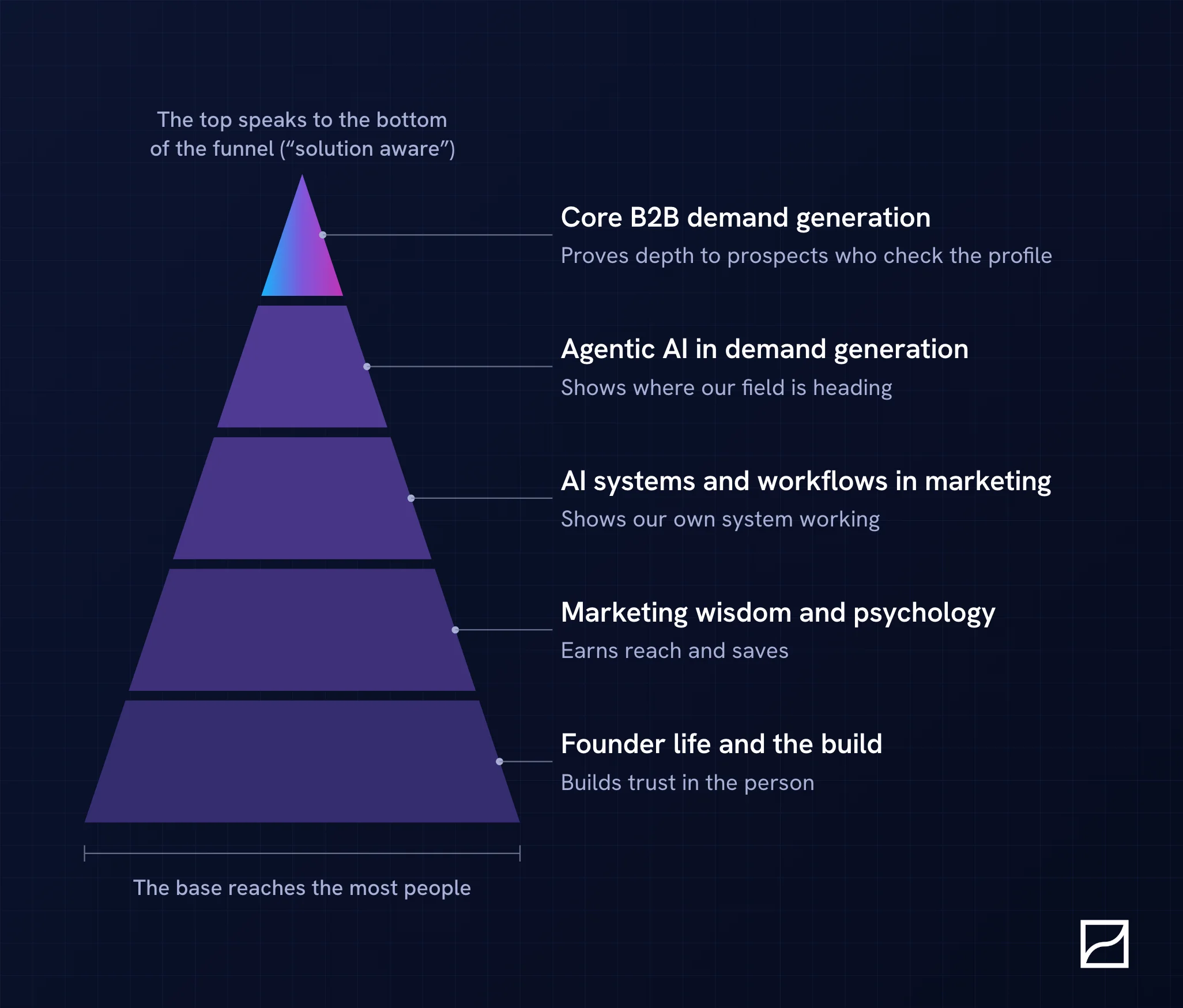
Look at the shares for a moment. We give the narrow top the most posts. That's where we prove our depth to the people who check our profile before a call. We give the wide base the fewest, even though those posts reach the widest audience.
A common B2B split is 50/30/20, with 50% of posts for people early in their search. We give our biggest share, 30%, to the topic closest to what we sell, because prospects check our profile before a call. The other 70% spreads over four layers that reach a wider audience.
We plan about four LinkedIn posts a week. Over a month, that gives the top layer about five posts and the base one or two.
For posts in the two lower layers, we use a test. Could a new reader tell what we do after seeing the post? If not, we add a sentence that leads back to the top, or we move the post to X.
Your layers will look different from ours. Say you sell compliance software to banks. Your top layer is compliance for banks. A middle layer could be how regulation is changing, and your base could be what you're learning as a founder.
This is where you turn your context into a brief for each piece.
Before we write anything, we fill in a short card. It asks a few questions:
That last question matters more than it looks. Your topics are part of your context, so we tag every piece with one of five sources:
You pull the first three straight from your material folder, and your competitors don't have them. If every topic you post comes from what's trending, your content will sound like theirs, because they scroll the same feed.
Then we write three lines: the hook, what keeps people there and the reward they leave with.
And we place a bet. Before we publish, we write down what we expect to happen.
Here's the card from last week's post:
The post earned 8 saves and 5 comments, so my bet held. But most of its views still came from inside my network, even though I tagged 10 creators. I logged that on the card too.

That's the point of the bet. You translate what works for others into your own world, you test it and you learn quickly.
For me, it's about the velocity of learning.
The card also changes how you work with AI. When the model drafts for us, we give it the card first, with the core idea and its proof. Then it writes from our argument and our evidence. If you're wondering which work to keep for yourself, start with what to delegate to AI.
And we use the same card beyond posts. We fill it in for an article, a newsletter or a lead magnet.
For the craft itself, I look up to Dan Koe and Jay Yang. Koe describes a spectrum from slop to signal. The more of your own writing, notes and opinions you give the model, the closer its output comes to signal.
You're looking at the example right now.
We turn this idea into five pieces, each with its own job, title and opening:
We publish an anchor piece like this about every two weeks.
Then we distribute it, with the VIP care I mentioned in step 1.
Tycho Luijten, the CEO of Dapper, shared the LinkedIn engine behind his agency's inbound. His formula fits on a line: "Personal profiles + Content + Distribution = Inbound".
More than 15 people at Dapper post from their own profiles, about 120 posts a month. Each month, they pick the posts that worked and carried the right message. Then they put ads behind them, so those posts reach about 30,000 people at the companies they want.
He says 30 to 40 leads come in each month, and that most of them know Dapper from LinkedIn.
That's quality, volume and distribution in the same plan.
Tommy Clark, the CEO of Compound, makes the same case in seven lessons from more than 10,000 LinkedIn posts. In his words: "It's no longer enough to post organic content and hope leads materialize."
Distribution also needs a person at the end of it. When people engage, someone on your team still has to follow up. I cover who does it and how fast in our guide on how to connect thought leadership and demand generation.
Volume and distribution matter, but at Wispr Flow, the team built volume only after that month on the story. Lenny's Podcast describes the system Hector Serrano built there: about 50 paid creators who drive 500 to 600 ads a month.
Wispr Flow sells mostly to consumers, so I'd copy the order and leave the numbers.
We believe good content marries taste, content engineering and smart distribution.
Block two hours this week with your co-founder or your head of marketing.
Answer the three questions from step 1, list your 10 ideas and sketch your layers on a single page.
If you'd like a second pair of eyes on it, message me on LinkedIn and send me that page. Tell me which idea you'd defend first, and I'll tell you what I'd change and which layer I'd put it in.
And if you'd rather not build the system yourself, we built Demandster Studio for you. It learns who you sell to, your positioning, your core ideas, your proof and your voice from your own posts, calls and notes. It asks you three questions a week, so the ideas stay yours.
Studio doesn't cover all of this article yet. You can't set your own layers and shares in it today. I made this blog post, the Substack essay and the X article with our own tools outside Studio. Then I edited each of them by hand.
We're opening it in small cohorts, and you can join the waitlist.
The 70/20/10 rule splits your posts by type: in the common social version, 70% give value, 20% share other people's work and 10% promote you. A B2B content pyramid splits them by who they're for. Ours gives 30% of our LinkedIn posts to the top layer and 10% to the base. Use both: set your mix, then check it inside each layer.
A B2B content strategy ties what you publish to a business goal. It names the people you want to reach, the stages they move through before they buy and the ideas you want them to remember. Then it sets formats, channels and distribution. A content pyramid is the planning tool inside it. Put your goal and about 10 core ideas on a single page this week.
Three to five content pillars is the common advice, and it works for broad topics. Go one level deeper too. I tell founders their market will remember them for maybe 10 core ideas, so pick those on purpose and spread them across your pillars. Back each idea with a result, a number or a story from your own work. List your 10 now, and cut any you can't prove.
A good brief states the core idea the post argues, the topic it belongs to, the reader's stage and how much they already know. It sets the goal, such as reach, saves, comments or a conversation, plus the format and where the topic came from. Then add the hook, what keeps people reading and the reward. Finish with the result you expect, so you can score the post against it.