The first B2B marketing channels to start are your team posting on LinkedIn, signal-based outbound to the people who engage, and small dinners or roundtables. They bring sales conversations inside a quarter and they keep compounding. Start the slow channels early, add paid ads once your message converts, and skip the rest for now.
Key takeaways
"There's a painful difference to evolve from selling to Early Adopters who trust you, to Mainstream Buyers who don't."
- Aaron Ross and Jason Lemkin, From Impossible to Inevitable
If outbound and referrals and your network built your company, it's normal to have your doubts about marketing.
You reached $1M, $5M or more in annual recurring revenue (ARR) on people who already trusted your name. Same about direct outbound outreach.
Then you have a chat with a marketer who talks about brand, content calendars and awareness, and that whole pitch sounds soft. Moreover, in tech, most founders have engineering backgrounds. Systems thinking and cause and effect are your modus operandi. With outbound, you send a hundred messages, book X number of meetings, and close Y number of deals.
When you've built a business that way, treating marketing as a side experiment makes complete sense. You give it a slice of your budget and expect the pipeline to appear in a reasonable period. When that doesn't happen, you pull the plug.
You aren't alone in that chair. Kyle Poyar and Maja Voje surveyed 300 software go-to-market leaders for their 2026 State of B2B GTM report. Between $1M and $10M ARR, founder-led sales is still the second most common motion (26% of respondents), and the network stays the channel teams rely on most. "Founder-led growth" is a category of its own.
The catch with founder-led growth is that your own network and calendar eventually become your growth ceiling. You can only shake so many hands or ask for so many introductions before growth starts flattening out.
I know that ceiling, and we are slowly hitting it at Demandster too.
Network and referrals are the least expensive of all channels.
But selling only to people who know you doesn't make a durable business. Contrast that with selling to strangers, which takes a repeatable system and no heroics.
Lately, inbound conversations have started coming in on top of our own content flywheel. Roughly every two weeks, we take a core topic and publish a blog post structured for AI search (like this), a Substack essay, a LinkedIn article and a couple of social posts around the same core idea.
I hear a similar shift from founders who finally start creating and pushing content consistently. When they create useful content, they mention that prospects reply faster to their messages, and people perceive them differently. Even friends respond more quickly (that's really a thing). Often their earliest inbound leads aren't even their ideal customers yet, and it still flips a switch in their head from "this is an experiment" to "something here moves business".
If outbound carried your business, shutting it off completely to create content and invest in paid media would be reckless, especially if your team already understands the power of true signal-based campaigns (not traditional spray-and-pray outbound). Keep doing (and improving) what works. Loop it.
But it's always troubling when outbound hits that flat line and you can see how your month-over-month growth slows down.
Let's think about a part of the buying journey that's intuitively clear to all of us. Before a prospect responds to your email or books a conversation, they research you.
In its 2026 report on B2B buying, 6sense studied 3,596 completed B2B purchases and reported that prospects first contacted a vendor 59% of the way through a process lasting about ten months. The vendor they favoured before that first contact won 82% of the time.
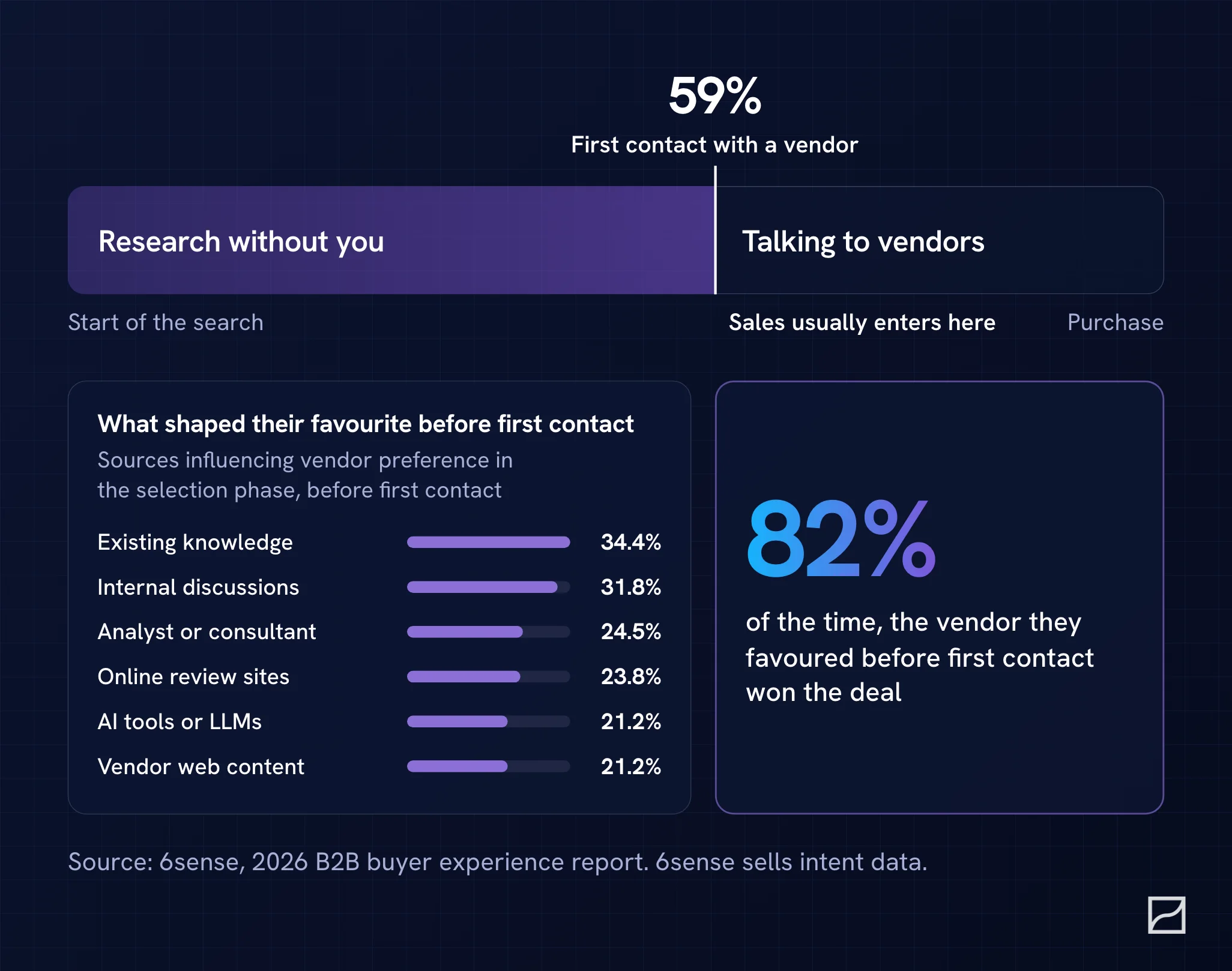
The same report lists what influenced that preference before first contact. Existing knowledge (34.4%) and internal discussions (31.8%) came ahead of analysts, review sites, AI tools and vendor web content. 6sense sells intent data, so it has a stake in the finding.
Your digital footprint IS the first screening before your sales team ever speaks.
Before prospects trust your company as an authority, you are in the education business. You earn authority by teaching your market how to diagnose its problem and assess its options clearly.
A prospect will see your website messaging to look for clues that you understand their world. They look at reviews and read case studies for proof. They look up your team and content on LinkedIn to see how well you understand your space.
Thought leadership warms the room long before your sales rep sends that message.
The textbook rule goes that the market creates demand. Many think marketing should focus strictly on capturing people already shopping for a vendor.
First, let's clear up a definition that even experienced B2B marketers can get wrong.
Demand generation is the umbrella term that holds the full commercial engine. It contains two main and distinct motions inside it: demand capture and demand creation.
Demand capture is all your efforts that go after the small slice of your market actively looking to buy. Demand creation is about influencing how a much larger group of prospects, who aren't looking to buy, see their problem long before they compare vendors.
I agree 100% that you should capture existing demand first.
Where I wholeheartedly disagree is with the claim that you can't influence demand.
I've done it so many times. You can pave the way for prospects who aren't ready to buy.
How do you do it?
Well, it's an art and a science. My short answer is you do it by creating content that speaks directly to use cases, with events you host or sponsor, with guest appearances and by contributing to the communities where your prospects already spend time. You do it by relentless organic and paid media distribution. Let me tell you, that last point carries a spectrum and it's a special skill too.
Then you repeat a coherent story and share your strongest opinion and thinking across the right channels, and the perception shifts gradually. So when your potential customer enters the problem-identification stage, your name is already well engraved in their memory.
In B2B, you must not forget that it's also about the individual journey. You speak to specific people inside a buying group, including the decision maker and several influencers who can champion or block your deal.
They ask questions like: How do I keep my job? How do I thrive in this role? How do I earn my next promotion?
Capturing demand is your short-term ROI, while creating demand is about shaping the shortlists you make next year.
Agree on your strategy and your big bet campaign first. Then rank every channel by how soon it shows first signs of proof and results and what value stays when you pause it. We recommend to start with the three that do both: LinkedIn organic content, signal-based outbound and small dinners or roundtables.
These are the steps I'd take if I were starting marketing from scratch and your business is well established.
When you have no marketing function yet, the first move is to refuse to launch campaigns on intuition alone. You learn by doing, and bias for action is a smart mantra, but that's the wrong way to project it.
You need your leadership team aligned on a few things: 1) your ideal customer profile, 2) the narrative you want to carry, and 3) your position against the alternatives, and why you win customers (why they love you).
Then comes the conviction call: choosing a big-bet marketing initiative that your whole team believes in.
Let's say your business is in B2B. Established companies sit on years of original data, customer patterns, institutional knowledge and market insight that competitors can't copy. Turning that raw knowledge into a benchmark or original research report gives you thought leadership content with genuine value.
Before you promote it, you plan how to stretch it across weeks on every channel that matters: paid ads, LinkedIn carousels, personal posts from your employees, your leaders and your CEO, X threads, email marketing, nurture flows, a long-form article, a newsletter edition and tailored customer success material for account expansion with existing clients.
Litmus test: could your entire team name the same enemy and the same big bet for the next quarter?
Once your strategy and big bet are clear, you need prioritisation. Most companies don't have unlimited resources, so you sequence which go-to-market (GTM) channels to turn on first.
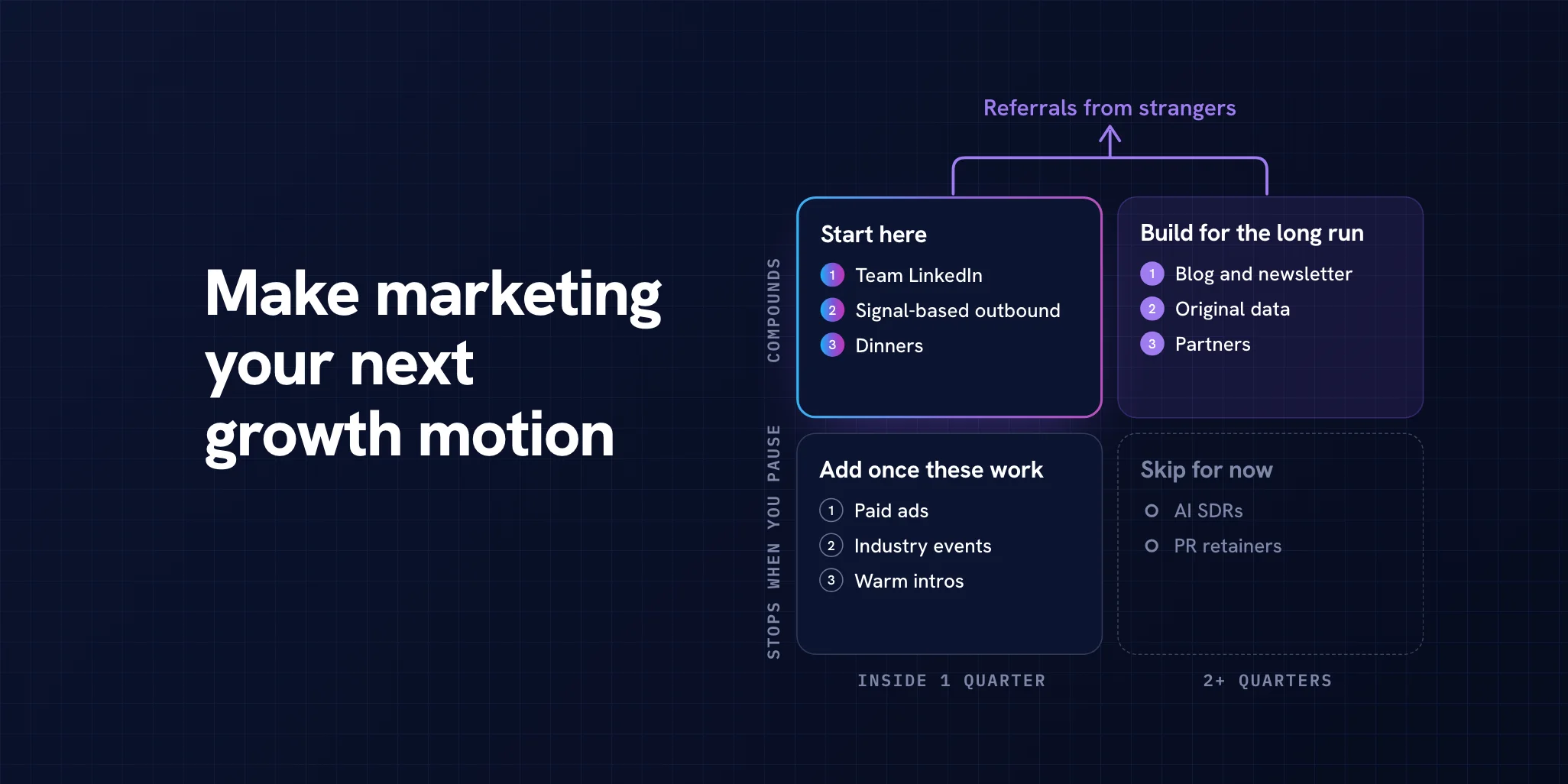
Use The Compounding Channel Map. We look at two dimensions: time to first results (does it bring replies, sales conversations or pipeline inside a quarter, or does it take more time?) and what stays when you pause (does it build compounding assets over time, or does it stop the day you pause spend, outreach or events?).
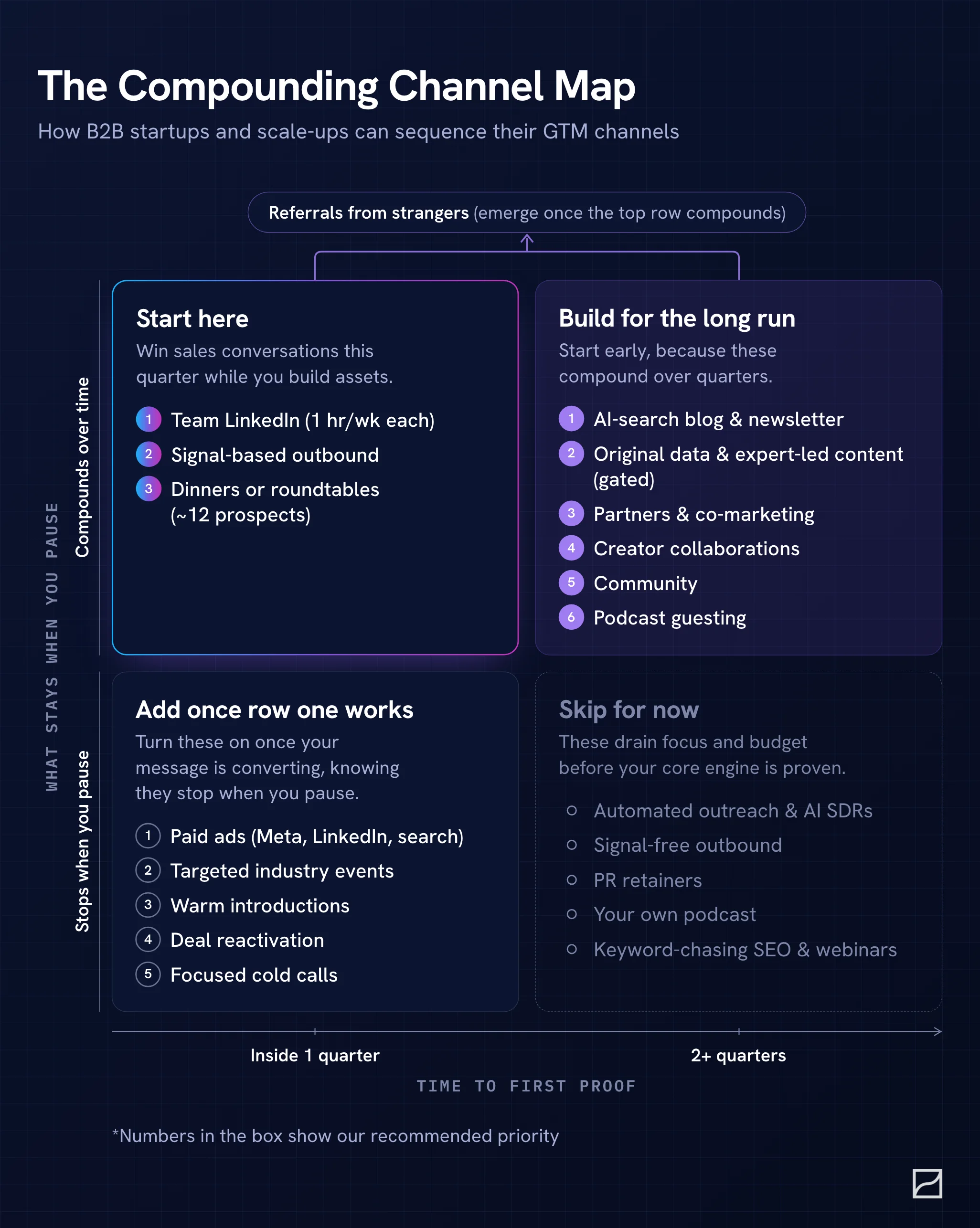
Quick reading on the map.
Here's the same map as a table, with every channel in its box.
| Box | Time to first proof | What stays when you pause | Channels, in priority order |
|---|---|---|---|
| Start here | Inside 1 quarter | Compounds over time | 1) Team LinkedIn (1 hr/wk each), 2) signal-based outbound, 3) dinners or roundtables (~12 prospects) |
| Build for the long run | 2+ quarters | Compounds over time | 1) AI-search blog & newsletter, 2) original data & expert-led content (gated), 3) partners & co-marketing, 4) creator collaborations, 5) community, 6) podcast guesting |
| Add once row one works | Inside 1 quarter | Stops when you pause | 1) Paid ads (Meta, LinkedIn, search), 2) targeted industry events, 3) warm introductions, 4) deal reactivation, 5) focused cold calls |
| Skip for now | 2+ quarters | Stops when you pause | Automated outreach & AI SDRs, signal-free outbound, PR retainers, your own podcast, keyword-chasing SEO & webinars |
Two pieces sit outside the four boxes on purpose. One is an operating rule of engagement, and it multiplies every channel on the map: follow up on every major signal inside 48 to 72 hours across LinkedIn, email and phone. The other leaves the top row as the long-term payoff: you can start expecting referrals from strangers to emerge once those channels have run long enough.
When you map your last ninety days of sales and marketing activity onto these four boxes, how much of your effort sat in the bottom row?
If a company was super successful with outbound and has never done content, the first high-return move is at number one in the Start here box. Get your team active on social, especially LinkedIn (or X and Substack, depending on where your industry gathers).
Your founders and commercial leaders hold deep market knowledge and expertise. They've done it in the field by speaking to customers and partners. Equipping them with a light system is easy to do, and it turns their profiles into a sales accelerant for every outbound message your sales reps send.
To stop teams from feeling overwhelmed on day one, I break the ramp into four stages from 0 to 3, moving from crawl to walk, jog and run.
Once your team posts consistently, layer in numbers two and three in that box: signal-based outbound to prospects engaging with those posts, and intimate dinners or roundtables for about twelve prospects so they meet you face to face with peers.
Where do your founders and top commercial people sit on that 0 to 3 scale today?
The top-right box will never save your current quarter, and expecting it to will make you quit too soon.
The way prospects research and buy is changing and evolving. AI search, chat prompting and AI agents are becoming a standard way prospects collect information.
Start with your recurring owned content like a blog and a newsletter so every question prospects research leads back to your point of view (built for AI search). Next, build thought leadership with original data and expert-led content. Once that core runs, layer in partners and co-marketing, creator collaborations, community participation and podcast guesting to borrow trust from audiences that already exist.
Over time, those assets create the trail that brings referrals from strangers who have never bought from you before.
If a prospect asked an AI assistant today which company understands their problem in your space, would your name appear in the answer?
If cash is tight early on, stay organic while you prove which message resonates (well-funded companies can do it the other way around). Once row one converts and you have budget to put behind it, the bottom-left box gives you near-term volume, starting with paid ads (Meta, thought leader ads on LinkedIn and paid search) and targeted industry events where your prospects gather in person.
Look beyond LinkedIn alone as ad prices climb. In Metadata's 2026 B2B advertising benchmarks, which cover 2025 spend across 153 B2B advertisers, cost per lead came to $145 on Facebook against $202 on LinkedIn.
Warm introductions close very strongly, yet they dry up fast, deal reactivation brings quick conversations yet only fires a few times a year, and focused cold calls stop producing the day reps stop dialling. Turn these channels on when the economics work, knowing every play on the bottom row pauses the moment you stop funding or working it.
Draw a firm line around the Skip for now box: automated outreach and AI SDRs, spray-and-pray outbound emails and DMs, PR for PR's sake, your own podcast, and keyword-chasing SEO. They will drain your focus, energy and budget.
You don't need to reinvent the wheel when you measure these channels, either. You're looking at the same numbers that already matter to the business: revenue, customer acquisition cost (CAC), and over time, lifetime value (LTV) and your LTV-to-CAC ratio.
For me, the order comes before the budget, because paid channels only multiply the message you already have.
Are you still putting time or budget into any channel in the Skip for now box right now?
A good plan can break in the engagement rules of the follow-up, the improvement loops, the number of touches and the right channels.
Many technical founders who tell me marketing doesn't work have already tried it once and watched it fizzle.
Almost every time, they fell into one of the twelve traps we break down in our Random Acts of Marketing guide. Two appear constantly: the "more content" fallacy, where teams trap themselves on a content treadmill publishing volume with no strategy, and the hope strategy, where you ship campaigns and pray pipeline materialises because you have no idea what moves deals.
First, broken rules of engagement. In a client pilot, ownership looked spotless on paper. Every buying signal routed round-robin in an equal split across the AEs.
The incentive structure fought the motion: instead of SDRs whose pay depends on booking meetings, we gave follow-up to AEs who stayed busy managing and closing live deals. Next, we never locked the cadence: how many touches happen, when phone calls fire, using multiple numbers to reach senior prospects, researching account context before writing a LinkedIn note, and educating the team early on why multi-channel follow-up inside 48 to 72 hours changes attendance rates. Finally, we never analysed call scripts, emails or LinkedIn messages to improve reply rates.
Second, putting a form in front of an asset that misses the prospect's awareness level. Your gated and expert-led content steers both your distribution and your paid budget. When you sell in a new category, you have a big market-education job ahead of you. Your first gated asset has to move prospects from "problem-aware" so they slowly become "solution-aware".
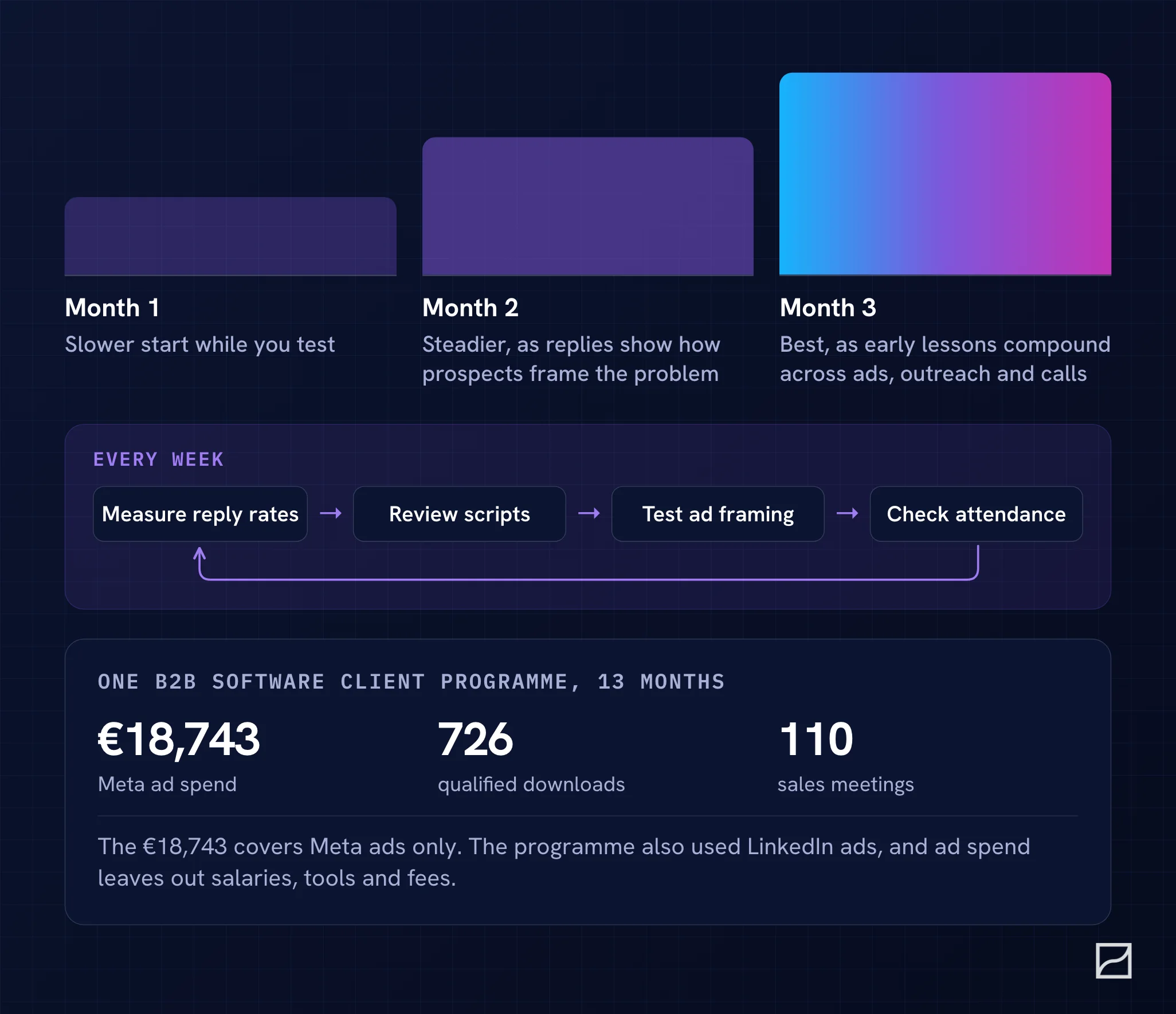
Third, quitting before the three-month ramp finishes. When you launch a new demand generation and marketing programme, month one usually starts slower.
Month two gets steadier as market responses show you how prospects frame the problem in their own words. Month three performs best, because those early lessons compound across your ads, your outreach and your calls.
In a 13-month programme for a B2B software client, the engine produced 726 qualified downloads and 110 sales meetings. The Meta ads cost €18,743, and the programme also used LinkedIn ads. So that figure covers part of the ad budget and none of the salaries, tools or fees.
Action and a self-learning loop (to borrow from the AI engineering world) win.
When you run plays without a weekly loop to measure reply rates and evaluate scripts, ad framing and attendance rates, you wake up after a quarter convinced that marketing failed, when small adjustments along the way would have turned the programme around.
Block two hours this week with your co-founder or your commercial lead.
Draw The Compounding Channel Map on a single page, place every current sales and marketing channel into its box, and mark where your founders and reps sit on the 0 to 3 LinkedIn scale.
And if you'd like to build your map, your big bet and your first-quarter sequence with me directly, I'm opening 1:1 coaching sessions for founders and revenue leaders. Book a free diagnostic call, bring the box that holds most of your team's calendar right now, and I'll tell you what I'd move first.
The Compounding Channel Map is a four-box grid Demandster invented to sort B2B marketing channels by two questions: how soon a channel shows first proof, and what stays when you pause it. Start with the box that proves itself inside a quarter and keeps compounding, build the slow compounding box early, add paid ads and events once your message converts, and skip the rest for now.
The three start-here channels bring replies and sales conversations inside a quarter. A new programme usually starts slower in month one, gets steadier in month two and performs best in month three, so give it the full three months and review it every week. Channels such as an AI-search blog, original research and partners take two quarters or more, which is why you start them early.
If cash is tight, start organic and prove which message resonates, then put budget behind it. Well-funded companies can do it the other way around. Paid ads bring volume fast, and they stop the day you pause the spend. In one 13-month client programme of ours, the engine produced 726 qualified downloads and 110 sales meetings, with €18,743 in Meta ad spend alongside LinkedIn ads.
At this stage I'd skip automated outreach and AI SDRs, outbound with no signal behind it, PR retainers, your own podcast and keyword-chasing SEO. They take two quarters or more to show proof and they stop when you pause, so they drain focus and budget before your core growth is working. Come back to them once the top row of the map works.