Ninety-four percent of B2B buyers rank their shortlist before they contact a single seller.
That figure comes from 6sense's 2025 Buyer Experience Report, built on close to 4,000 buyers with a median deal size between $200,000 and $300,000. Among the buyers who ranked, 84% bought from the first vendor they spoke to. Buyers with no ranked list bought from their first conversation about half the time.
You need to be on the shortlist to win.
You hired reps to win a conversation. You built comp around the conversation, coached it, forecast against it, reviewed it every Monday, and so did everyone else. Meanwhile the market moved the contest months earlier, onto a list your reps never see, and kept scoring them on the part that was already decided.
The list is winnable, and it costs less to win than a meeting does.
We looked at our own first-party data and split 76 booked meetings by source across nine months on one B2B programme to see what actually wins that list. Content produced 45 of those meetings, and the automated outreach sequence produced only six.
This piece is for leaders whose reps are grinding against a market that stopped answering. If your sequences still book and your team is at quota, close the tab and enjoy the run while it holds.
Because the market moved and the process stood still.
The Bridge Group has run the same SDR study every two years for two decades. In the 2025 edition, across 351 B2B companies, 60% of reps hit quota, the lowest figure in the study's history. And the quotas themselves had already been cut: monthly Stage 0 quota, the opportunities one SDR is expected to create, is down 40% since 2018. The industry lowered the bar and still missed it.
The rules tightened at the same time. Google now requires SPF, DKIM and DMARC from anyone sending 5,000 or more messages a day, with a 0.30% spam ceiling. Gartner asked 646 B2B buyers in late 2025 and 67% said they prefer a rep-free buying experience, up from 61% six months earlier.
So you did what every leader does: new scripts, a tighter cadence, a different sequencing tool, more dials on the board, a harder Monday review. None of it touches the variable that moved.
Give a good rep a market that already recognises the name in the inbox, and the same message converts and books.
They make most of the decision before you ever hear about the deal.
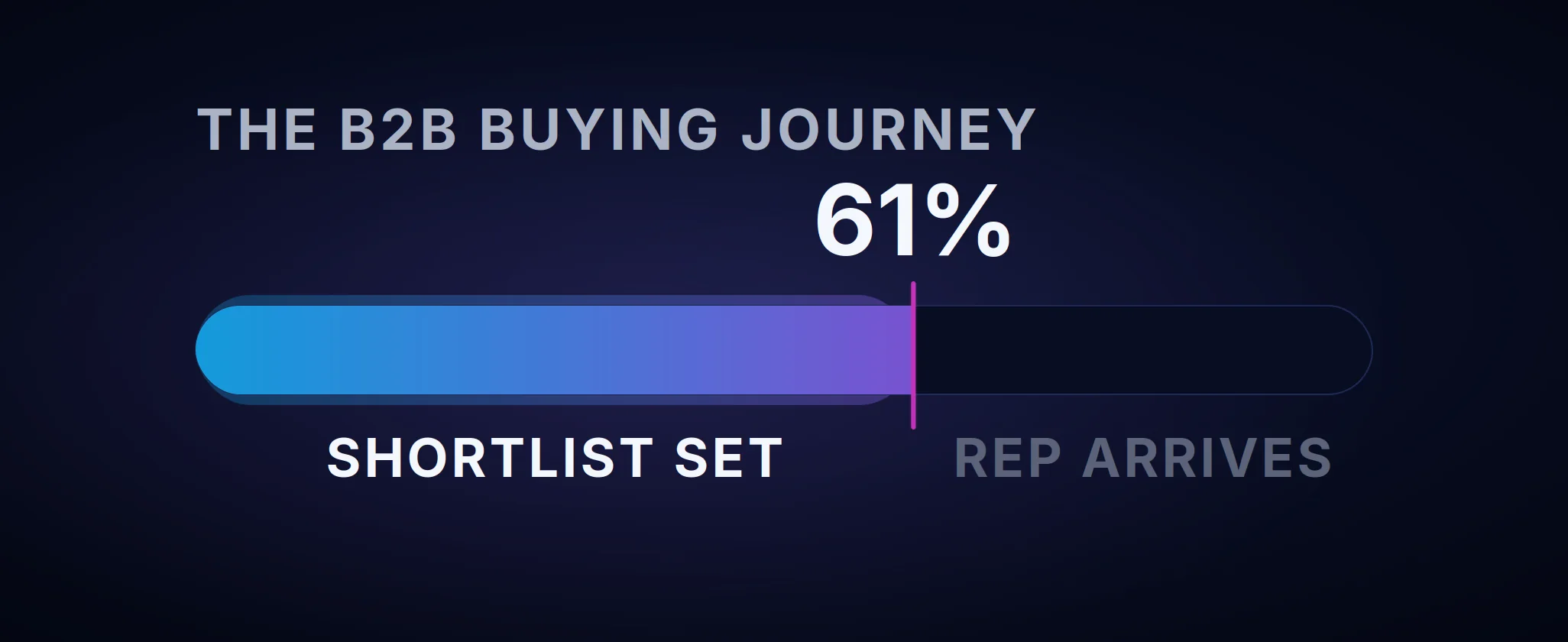
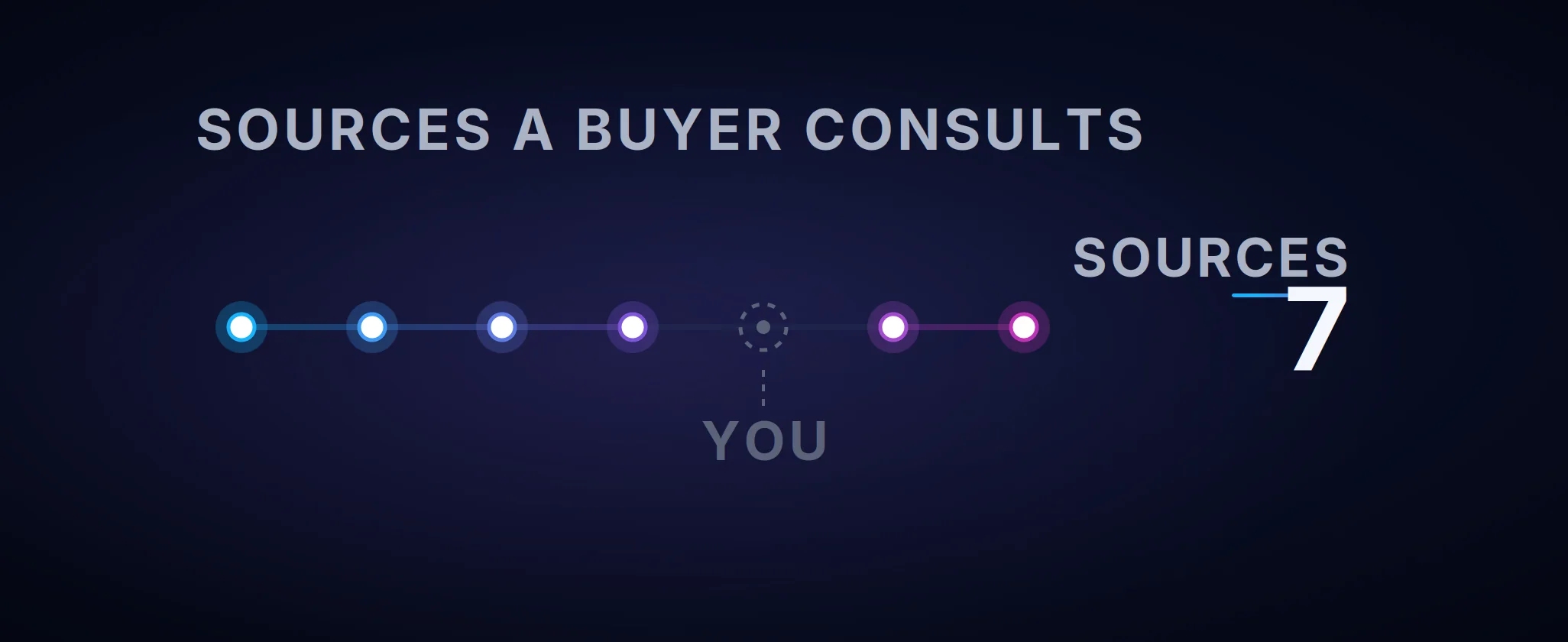
By the first call, the buyer is 61% through the journey and has consulted seven information sources. 6sense puts 95% of eventual purchases inside the Day One shortlist. Bain and Google found the same shape in 2022 across 1,208 US buyers: 90% chose a vendor that was on the list at the beginning. Two studies ran four years apart and reached the same conclusion.
Then comes the number I would put in front of a board before any of our own data.
85% of buyers said they had previous experience with the vendor they bought from.
They had read something, consumed content, used something, or met the company somewhere along the way. The winner was picked from memory, and that memory was built months earlier, for free, by whoever kept teaching the market while everyone else went quiet. The full picture of how that list forms is in buyers put you on the shortlist from day one.
Your rep dials on Tuesday. The list was written in March.
One of the best leaders I ever worked under, a CRO who came up through sales and someone I still call a mentor, was preaching this back in 2018: count the touches, across every channel, per account, before anyone agrees to a call. He drew it on whiteboards for anyone who would sit still.
He was right, and the number has grown since.
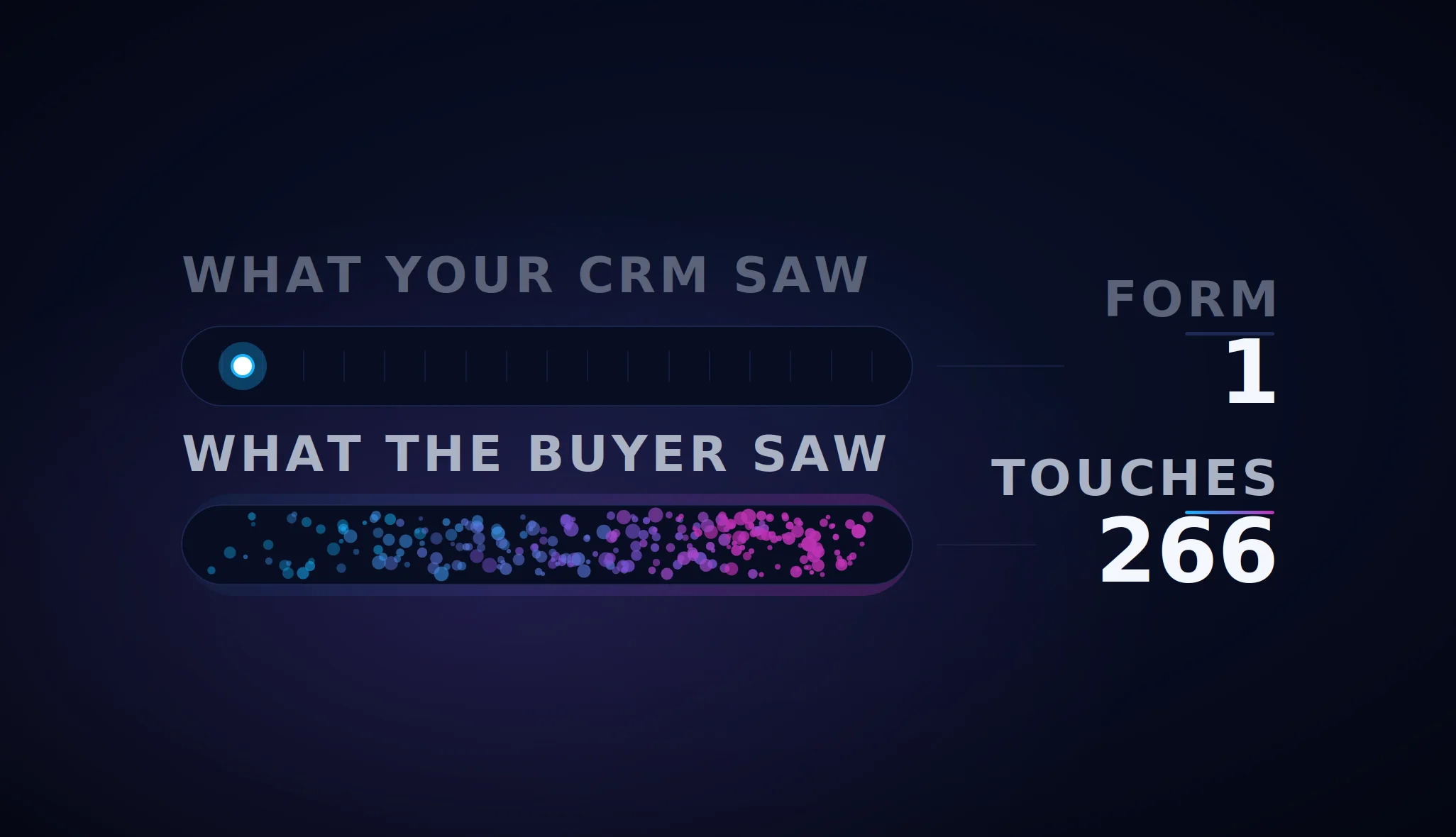
HockeyStack measured it in 2024 across 150 B2B SaaS companies, all spending at least $15,000 a month on ads. The average closed deal took 266 touchpoints and 2,878 impressions. Above $100,000 in deal size, the average climbs to 417 touchpoints and 5,500 impressions.
Your sequence has nine steps, which leaves roughly four hundred touches that will come from somewhere else. If they keep coming from your content and your ads, the buyer walks into the first call already knowing you. If they keep coming from a competitor, the buyer walks in knowing them instead. Nine emails against a year of someone else's presence loses quietly, every time, and no dashboard ever flags it.
Midway through the programme behind our meeting data, a buyer booked a meeting with the client and asked to hold it at a trade show both were attending.
He had never filled in a form, never replied to an email, never raised a hand anywhere a CRM could see. He had scrolled past the LinkedIn ads, seen the Meta ads, read the content and deleted the SDR emails. On every dashboard the business owned, he was anonymous. Then he sat down at that trade show and opened with the reason he had come: he wanted to see what these people actually do.
This is where we can joke about self-reported attribution.
The CRM had that man filed as a stranger, and the man had the company filed as familiar. Every touch was invisible, every touch was working, and the sum of them booked the meeting.
That is the SDR nobody puts on the org chart. It contacts people who never reply. It works through the months when the team is heads-down on delivery. It costs the same reaching a thousand accounts as ten. And by the time a human calls, the introduction has already been made.
No published study measures cold reply rates by prior brand familiarity, and we looked twice to make sure. The companies holding the data sell the exposure, and the companies who could run a clean test keep the answer to themselves. Anyone quoting you a settled brand-lift figure for outbound is quoting a guess.
What exists is observational, and it points one way.
HockeyStack split outbound deals by ad exposure across 50+ B2B SaaS companies. Deals with no ad exposure converted at 16.96%, deals with prior impressions at 21.09%, and deals with prior engagement at 22.50%, closing six to eight days faster on top. Before you raise the objection, I will raise it for you: ad targeting selects good accounts, and good accounts convert anyway. The gap between those rates is real, and how much of it the ads caused is the part nobody has proven yet.
Gong read 30,000 prospecting emails across 250+ companies. Emails referencing what the prospect had already done, a piece of content read, an event attended, a page visited, earned three times the replies. Gong flags their own confound in the same article, that those leads run warmer to begin with, and that admission is exactly why I trust the number.
And Edelman with LinkedIn asked 1,934 executives in March 2025. 95% said strong thought leadership makes them more receptive to sales and marketing outreach, and 79% said they would champion such a vendor inside an RFP. These are survey answers, so apply whatever discount you want for people describing their best selves. I have tried discounting a 95 down to something ignorable and it does not get there.
The data covers nine months on one programme with a complex B2B sale. The team booked 113 meetings in that window, and 76 of them carry a recorded source.
Content-originated meetings, downloads plus hand raisers, were 45 of 76. The automated sequence booked six.
Content downloads produced 30 of those meetings, cold calls produced 25, hand raisers produced 15, and the automated outbound sequence produced six. Downloads and hand raisers both start with content, so content opened 45 of the 76 meetings, which is 59%, against 31 for the two cold motions. In the four months where opportunities were tracked as well, inbound created eight and outbound created two.
Two caveats before anyone finds them for me: ad spend grew roughly eight times across the window, which lifts everything, and this is correlation, on one programme.
Now for the part that made me stop and recount.
The client is Enhance XR, a 3D product visualisation platform for furniture and retail brands. Before we started working together they were on the content treadmill: blogs, LinkedIn posts, founder videos answering real buyer questions. Then they stopped, at the exact point most companies stop, when there's serious seffort involved and the results are still invisible. Underneath the content plan there was no tight ICP, no traction channel, no distribution plan and no follow-up process. Nothing was connected, so nothing compounded, so it looked dead.
We rebuilt it in order. Strategic foundation first, with the market mapped and the buying committees defined, then three lead magnets in three months, one per buying stage, from an awareness playbook down to a bottom-funnel diagnostic. The first one, timed to the new year, pulled downloads across every persona they cared about, and every ICP signal triggered follow-up across email, LinkedIn and phone inside 24 hours.
Then the old content woke up.
Fifteen hand raisers, a fifth of all attributed meetings, came in through search, through posts and articles that had produced nothing for a year. The new campaigns gave buyers a reason to look, and what they found was three years of proof that this company knew its field.
That is the flywheel, and the client had stopped pushing it about thirty seconds before it caught.
In March the sequence booked four meetings. In July, August and September it booked none, and in October it managed two. The cold callers worked the same months and booked four, three, eight and six. Both motions sat under the same growing air cover, with download signals climbing from 9 a month to 88 and ad spend rising roughly eight times, and the automated one flatlined anyway.
The mechanism is simple enough. Cold email drowned in its own volume, and the deliverability rules that followed now tax whoever survived. The phone went the opposite way: everyone left it for automation, which made it quiet, and a quiet channel books again. Between the two cold channels I would back the phone in most contests today, and I say most rather than all because the offer still decides plenty of them.
That leaves two variables I can actually observe: what was running above the motion, and who made the touch. We call the picture the Air Cover Grid, borrowed from how militaries think about the same problem: ground units advance under air cover and get pinned down without it. Your reps are the ground unit, the content and the ads are the air, and only the cell with both produced meetings at volume.
I remembered one detail of this story wrong, and it changes the lesson. I thought the callers were working the download list. They were calling a separate cold list, people who had downloaded nothing and clicked nothing, and the calls still booked 25 meetings. The difference from the 749 cold invites in the next section is that this market had spent months seeing the client's name in the ads, the articles and the lead magnets. So you do not have to wait for a specific buyer to raise a hand before a call can work. You have to be known in the market you are calling into, and that is something you can build on purpose, with a budget and a calendar.
We own the control case, unfortunately.
A different programme ran cold LinkedIn sequencing on third-party signals: job posts, funding rounds, headcount growth. It ran nine sequences across roughly ten weeks, disciplined and well targeted.
The programme sent 749 invites and earned 141 accepts, an 18.8% accept rate. Twenty-one of the accepts replied, which is 14.9%, and it booked zero meetings.
Study the middle of that funnel. The accept rate beat benchmark. The reply rate beat benchmark. Every number a dashboard celebrates came in green, and the only number a board reads came in at zero. The programme ran with no lead magnet and no content engine behind it, both confirmed out of scope at the time. The market was being asked to take a meeting with a company it had met eleven seconds earlier.
Accept rates are applause, and meetings are revenue.
I priced the full path from media spend to booked call in what a booked meeting actually costs, and covered the wider retreat from cold sequencing in is cold outreach dead in 2026.
There are four moves, and the first one costs nothing.
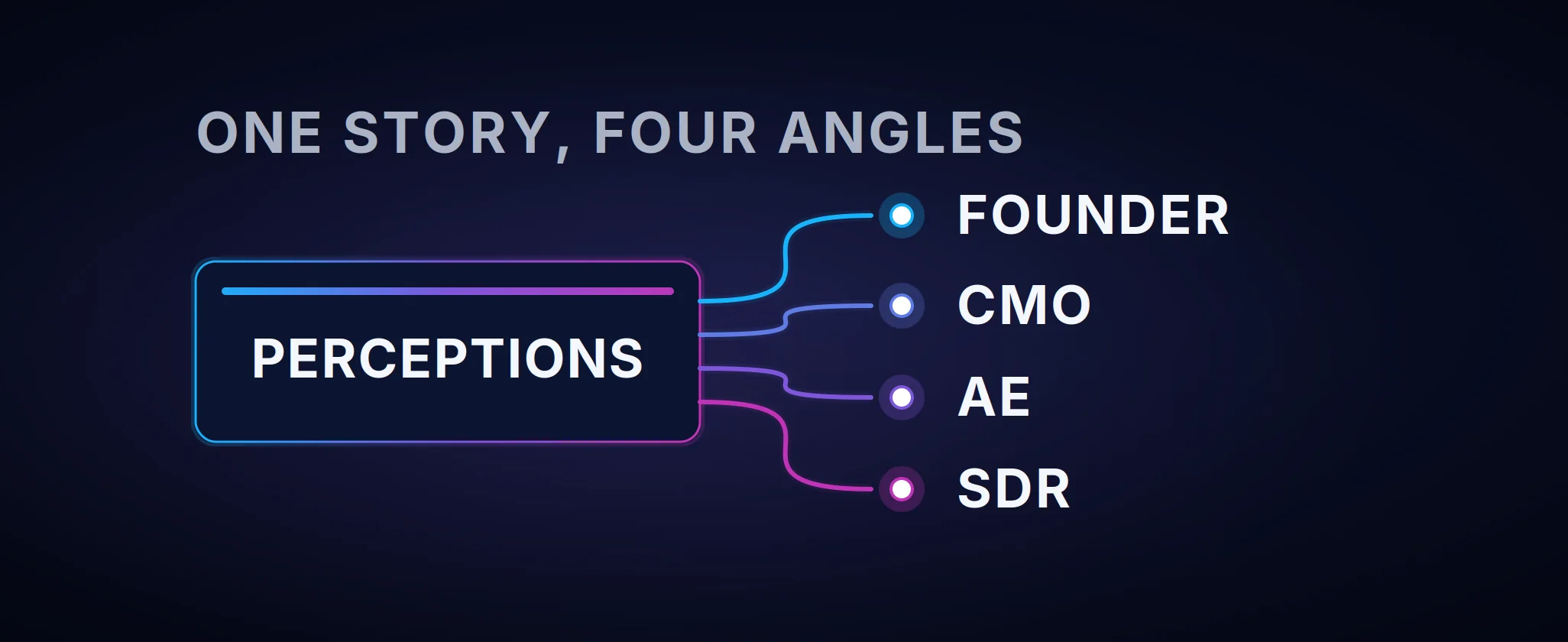
1. Shared perceptions, individual angles.
Sit marketing and sales in one room and agree the perceptions: the beliefs the market should hold about the category and about you. Those are shared on a company level, one set for everyone. The exercise comes from Emily Kramer's perceptions framework at MKT1.
The angles are the part that stays personal. Each seller carries the same story through their own examples, their own emphasis, their own way in. That is the uniqueness factor, and it is why twelve people publishing weekly sound like twelve people instead of one bot posting twelve times.
The entire cost is one meeting and one decision.
2. Put your reps on their own profiles, on LinkedIn and on X if your buyers live there.
Buyers read people and skim company pages. The same idea under a company logo arrives as an ad and gets treated like one, while under a person's name it arrives as a view worth weighing. The feeds are built around that instinct too. Distribution goes to profiles, and trust follows the person.
This is also where the touchpoint maths from earlier starts working for you instead of against you. One company page cannot supply four hundred touches into an account. A founder, a CMO and a handful of sellers, each carrying their own angle on the shared narrative, can surround a buying committee from five directions at once, and to the buyer it reads as five people thinking rather than one brand broadcasting.
And remember what happens after every touch a rep sends: the prospect looks up the sender. The profile is the first meeting, held before anyone agrees to one. A rep whose profile shows a year of thinking about the buyer's problem walks into that invisible meeting already introduced.
3. Treat distribution as a product release.
Give it a date, a plan, an owner and a review. Content rarely fails in the substance. It fails the day after publishing, when everyone moves on and the asset sits unread until someone gives the market a reason to find it.
4. Fix the clock on warm signals.
Here is where the handoff actually breaks. A warm signal feels like nobody's quota event, so it waits. Marketing counts leads that never got a call. Sales counts leads that were never qualified. Both are reading the same dead clock from opposite sides, the oldest argument in the building. The fix is one owner per signal and a response window measured in hours.
The operating model behind all four came from that same CRO. Everyone owns their function and does their best work, marketing, SDRs, sellers, customer success, and they play as one team. Ownership and alignment ride together. Split them and you get a marketing team writing for awards while sales calls strangers.
One warning before you go spend more on content.
We ran an ABM programme that delivered 42 qualified downloads from senior technical buyers at €34.71 each. The names were real, the seniority right, the ICP exact, and zero meetings came out of it. The content did its job, and nobody worked the signal. A signal nobody works is a list.
That programme sits at the far negative end of a spectrum, and the Enhance XR programme this article is built on sits at the other end. Both generated qualified signal from the right buyers at a comparable cost. One had every signal worked across three channels inside 24 hours, and one had a templated sequence waiting on the client's side. The content performed at both ends, and the follow-up decided everything after it.
So build the system. Recognition comes first, so the market knows who is calling, and a human works the warm end, so the recognition converts. You cannot brute force your way into being known.
Be known first, then dial. And this week, before the next review, pull the one report the dashboard does not volunteer: where did your last ten meetings actually come from, and does your budget agree with the answer?
Cold calling still books meetings. On the programme in this article, cold calls produced 25 of 76 attributed meetings, the second-largest source. What collapsed is the automated cold email sequence, which produced six across the same nine months. The phone still books, and it books more when the market already recognises the company calling. Treat the sequence as support and the phone as the motion.
On our own nine-month data the phone won four to one, booking 25 meetings against six for the automated email sequence. The more useful answer is that neither cold channel carried itself. Content originated 45 of the 76 attributed meetings, and the cold calls that worked were dialling into a market that had spent months seeing the company in ads, articles and lead magnets. Run them together: content builds the recognition, and a human converts it.
Start by splitting booked meetings by source in your CRM, which few teams can do today. That single report tells you more than any attribution model you can buy. Accept that part of the effect stays invisible: the buyer who books a meeting without ever filling in a form is real revenue and unattributable revenue at the same time. Measure what you can, and stop treating the unmeasured part as zero.
The data points the other way. The combination that booked meetings at volume had both a human touch and market recognition behind it. Cutting the humans removes half of what worked. Give the reps something to reference and a market that already knows the name on the caller ID.
On this programme, cold calling ran at roughly 455 dials per booked meeting, a 5.3% connect rate, and 3.5% of connects converting to a meeting. That is about 2.2 meetings per 1,000 dials. Published benchmarks usually quote one meeting per 35 to 50 dials, but those count connects rather than total dial attempts, so read the definition before comparing. Published in-house SDR costs run $700 to $1,150 per meeting fully loaded, agencies $150 to $400.